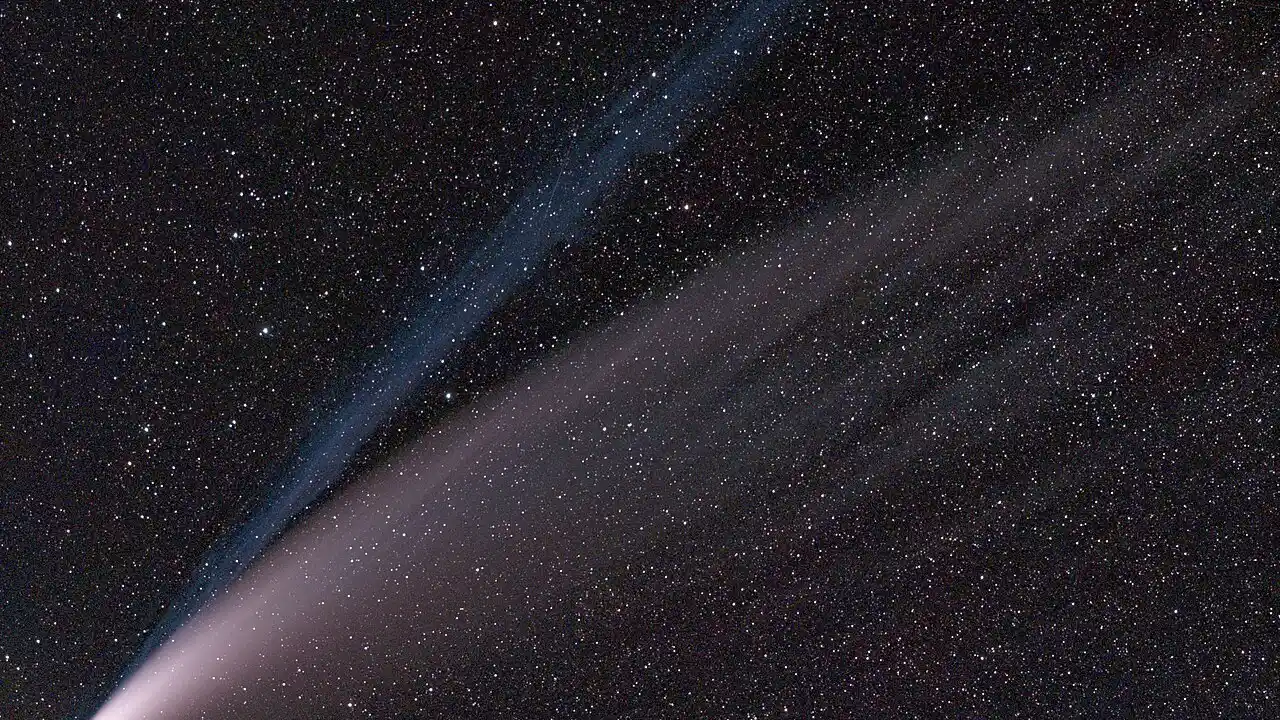
2. Under which famous star pattern did Comet NEOWISE shine in July 2020?
🤯 Mind-Blowing Fact • Grade 2
After saying goodbye in summer 2020, Comet NEOWISE won't return to Earth's skies for nearly 6,800 years!
✨ Word Sparks (Grade 2 Glossary)
Tap 🔊 to hear
infrared
Invisible heat light sensed by special cameras
crumble
Break apart into tiny pieces and dust
hemisphere
Half of Earth north or south of equator
🪝
Why did astronomers cheer when Comet NEOWISE came out intact from behind the blazing Sun?
1
Spotted with Heat Vision
In spring 2020, two earlier comets crumbled into dust before they could brighten our skies. Meanwhile, NASA's space telescope NEOWISE detected a dark 3-mile-wide snowball racing inward and named it C/2020 F3 (NEOWISE).
2
A Scorching Sweep Past Mercury
On July 3, 2020, Comet NEOWISE swooped just 27 million miles from the Sun—closer than rocky planet Mercury! Intense heat baked its surface to hundreds of degrees, yet its sturdy icy core held together.
3
Brightest Northern Comet Since 1997
Superheated ice and soot erupted into a sweeping golden fan and a thin blue gas tail, making NEOWISE the brightest comet in Northern skies for twenty-three years!
1. What special kind of light does the NEOWISE space telescope detect?
2. How close did Comet NEOWISE pass to the Sun in July 2020?
🤯 Mind-Blowing Fact • Grade 3
Photographs took breathtaking shots of Comet NEOWISE framed behind glowing purple aurora lights and silvery high-altitude noctilucent clouds at the exact same time!
✨ Word Sparks (Grade 3 Glossary)
Tap 🔊 to hear
crucible
A severe test involving intense fiery heat
soot
Fine black carbon powder coating a surface
aurora
Colorful sky glow caused by solar particles
🪝
How did a solar probe flying near the Sun catch a close-up view of Comet NEOWISE's twin tails?
1
A Recycled Asteroid Hunter
Originally launched as WISE to map the infrared universe, NASA woke up its retired space telescope in 2013 and renamed it NEOWISE to hunt near-Earth asteroids and comets. On March 27, 2020, its heat-sensitive detectors caught a cold traveler diving inward from the Southern Hemisphere sky.
2
Passing the Solar Crucible
Measuring roughly 3 miles (4.8 kilometers) across and coated in dark , Comet NEOWISE plunged to a perihelion of just 0.29 astronomical units on July 3, 2020. While smaller comets ATLAS and SWAN had shattered months earlier, NEOWISE's solid nucleus endured temperatures over 600 degrees Fahrenheit!
3
Parker Solar Probe's Front-Row Seat
Right as NEOWISE rounded the Sun, NASA's Parker Solar Probe happened to be nearby! Parker's wide-field cameras revealed delicate ripples inside the dust tail and discovered that its blue ion tail actually split into twin streamers.
4
A 6,766-Year Farewell
Planetary gravity stretched NEOWISE's outbound loop from 4,500 years to roughly 6,766 years as it sped back toward the deep outer Solar System.
1. Which sun-studying spacecraft snapped unique close-up images of Comet NEOWISE's tails near perihelion?
2. Why did Comet NEOWISE survive its close pass by the Sun when two other 2020 comets broke apart?
🤯 Mind-Blowing Fact • Grade 4
Hubble Space Telescope images taken in August 2020 proved Comet NEOWISE's icy heart emerged completely unbroken from its solar bake, spinning once every 7.6 hours!
✨ Word Sparks (Grade 4 Glossary)
Tap 🔊 to hear
thermal emission
Heat energy given off by warm objects
bifurcated
Split neatly into two separate branches
radiation pressure
Gentle outward push exerted by beams of light
🪝
Why did Comet NEOWISE leave our inner Solar System on an orbit 2,200 years longer than the one it arrived on?
1
Infrared Detection in the Dark
Visible-light telescopes can easily miss an incoming comet whose crust reflects barely 3 percent of sunlight. Fortunately, NASA's Near-Earth Object Wide-field Infrared Survey Explorer (NEOWISE) measures —the faint warmth radiated by dark dust. Scanning 312 million miles from Earth on March 27, 2020, NEOWISE pinpointed C/2020 F3 climbing steeply upward on a 129-degree retrograde orbit.
2
Thermal Stress Inside 0.3 AU
Sweeping within 27.5 million miles of the Sun on July 3, NEOWISE absorbed over eleven times the solar energy per square foot that Earth receives! Furious sublimation blasted spiral jets from its rotating 4.8-kilometer nucleus—spotted later by the Hubble Space Telescope as two opposing cones of gas and dust that remained intact even after perihelion.
3
Synchrone Stripes and Sodium Streamers
Long-exposure images captured subtle 'synchrone' bands across its golden dust fan, caused by rhythmic puffs of pebbles and dust pushed by solar , alongside a bright orange-glowing neutral sodium tail and a blue carbon-monoxide ion tail.
4
Gravitational Boost Outward
Passing within 64 million miles of Earth on July 23, NEOWISE gained subtle orbital energy from planetary tugs—stretching its aphelion from ~540 AU out to ~715 AU and lengthening its orbital period from 4,500 to 6,766 years!
1. Why are infrared telescopes like NEOWISE so effective at measuring a comet nucleus's true size?
2. What caused Comet NEOWISE's orbital period to jump from about 4,500 years to 6,766 years?
🤯 Mind-Blowing Fact • Grade 5
As Comet NEOWISE roared past perihelion, Japan's Hisaki ultraviolet space telescope measured its 3-mile core spraying more than 30 metric tons of water vapor into space every single second!
✨ Word Sparks (Grade 5 Glossary)
Tap 🔊 to hear
irradiance
Intensity of sunlight hitting each unit area
torque
Twisting force that speeds or tilts rotation
striae
Delicate parallel stripes inside a comet's dust tail
🪝
How did an armada of solar, infrared, and orbital observatories turn Comet C/2020 F3 (NEOWISE) into a real-time physics lab?
1
Thermal Radiometry from a Repurposed Explorer
Originally launched in 2009 as the Wide-field Infrared Survey Explorer (WISE), NASA reactivated the spacecraft's 3.4- and 4.6-micron infrared channels in 2013 as NEOWISE to characterize hazardous near-Earth objects. On March 27, 2020, automated pipeline software flagged a diffuse source moving across Puppis at 2.1 astronomical units from the Sun. By comparing infrared thermal flux against optical brightness, mission scientists calculated a 4.8-kilometer diameter—large enough to resist the rotational and thermal fracture that had just disintegrated comets C/2019 Y4 (ATLAS) and C/2020 F8 (SWAN).
2
Surviving Eleven Solar Constants at Perihelion
Ascending along a retrograde 128.9-degree inclination, NEOWISE skimmed perihelion at 0.295 AU on July 3, 2020, enduring solar more than eleven times stronger than at Earth's orbit. Post-perihelion Hubble Space Telescope observations at 18,000-kilometer resolution resolved twin symmetric dust cones curving into spiral shells every 7.6 hours—proving the nucleus spun cohesively without shedding secondary fragments.
3
Multi-Spacecraft Stereoscopy Near the Sun
Because NEOWISE's perihelion coincided with NASA's Parker Solar Probe Encounter 5, Parker's WISPR imagers alongside SOHO, STEREO-A, and JAXA's Hisaki ultraviolet satellite captured an unprecedented multi-angle dataset. WISPR resolved fine-scale dust —stripes formed as larger friable dust aggregates fragmented in sunlight—plus a bifurcated blue carbon-monoxide plasma tail buffeted by turbulent coronal wind and a narrow orange atomic sodium tail.
4
Barycentric Perturbations to a 6,766-Year Ellipse
Astrometric tracking across its 0.69-AU closest approach to Earth on July 23 revealed how planetary gravitational perturbations and minor non-gravitational outgassing recoil boosted its orbital semi-major axis from roughly 272 AU to 358 AU, pushing aphelion to ~715 AU.
5
Legacy of a Twenty-First-Century Great Comet
Peaking near first magnitude beneath Ursa Major while NEOWISE itself retired cleanly in 2024 ahead of NASA's next-generation NEO Surveyor, C/2020 F3 left behind one of astronomy's richest multi-wavelength comet portraits.