🧬 HUMAN BODY
🧬 Dyschromatopsia (Color Vision Deficiency) • Visual & Genetic Systems
VA Science & Health SOL 1.1, 3.1, 4.2, 5.1 (Cells, Organs & Body Systems)
Color Blindness
How Tiny Cone Cells Shape the Rainbow You See
Grade 3 • Fluent • 149 words
🩺 Body System & LocationSensory Visual System & Genetics • Retinal Macula Cones and X Chromosome
🔬 Size / Cell Count~6 million retinal cone cells • ~1 in 12 boys & ~1 in 200 girls
⚙️ Core JobAlters how red-, green-, or blue-sensing cone cells blend wavelengths of light
⚡ Body SuperpowerSpots hidden camouflage patterns that trick standard color vision
🤯 Mind-Blowing Fact • Grade 1
Dogs naturally see the world mostly in shades of blue and yellow—very similar to humans with red-green color blindness!
✨ Word Sparks (Grade 1 Glossary)
Tap 🔊 to hear
cones
Tiny eye cells that detect bright colors
shade
Particular tone or version of a color
rainbow
Colorful arc of light in the sky
🪝
Does everyone see the exact same red apple and green leaf that you see?
1
Seeing Shades Differently
Peek at a bright in the sky! Most people think 'color blind' means seeing only black and white. Surprise—almost everyone with it still sees lots of colors!
2
Tiny Cone Helpers
Deep inside the back of your eyes sit tiny color helpers called . Three kinds of cones catch red, green, and blue light.
3
Mixing Up Reds and Greens
Sometimes one cone helper works differently. Then bright red berries and green leaves can look almost the same brownish-yellow !
1. Do most people with color blindness see the world only in black and white?
2. What are the tiny color-catching helper cells inside the back of your eye called?
🤯 Mind-Blowing Fact • Grade 2
People with red-green color blindness are awesome at spotting camouflaged animals or insects hiding in dappled leaves where color tricks other eyes!
✨ Word Sparks (Grade 2 Glossary)
Tap 🔊 to hear
retina
Light-sensing layer lining back of eyeball
rods
Eye cells helping you see dim shapes
camouflage
Colors and patterns helping creatures blend in
🪝
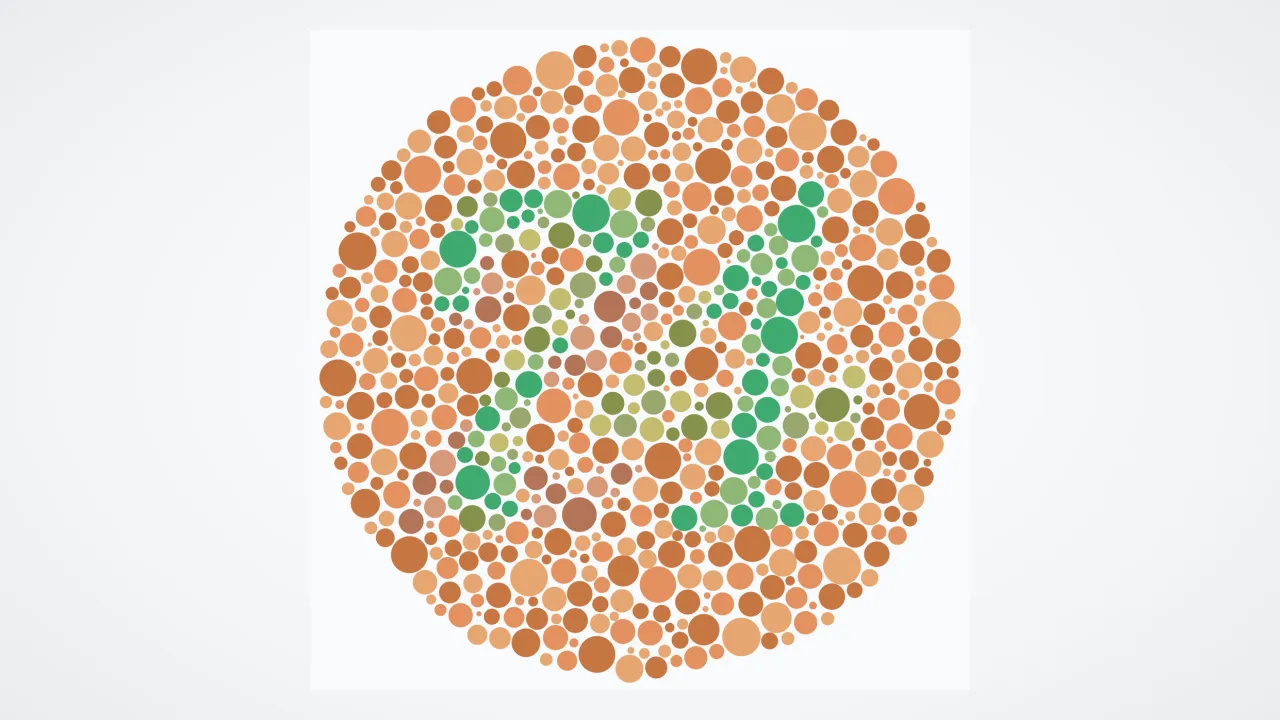
How do eye doctors use circles made of colorful dots to check how your cones work?
1
Rods and Cones in Your Retina
Shine a flashlight at a box of crayons—instant color! At the back of your eyeball sits a light-catching screen called the . Rod cells help you see shapes in dim light, while six million cone cells read bright daytime colors.
2
Three Color Channels
Normally, red, green, and blue cones team up like mixing paints to show millions of hues. In red-green color vision deficiency—the most common kind—either the red or green cones overlap, making purple look blue and ripe tomatoes match green vines.
3
Dot Pictures and Smart Design
Eye doctors show fun dot circles called Ishihara plates with hidden numbers inside! Traffic lights also put red on top and green on the bottom so drivers always know whether to stop or go.
1. How can a driver with red-green color blindness always read a standard vertical traffic light?
2. What cool visual advantage do people with red-green color deficiency often have?
🤯 Mind-Blowing Fact • Grade 3
Famous chemist John Dalton wrote the very first scientific paper on color blindness in 1794 after realizing his 'dark blue' coat actually looked bright scarlet red to everyone else!
✨ Word Sparks (Grade 3 Glossary)
Tap 🔊 to hear
photoreceptor
Specialized retina cell converting light into signals
wavelength
Distance between peaks of a light wave
chromosome
Coiled DNA package carrying inherited family traits
🪝
Why is red-green color blindness about sixteen times more common in boys than in girls?
1
Photopigments That Catch Light Waves
Imagine sunlight as waves of different lengths—long waves look red, medium waves look green, and short waves look blue! Inside your retina's center, three types of cone hold special light-catching proteins called opsins tuned to those three wave zones.
2
The X-Chromosome Secret
Why do roughly 1 in 12 boys have red-green color deficiency compared to only 1 in 200 girls? The genes that build red and green opsin proteins ride on the X ! Girls inherit two X chromosomes (XX), while boys inherit one X and one Y (XY).
3
Backup Copy Advantage
If a girl inherits one altered cone gene on one X , her second X chromosome usually supplies a working backup copy! Because boys have only one X chromosome, a single altered copy gives them color-deficient vision.
4
Designing for Everyone
Today, game designers, mapmakers, and teachers add clear shapes, patterns, and labels alongside colors so board games, weather maps, and science charts work great for every student's eyes!
1. Why do girls develop red-green color blindness much less often than boys?
2. How do thoughtful game and app designers make charts friendly for color-blind users?
🤯 Mind-Blowing Fact • Grade 4
Mantis shrimp hold the animal-kingdom record with 12 to 16 different types of photoreceptor channels—including ultraviolet—while birds use 4 cone types to see glowing UV feather patterns invisible to us!
✨ Word Sparks (Grade 4 Glossary)
Tap 🔊 to hear
trichromacy
Standard vision combining three distinct cone channels
fovea
Tiny central retina pit packed with cones
tetrachromacy
Rare vision using four distinct cone types
🪝
What is the scientific difference between shifted cones, missing cones, and rare four-cone 'super-color' vision?
1
Trichromacy Inside the Fovea
Focus your gaze on a vibrant hummingbird feather: light focuses onto a tiny pit in your retina called the , packed tightly with S-cones (short-wave blue), M-cones (medium-wave green), and L-cones (long-wave red). Normal human vision is called because your visual cortex compares electrical ratios from all three cone types to distinguish roughly one million subtle shades.
2
Deuteranomaly, Protanomaly, and Dichromacy
Doctors prefer 'color vision deficiency' because total monochromacy (seeing only grayscale) affects just 1 in 30,000 people! Far more common is anomalous : in deuteranomaly, green M-cones shift their sensitivity closer to red, while in protanomaly, red L-cones shift toward green. When one cone class is completely absent—dichromacy—two channels handle all color mixing. Much rarer is tritanopia, a chromosome-7 trait affecting blue-yellow S-cones equally in boys and girls.
3
How EnChroma-Style Notch Filters Work
Special optical-filter glasses cannot cure missing cones, yet for people with overlapping red and green opsins, precision lens coatings block the narrow band of yellow-green wavelengths right where M-cones and L-cones overlap—sharpening contrast between reds and greens outdoors!
4
Tetrachromacy: Four Cones Instead of Three!
Because females carry two X chromosomes, some women who carry one shifted opsin gene actually express four distinct cone types—a rare phenomenon called that can split rainbows into extra micro-shades!
1. How do special optical notch-filter glasses help some people with anomalous trichromacy?
2. Why does rare blue-yellow deficiency (tritanopia) affect boys and girls at the exact same rate?
🤯 Mind-Blowing Fact • Grade 5
In 1995, geneticists extracted DNA from chemist John Dalton's preserved 1844 eye tissue, proving 151 years after his death that he lacked green-sensing M-cone opsin genes!
✨ Word Sparks (Grade 5 Glossary)
Tap 🔊 to hear
dyschromatopsia
Clinical medical term for color vision deficiency
opsin
Light-sensitive protein tuned to specific light wavelengths
achromatopsia
Rare condition seeing only shades of gray
🪝
How did 1995 DNA tests on chemist John Dalton's preserved 150-year-old eye tissue solve a two-century mystery—and how did viral gene therapy give squirrel monkeys trichromatic sight?
1
Spectral Biophysics of OPN1LW, OPN1MW, and OPN1SW
Every color you perceive is a neuro-computational masterpiece constructed from electromagnetic waves spanning 380 to 700 nanometers. Inside human retinal cone outer segments, vitamin-A-derived 11-cis-retinal chromophores nestle inside G-protein-coupled proteins: short-wavelength S-opsins (OPN1SW on chromosome 7, peaking near 420 nm), medium-wavelength M-opsins (OPN1MW, ~530 nm), and long-wavelength L-opsins (OPN1LW, ~560 nm). Because ancestors of Old World primates duplicated an opsin gene on the Xq28 chromosomal region roughly 30 million years ago, OPN1LW and OPN1MW sit head-to-tail with 96 percent sequence identity—making unequal crossover recombination during meiosis remarkably common.
2
Solving John Dalton's 200-Year-Old Mystery
In 1794, Quaker chemist John Dalton published the first clinical account of —giving many languages the word 'daltonism.' Dalton hypothesized that a blue-tinted vitreous humor inside his eyeball absorbed red light, and he donated his eyes to science upon his death in 1844 to test his theory! His eye fluid proved crystal clear, yet preserved tissue survived in Manchester until 1995, when Molly Dulai, John Mollon, and David Hunt extracted Dalton's ancient DNA—proving definitively that Dalton was a deuteranope completely lacking functional M-cone middle-wave photopigment!
3
Ishihara Pseudoisochromatic Plates and Achromatopsia
Designed by Japanese ophthalmologist Shinobu Ishihara in 1917, pseudoisochromatic dot plates randomize luminance (brightness) across dots so only chromatic (wavelength) differences reveal hidden numerals. Complete rod monochromacy (), caused by autosomal recessive CNGA3 or CNGB3 ion-channel mutations, leaves patients relying solely on scotopic rod cells—producing grayscale sight, photophobia in bright sun, and reduced foveal acuity.
4
Gene Therapy Breakthroughs in Visual Plasticity
For decades, neurobiologists assumed adult visual cortices lacked the wiring to interpret a brand-new cone type if added late in life. In a landmark 2009 Nature experiment, Jay and Maureen Neitz used harmless adeno-associated viral vectors to deliver human OPN1LW genes into the retinas of adult male squirrel monkeys born naturally red-green color-blind—and within weeks, the monkeys effortlessly passed computerized Ishihara color tests!
5
Evolutionary Frequency-Dependent Advantages
Field studies of wild capuchin monkeys and human observers show dichromats outscore trichromats at breaking countershaded predator and insect camouflage in dappled forest light, suggesting balanced natural selection helped maintain diverse color perception across primate troops.