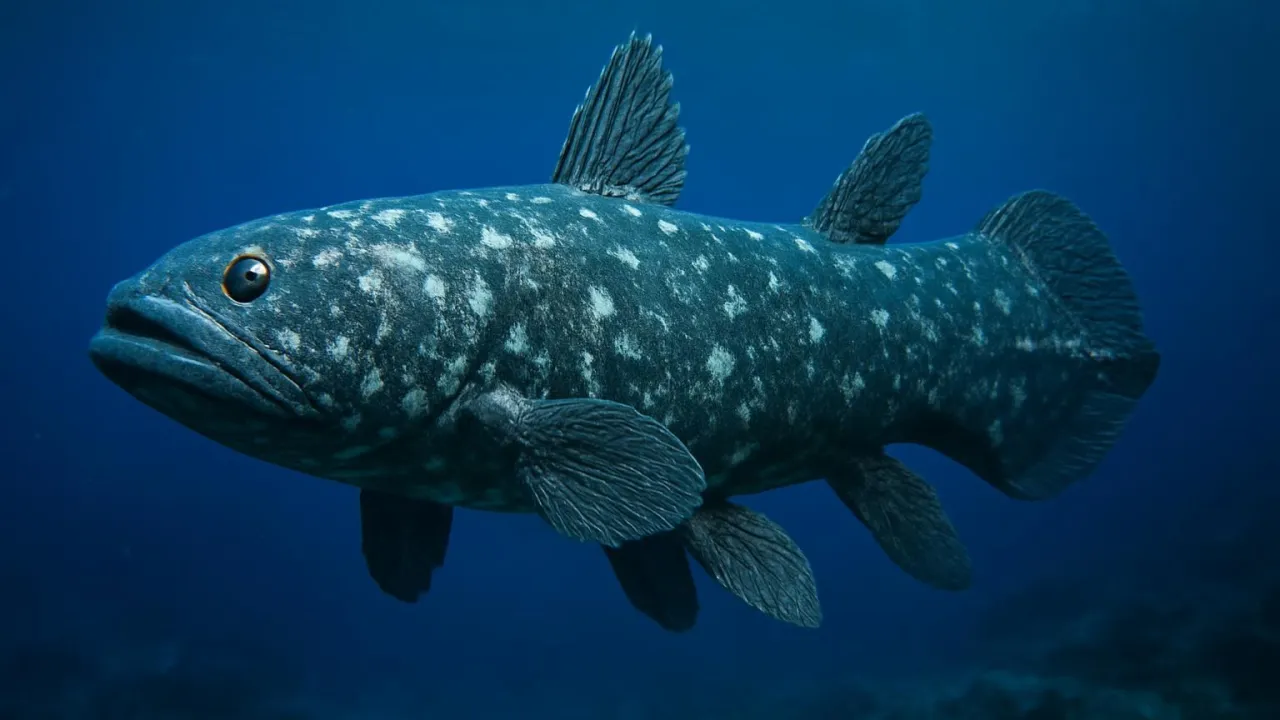
Coelacanths were thought extinct for 65 million years until one was found alive in 1938!
✨ Word Sparks (Grade 2 Glossary)
Tap 🔊 to hear
lobed fins
Fins shaped like little legs
predator
Animal that hunts other animals
nutrients
Food parts that help animals grow
🪝
Have you heard of a fish that uses its fins like legs to walk?
1
Deep Ocean Walker
The coelacanth lives deep in the ocean where sunlight is very dim. It uses its to move slowly like legs on the ocean floor. This helps it explore rocky caves and find food easily. It is a rare fish that scientists once thought was extinct.
2
Big and Blue
Coelacanths can grow up to six feet long and weigh about 100 pounds. Their bodies are dark blue with white spots, helping them blend into the deep ocean. They have thick scales that protect them from . Their unique shape makes them look very different from most fish.
3
What It Eats
Coelacanths hunt at night and eat smaller fish and squid. They use their strong jaws to catch prey hiding in caves. Their slow movements help them sneak up without scaring food away. This diet gives them the needed to survive deep underwater.
Coelacanths have a special rostral organ in their snouts to detect electrical signals from prey!
✨ Word Sparks (Grade 3 Glossary)
Tap 🔊 to hear
adaptation
A body change that helps survival
metabolism
How an animal uses energy
ecosystem
All living things in one place
🪝
Did you know the coelacanth is called a 'living fossil' because it looks like ancient fish?
1
Living Fossil from the Deep
The coelacanth has changed very little for millions of years, earning it the name 'living fossil.' It lives in deep ocean caves near Africa and Indonesia. Its lobed fins help it move slowly across rocky ocean floors. This allows it to explore places other fish cannot reach.
2
Unique Body Features
Coelacanths have thick, bony scales that protect their bodies from predators. Their lobed fins are supported by bones similar to limbs of land animals. This helps them 'walk' underwater instead of just swimming. Their large eyes help them see in the dark ocean depths.
3
Important Role in Ecosystem
As a predator, the coelacanth helps keep smaller fish populations balanced. It hunts squid and fish hiding in caves using slow, careful movements. Its presence shows how deep ocean stay connected over millions of years. Scientists study coelacanths to learn about evolution and survival.
4
How It Survives Deep Down
The coelacanth can survive in cold, dark water with low oxygen. Its slow helps it use energy efficiently. It hides in caves during the day and hunts at night. These survival traits help it live in a harsh environment where few others can.
1. What helps coelacanths move across ocean floors?
2. Why do coelacanths hunt slowly?
🤯 Mind-Blowing Fact • Grade 4
Coelacanths can live more than 60 years, making them long-lived deep-sea survivors!
✨ Word Sparks (Grade 4 Glossary)
Tap 🔊 to hear
symbiotic
Two animals helping each other live
conservation
Protecting animals and their homes
geographic
Related to places on Earth
🪝
How has the coelacanth survived unchanged for millions of years in deep ocean caves?
1
Ancient Fish in Modern Oceans
The coelacanth is often called a 'living fossil' because it has remained almost unchanged for about 400 million years. It lives in deep ocean caves near Africa and Indonesia where few predators can reach it. Its lobed fins allow it to move slowly and carefully across rocky ocean floors, helping it hunt and hide effectively. This slow movement conserves energy in the cold, dark water.
2
Role in the Ocean Food Web
As a predator, the coelacanth plays an important role in balancing ocean ecosystems by controlling smaller fish and squid populations. It hunts mainly at night, using its keen senses to locate prey in dark caves. This relationship helps maintain healthy populations of other marine animals. Humans impact coelacanths mainly through fishing and habitat disturbance, so efforts are vital.
3
Adaptations for Deep-Sea Life
Coelacanths have thick, bony scales that protect them from predators and rough underwater terrain. Their lobed fins, supported by bones, enable a walking motion that helps them explore complex cave structures. They have a slow metabolism that allows them to survive with less oxygen in deep water. Their large eyes are adapted to see in dim light, which helps them avoid danger and find food.
4
Where Coelacanths Live
Coelacanths are found in the deep waters off the coasts of East Africa and Indonesia, typically between 500 and 800 meters deep. These regions offer rocky caves and ledges that provide shelter and hunting grounds. The stable cold temperatures and low light levels create an environment where coelacanths thrive. isolation has helped preserve their unique traits over millions of years.
Coelacanths have lobed fins with bones similar to early land animals’ limbs!
✨ Word Sparks (Grade 5 Glossary)
Tap 🔊 to hear
Sarcopterygii
Group of lobe-finned fish like coelacanths
rostral organ
Sense organ detecting electric signals
apex predator
Top hunter in its food chain
🪝
What makes the coelacanth a rare ancient fish that connects us to Earth’s distant past?
1
Taxonomy and Scientific Importance
The coelacanth, Latimeria chalumnae, belongs to the lobe-finned fish group , which is closely related to the ancestors of land vertebrates. It was believed extinct since the Late Cretaceous period until rediscovered in 1938 near South Africa. This fish provides scientists with a living model to study evolutionary transitions from water to land animals. Its unique skeletal structure bridges the gap between fish and tetrapods.
2
Physiological Mechanics and Adaptations
Coelacanths have lobed fins containing bones and muscles that allow a walking motion underwater, unlike most fish with ray fins. They possess a that detects electrical signals from prey, aiding hunting in the dark. Their slow metabolism supports survival in cold, low-oxygen deep waters. Thick cosmoid scales and a hinged skull provide protection and flexibility while navigating rocky caves.
3
Conservation and Botanical History
Coelacanth populations are vulnerable due to their limited habitat and slow reproduction rates. Conservation efforts focus on protecting deep-sea habitats near Africa and Indonesia from fishing and pollution. Their discovery challenged scientific ideas about extinction and biodiversity. Studying coelacanths helps understand ancient marine ecosystems and guides protection of other rare species.
4
Quantitative Comparisons and Environmental Conditions
Coelacanths can grow up to 6 feet (1.8 meters) and weigh around 100 pounds (45 kilograms). They inhabit depths between 500 and 800 meters where temperatures range from 10 to 20 degrees Celsius. Their swimming speed is slow, averaging about 1.5 miles per hour (2.4 kilometers per hour), conserving energy in nutrient-poor environments. These factors combine to make them highly specialized deep-sea survivors.
5
Ecological Role and Scientific Legacy
As in their niche, coelacanths regulate prey populations such as squid and smaller fish, maintaining balanced ecosystems. Their evolutionary significance provides insight into vertebrate history and adaptation. The coelacanth’s survival for over 400 million years exemplifies resilience in changing oceans. Continued research supports marine conservation and inspires curiosity about life’s ancient origins.