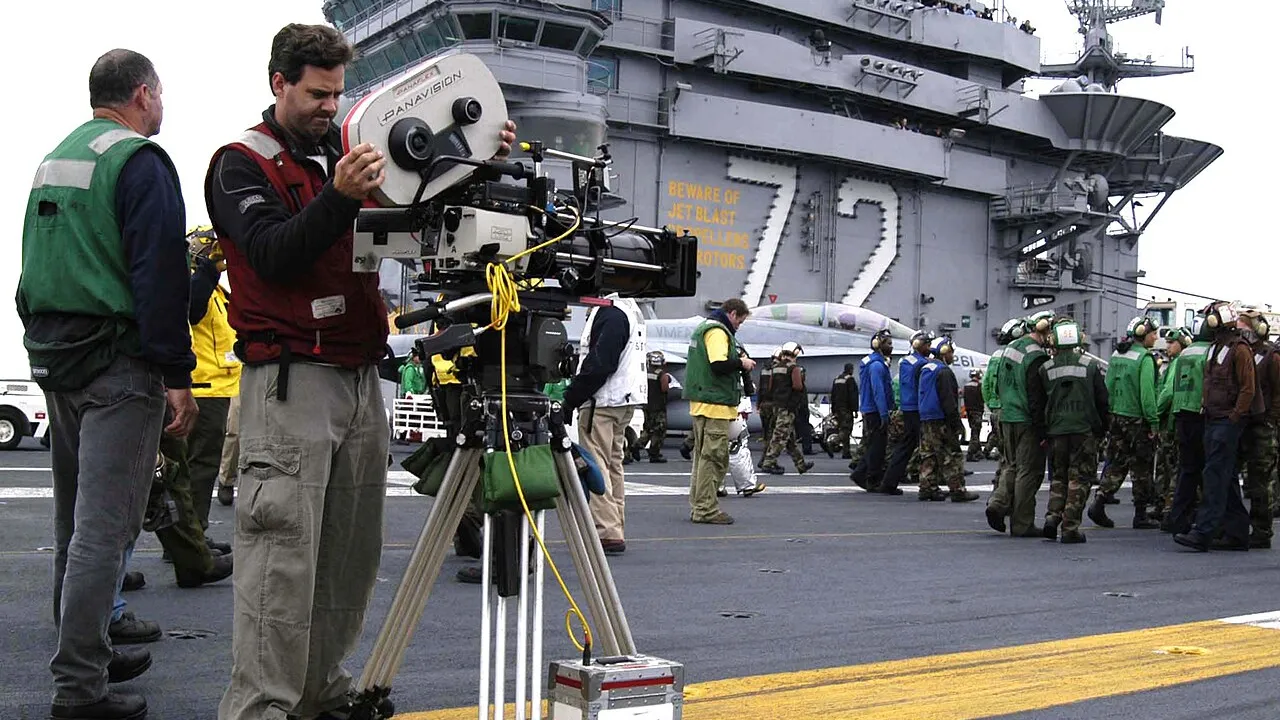
1. Which two movie teams does a cinematographer lead on set?
2. What short nickname do movie crews use for the Director of Photography?
🤯 Mind-Blowing Fact • Grade 2
Underwater cinematographers wear scuba gear and waterproof camera housings to film whales, octopuses, and coral reefs for nature documentaries!
✨ Word Sparks (Grade 2 Glossary)
Tap 🔊 to hear
dolly
Wheeled cart rolling a camera along tracks
gaffer
Chief electrician running lights on movie sets
glare
Harsh, overly bright light hurting clear view
🪝
How does a heavy movie camera glide smoothly beside a galloping horse without bouncing?
1
Smooth Tracks and Cranes
Ever notice how a movie camera floats up to a second-story window like a bird? Cinematographers mount heavy cinema cameras on wheeled carts called dollies, tall cranes, or special vests that soak up every bump!
2
Working With Gaffers and Grips
Shaping movie light takes great helpers. The chief lighting technician, called the , sets up bright lamps, while grips place silk screens and bounce boards to soften harsh .
3
Chasing Golden Hour
Outdoors, cinematographers love filming right after sunrise or just before sunset—a magical time called 'golden hour' when sunlight looks warm and gentle.
1. What do movie crews call a wheeled cart that rolls a camera smoothly along tracks?
2. When is 'golden hour' for outdoor cinematographers?
🤯 Mind-Blowing Fact • Grade 3
Invented in the 1970s by cinematographer Garrett Brown, the 'Steadicam' uses springs and counterweights strapped to an operator's vest so handheld cameras float smoothly up stairs!
How can a cinematographer make noon inside a studio look like moonlight at midnight?
1
Building Weather and Time Indoors
Walk onto a windowless Hollywood or Atlanta soundstage at noon, and it might look like a snowy midnight cabin! Using blue gel filters, soft silk , and flickering fireplace lamps, a cinematographer builds any time of day from scratch.
2
Three-Point Lighting
To make faces look three-dimensional rather than flat, cinematographers often start with three lights: a main 'key light,' a softer 'fill light' to brighten dark shadows, and a '' behind the actor to separate them from the wall.
3
Blurring Backgrounds on Purpose
Have you noticed how an actor's eyes look tack-sharp while trees behind them melt into soft circles of light? Choosing a wide lens opening creates shallow depth of field, focusing your attention right where the story matters.
4
Polishing Colors at the End
Long after filming finishes on set, the cinematographer sits beside a digital in a darkened theater suite to make sure golden sunset oranges, forest greens, or snowy blues match smoothly from shot to shot.
1. Which three lights make up classic 'three-point lighting' in cinematography?
2. What invention lets a walking camera operator film up stairs smoothly without shaking?
🤯 Mind-Blowing Fact • Grade 4
Nature cinematographers filming BBC and National Geographic series sometimes wait quietly inside camouflaged snow blinds for four weeks straight just to capture five minutes of rare snow leopard footage!
✨ Word Sparks (Grade 4 Glossary)
Tap 🔊 to hear
optics
Science of how light bends through glass
Kelvin
Scientific scale measuring warm or cool light
focus-puller
Assistant keeping moving actors sharp on camera
🪝
How do cinematographers combine physics, optics, and fine art painting on every set?
1
Inspired by Master Painters
Many world-renowned cinematographers begin preparing for a new film by walking through fine art museums! Studying how seventeenth-century painters like Rembrandt or Johannes Vermeer angled soft window light across human faces helps a Director of Photography design emotional shadow and contrast before unpacking a single studio lamp.
2
Color Temperature in Kelvins
To everyday human eyes, most household bulbs look plain white, yet cinema camera sensors detect dramatic differences in color temperature—measured scientifically on the scale. Fireplace candlelight glows warm amber around 1,900 Kelvins, whereas midday outdoor skylight shines cool blue near 5,600 Kelvins. Cinematographers tune modern LED panels accurately so skin tones and natural landscapes look true.
3
Aspect Ratios: Tall vs. Widescreen
Cinematographers also partner with the director to choose the exact rectangle shape of the movie frame, called its aspect ratio. Ultra-wide cinema frames (2.39 to 1) stretch horizontally to showcase sweeping Virginia Blue Ridge horizons, while taller IMAX frames capture towering redwoods, waterfalls, and vertical rocket launches.
4
Safety and Teamwork With Camera Assistants
Right beside the camera stands the First Assistant Camera, known as the 'focus puller,' who measures exact distances in feet and inches using laser rangefinders so sprinting or turning actors remain tack-sharp every single frame.
1. What scientific unit do cinematographers use to measure warm versus cool light temperature?
2. What is the job of the First Assistant Camera ('focus puller') during a moving shot?
🤯 Mind-Blowing Fact • Grade 5
For the 1975 historical film 'Barry Lyndon,' NASA actually lent ultra-fast f/0.7 satellite lenses designed for Apollo moon mapping so the cinematographer could film indoor scenes lit purely by real beeswax candles!
How did cinematography evolve from hand-cranked celluloid strips to 16-stop digital sensors and LED volume walls?
1
Translating Story Subtext Into Light
Weeks before principal photography begins, the cinematographer collaborates closely with the director and production designer to assemble a visual 'lookbook.' Every optical and lighting choice—whether capturing grain on photochemical 35-millimeter film stock or shooting uncompressed RAW data on large-format digital cinema sensors, selecting spherical versus oval-bokeh lenses, or motivating shadows from practical desk lamps—translates emotional themes directly into light.
2
Dynamic Range and Optical T-Stops
Whereas everyday still-camera lenses are marked in geometric f-stops, professional cinema prime lenses are individually calibrated in T-stops ( stops), measuring the exact physical brightness passing through internal glass elements so switching from a wide lens to a close-up lens never alters exposure. State-of-the-art cinema sensors record 15 to 16 stops of dynamic range, preserving delicate sunlit cloud edges alongside rich texture in deep shadows.
3
Virtual Production LED Volumes
Modern studio engineering has replaced many flat green screens with curved, twenty-foot-tall LED 'volume' walls driven by real-time 3D graphics engines. Infrared tracking sensors follow the cinematographer's physical camera movements millisecond by millisecond, shifting distant mountain or starfield parallax naturally while casting authentic interactive light reflections across actors' faces and space visors!
4
Color Science and Look-Up Tables (LUTs)
Working alongside a Digital Imaging Technician (DIT) on set and a finishing colorist during post-production, the cinematographer authors custom mathematical Look-Up Tables (LUTs) so cinema laser projectors and home High Dynamic Range (HDR) televisions display identical shadow depth and color fidelity.
5
Mastery and Guild Recognition
Founded in 1919, the American Society of Cinematographers (ASC)—motion pictures' oldest continuously operating creative society—awards its respected 'ASC' post-nominal letters by invitation to directors of photography whose career artistry advances both optical engineering and expressive visual storytelling.