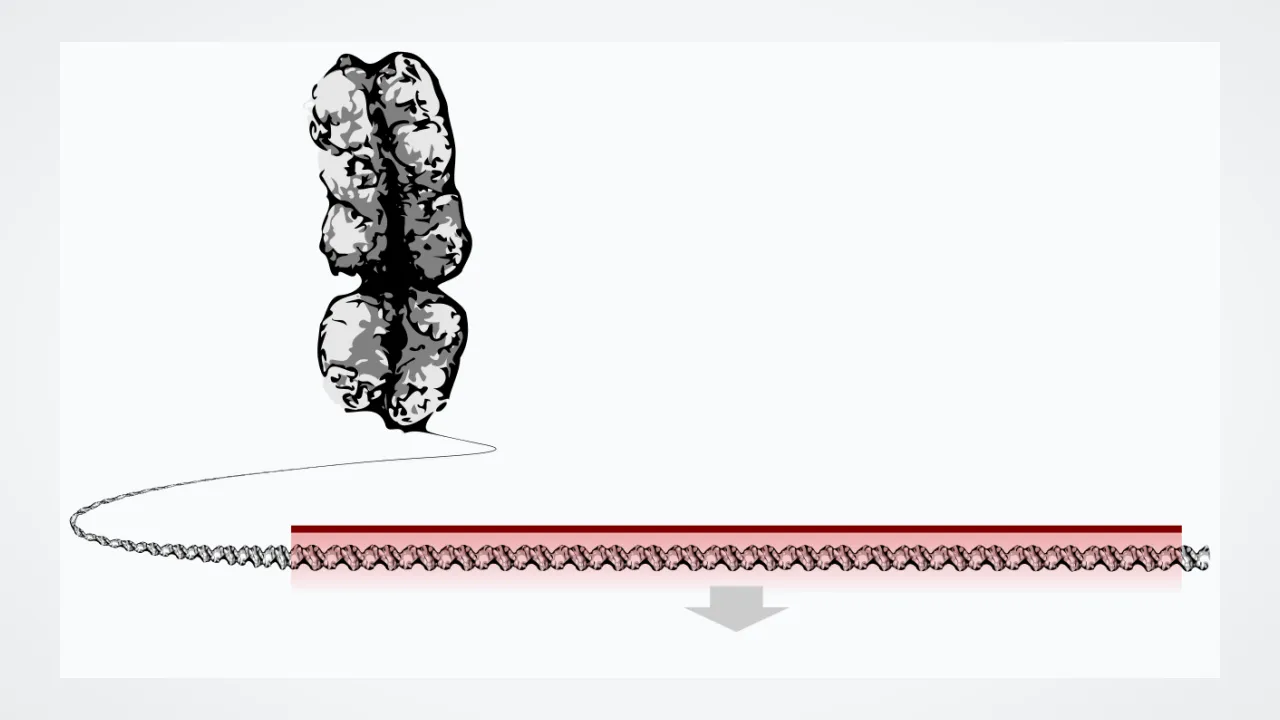
1. How many chromosomes do most human body cells carry inside their nucleus?
2. Why does DNA wind tightly into X-shaped chromosomes right before a cell divides?
🤯 Mind-Blowing Fact • Grade 2
Does more chromosomes mean a bigger creature? Nope—tiny garden ferns pack over one thousand chromosomes per cell, while giant elephants have fifty-six!
✨ Word Sparks (Grade 2 Glossary)
Tap 🔊 to hear
Histone
Spool protein that DNA wraps neatly around
Telomere
Protective cap shielding the tip of chromosomes
Divide
Split one parent cell into two cells
🪝
Why did early scientists name chromosomes 'colored bodies' when DNA itself is crystal clear?
1
Colored Bodies Under Glass
Over a hundred years ago, scientists added bright fabric dyes to cells under microscopes. Suddenly, coiled bundles inside dividing nuclei soaked up the dye like sponges! They named them chromosomes, meaning 'colored bodies.'
2
A Twenty-Three-Volume Encyclopedia
Think of your DNA as a twenty-three-volume encyclopedia of recipes, and you own two full sets—one set from each parent—making forty-six chromosomes in all! Helper proteins called act like tiny round spools keeping every thread tangle-free.
3
Protective Aglet Caps
Just like plastic tips called aglets keep your shoelaces from fraying, special caps called protect both ends of every chromosome!
1. What do telomeres at the tips of every chromosome act just like?
2. Why does the word chromosome literally mean 'colored body'?
🤯 Mind-Blowing Fact • Grade 3
Chromosome 1 is so huge that it packs nearly eight percent of all the DNA in your entire cell into a single volume!
✨ Word Sparks (Grade 3 Glossary)
Tap 🔊 to hear
Sister Chromatid
One of two identical joined chromosome copies
Centromere
Pinched waist linking twin chromatids together
Karyotype
Ordered photo lineup of a cell's chromosomes
🪝
Why do chromosomes only look like famous 'X' shapes right when a cell is getting ready to split?
1
Loose Yarn vs. Moving Boxes
Most of the time, chromosomes look like loose bowls of colorful yarn spread inside your nucleus so enzymes can read recipes easily! Only when a cell prepares for mitosis—cell division—does it copy all forty-six DNA strands and pack them ten thousand times shorter into sturdy rods.
2
Twin Chromatids and the Centromere
Why an X shape? Because each duplicated chromosome temporarily holds two identical twin copies—called —pinched together at a narrow waist called the ! Microscopic protein ropes tug one twin left and one twin right so both daughter cells receive all forty-six chromosomes.
3
Autosomes and X-Y Pairs
Scientists line chromosomes up from largest to smallest in a photo chart called a . Pairs 1 through 22 are matching autosomes present in everyone, while Pair 23—typically XX in females and XY in males—guides biological sex traits.
4
Chromosome 1: Heavyweight Champ
Chromosome 1 is your largest volume, holding over two thousand genes, whereas tiny Chromosome Y holds fewer than one hundred!
1. Why does a chromosome look like the letter X right before a cell divides?
2. What is an organized chart lining up all 23 pairs of chromosomes from largest to smallest called?
🤯 Mind-Blowing Fact • Grade 4
Thanks to chromosome shuffling and crossing over during meiosis, a single pair of parents can theoretically produce over seventy trillion genetically distinct combinations—more than every human who has ever lived!
✨ Word Sparks (Grade 4 Glossary)
Tap 🔊 to hear
Meiosis
Special cell division producing twenty-three-chromosome reproductive cells
Nucleosome
DNA coiled around an eight-histone protein spool
Crossing Over
Swapping matching segments between paired chromosomes
🪝
If every parent has 46 chromosomes, why don't babies end up with 92 chromosomes, and their kids with 184?
1
Diploid Body Cells vs. Haploid Gametes
Skin, muscle, and liver cells are diploid—meaning they hold a double set of twenty-three chromosome pairs, totaling forty-six. If reproductive cells kept all forty-six, chromosome counts would double every generation! Nature solves that math puzzle through a special two-step division called , which halves the count to twenty-three unpaired chromosomes (haploid) in egg and sperm cells so fertilization restores forty-six cleanly.
2
Crossing Over Creates Sibling Variety
Have you ever wondered why brothers and sisters with the exact same parents look similar yet unique? During , matching maternal and paternal chromosomes hug side by side and swap small corresponding segments in a friendly trade called —shuffling ancestral traits into brand-new combinations!
3
Beads on a String: Nucleosomes
To achieve ten-thousand-fold compaction without snapping fragile DNA, negatively charged DNA winds almost twice around octamers of positively charged histone proteins—forming 'beads-on-a-string' units called that loop further onto condensin scaffolds.
4
Telomeres and Telomerase
Repeating six-letter 'TTAGGG' sequences cap both ends of every linear chromosome as protective telomeres, buffering precious protein-coding genes from fraying each time body cells divide—a landmark discovery that won Elizabeth Blackburn, Carol Greider, and Jack Szostak the 2009 Nobel Prize in Physiology or Medicine!
1. Why must meiosis cut the chromosome number from 46 down to 23 in egg and sperm cells?
2. What repeating six-letter DNA sequence forms the protective telomere caps at the ends of human chromosomes?
🤯 Mind-Blowing Fact • Grade 5
Until cytogeneticists Joe Hin Tjio and Albert Levan gently spread dividing cells in 1956, every biology textbook on Earth mistakenly taught that humans had 48 chromosomes instead of 46!
✨ Word Sparks (Grade 5 Glossary)
Tap 🔊 to hear
Kinetochore
Protein winch on centromeres gripping spindle fibers
Telomerase
Enzyme rebuilding protective telomere tips in stem cells
X-Inactivation
Silencing one X chromosome to balance gene dosage
🪝
Why did every biology textbook in the world list the wrong number of human chromosomes for thirty years until 1956?
1
Hierarchical Compaction From 2 nm to Mitotic Rods
Packing two linear meters of two-nanometer DNA into forty-six discrete nuclear territories without topological knots requires multi-tiered protein engineering. Every 147 base pairs of negatively charged DNA wraps 1.65 turns around an octamer of lysine- and arginine-rich histones (H2A, H2B, H3, and H4) to form an eleven-nanometer nucleosome core particle. Linker histone H1 and ATP-driven condensin motor rings extrude chromatin loops until metaphase chromosomes achieve a staggering ten-thousand-fold shortening!
2
Kinetochores, Spindle Checkpoints, and Segregation
During S phase, cohesin protein rings embrace newly replicated sister chromatids along their length. At mitotic metaphase, multi-protein complexes assemble atop repetitive alpha-satellite DNA at each centromere—dividing every chromosome into a shorter 'p' (petit) arm and a longer 'q' arm. Remarkably, the spindle assembly checkpoint delays anaphase until every single one of all forty-six kinetochore pairs feels balanced microtubule tension, preventing aneuploidy!
3
The End-Replication Problem and Telomerase
Because lagging-strand DNA polymerase requires a temporary RNA primer that cannot be replaced at the extreme 3' tip of a linear chromosome, somatic chromosomes shorten by roughly fifty to a hundred base pairs per division. Stem cells counter this 'end-replication problem' using —a reverse-transcriptase ribonucleoprotein carrying its own RNA template to extend protective 5'-TTAGGG-3' telomere repeats, elucidated by Nobel laureates Blackburn, Greider, and Szostak.
4
Epigenetic Balance and X-Inactivation
How do XX females and XY males express equal doses of the roughly nine hundred genes on the large X chromosome? In 1961, British geneticist Mary Lyon discovered : early in female embryonic development, each cell randomly coats one of its two X chromosomes in XIST non-coding RNA, compacting it into a quiet Barr body!
5
Solving the 48-vs-46 Textbook Mystery
Walther Flemming sketched dancing mitotic threads in 1882, Heinrich Waldeyer named chromosomes in 1888, and Walter Sutton and Theodor Boveri linked them to Mendelian heredity in 1902—while Nettie Stevens identified X and Y sex chromosomes in 1905. Yet crowded microscope slides led textbooks from the 1920s onward to claim humans had forty-eight chromosomes (like chimpanzees, before ancestral human Chromosome 2 fused head-to-head), until Joe Hin Tjio and Albert Levan used hypotonic cell-spreading in 1956 to count the true human diploid number: forty-six!