1. About how wide was the Chicxulub Impactor space rock?
2. Which animals survived the climate change after the Chicxulub impact?
🤯 Mind-Blowing Fact • Grade 2
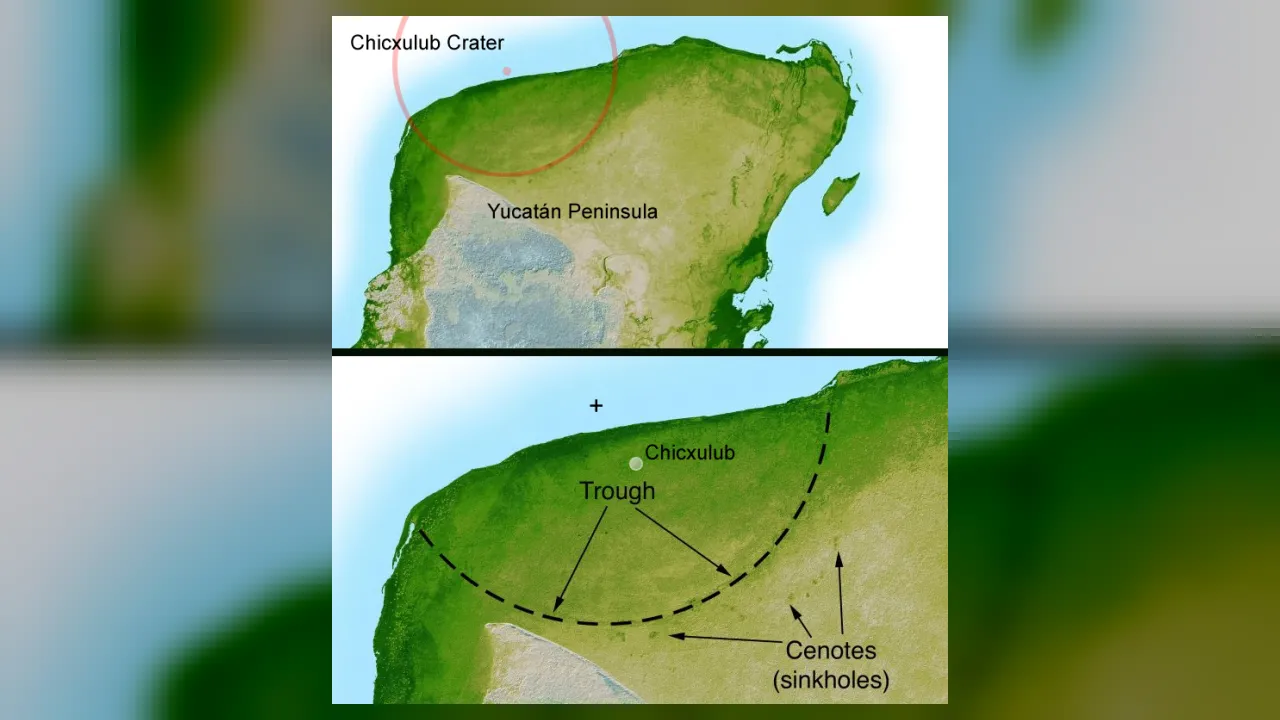
Underground water flowing around the rim of the buried Chicxulub Crater carved a giant curving necklace of crystal-clear sinkhole pools called cenotes!
✨ Word Sparks (Grade 2 Glossary)
Tap 🔊 to hear
iridium
Rare metal common inside asteroids from space
cenote
Natural limestone sinkhole filled with clear water
bullseye
The exact center spot where something hits
🪝
How did a thin finger-wide stripe of clay in Italy solve the biggest mystery in dinosaur science?
1
The Thin Gray Clay Clue
For over a century, nobody knew why giant dinosaurs vanished 66 million years ago. In 1980, geologist Walter Alvarez and his physicist father Luis Alvarez tested a thin gray clay layer in Gubbio, Italy, laid down right when dinosaur fossils stopped!
2
Stardust Metal From Space
Inside that clay hid huge amounts of —a rare metal scarce in Earth's crust yet common in asteroids! That proved a giant space rock had scattered dust around the whole globe.
3
Finding the Yucatán Bullseye
Ten years later, scientists matched that clue to a 112-mile buried ring on Mexico's Yucatán coast, naming it after nearby Chicxulub!
1. What space-rich metal inside a thin worldwide clay layer proved an asteroid hit Earth 66 million years ago?
2. Where on Earth did scientists finally locate the buried 112-mile Chicxulub Crater?
🤯 Mind-Blowing Fact • Grade 3
Tiny round glass beads blasted into space by the Chicxulub crash rained back down thousands of miles away across North America within a single hour!
✨ Word Sparks (Grade 3 Glossary)
Tap 🔊 to hear
tektite
Tiny glass droplet cooled from melted rock
photosynthesis
How green plants make food using sunlight
gypsum
Soft sulfur-rich mineral formed in shallow seas
🪝
Why did landing on Mexico's shallow sea rocks make the Chicxulub Impactor extra hard on Earth's climate?
1
Twelve Miles Every Second
Imagine a carbon-rich asteroid 6 to 9 miles wide plunging out of the northeast sky at 43,000 miles per hour—twelve miles per second! Sixty-six million years ago, it struck shallow sea bedrock at Chicxulub on Mexico's Yucatán Peninsula, gouging a temporary hole nearly twenty miles deep before the crust bounced back into circular mountain rings.
2
Unlucky Sulfur Rocks
Had the asteroid landed in deep open ocean, much less sulfur rock would have vaporized. Instead, Yucatán limestone held thick layers of sulfur-rich ! High-altitude sulfate mist and fine dust reflected sunlight back into space, chilling Earth into an 'impact winter' that paused plant .
3
Shocked Quartz and Glass Beads
Geologists confirmed Chicxulub was the culprit by tracing tiny glass droplets called and crisscrossed 'shocked quartz' grains that grew thicker closer to Mexico!
4
Fern Spikes and New Beginnings
Once skies cleared, hardy ferns carpeted the land first, and tiny warm-blooded mammals diversified into whales, horses, bats—and eventually humans!
1. Why did hitting Yucatán's shallow seabed trigger such a strong global cooling event?
2. Which tough green plants were the very first to carpet the land again as sunlight returned?
🤯 Mind-Blowing Fact • Grade 4
Drilling cores from Chicxulub's buried peak ring showed warm underground hot springs formed inside the fractured rocks right after impact—creating cozy habitats for microscopic life!
✨ Word Sparks (Grade 4 Glossary)
Tap 🔊 to hear
peak ring
Circular inner mountain ring inside giant craters
ruthenium
Rare platinum-group metal tracking asteroid birthplaces
Paleogene
Geologic period when mammals flourished after dinosaurs
🪝
How did scientists prove in 2024 that the Chicxulub Impactor started its journey out past Jupiter?
1
Anatomy of a Peak-Ring Crater
Chicxulub is the best-preserved 'peak-ring' impact structure on Earth—a 112-mile basin encircling an inner ring of mountains formed when deep granite crust flowed upward like a giant water splash and froze into solid peaks within minutes! Because half of the crater rests under Yucatán forests and half lies beneath the Gulf of Mexico, later limestone layers protected its ring from erosion. In 2016, an international ocean drilling ship bored nearly a mile beneath the seafloor right into that , pulling up shattered pink granite uplifted from six miles underground.
2
Steep Sixty-Degree Angle
Three-dimensional computer simulations matched against buried gravity maps revealed the Chicxulub Impactor struck from the northeast at a steep 60-degree angle. Planetary scientists realized that 60-degree trajectory was nearly the worst possible angle for prehistoric life, because it launched maximum volumes of vaporized sulfur and carbon gases symmetrically into the global stratosphere!
3
Ruthenium Isotopes Solve Its Birthplace
For decades, astronomers debated whether the impactor was an icy long-period comet or a rocky inner-belt chip. In 2024, ultra-precise measurements of rare isotopes inside the worldwide Cretaceous- clay layer settled the case: its atomic fingerprint matches dark carbonaceous C-type asteroids formed in the cold outer Solar System beyond Jupiter's orbit!
4
Why Planetary Defense Matters
Unlike dinosaurs, humanity builds sky-scanning telescopes and robotic spacecraft! When NASA's DART probe intentionally nudged asteroid moonlet Dimorphos in 2022, engineers proved we can steer a hazardous asteroid's orbit years in advance so Earth's ecosystems stay safe.
1. What did 2024 ruthenium-isotope measurements reveal about where the Chicxulub Impactor originally formed?
2. Why was the Chicxulub Impactor's 60-degree impact angle into shallow gypsum rock especially dramatic for Earth's climate?
🤯 Mind-Blowing Fact • Grade 5
Fossilized carbonaceous meteorite dust just 2.5 millimeters wide—an actual surviving crumb of the Chicxulub Impactor itself—was recovered intact inside a deep-sea sediment core from the North Pacific Ocean!
✨ Word Sparks (Grade 5 Glossary)
Tap 🔊 to hear
anhydrite
Calcium-sulfate mineral releasing sulfur when vaporized
transient cavity
Deep initial crater bowl before crust rebounds
radiometry
Measuring radioactive decay to date ancient rocks
🪝
How did geophysical oil maps, Gubbio clay iridium, and ruthenium isotopes piece together every minute of the Cretaceous-Paleogene impact?
1
Converging Lines of Evidence: Gubbio to Yucatán
In 1980, Walter Alvarez, Luis Alvarez, Frank Asaro, and Helen Michel published a landmark discovery: millimeter-thin boundary clays separating Cretaceous and Paleogene strata in Italy, Denmark, and New Zealand carried iridium enrichments dozens of times above crustal norms, pointing to a ten-kilometer extraterrestrial projectile. Meanwhile, geophysical gravity and magnetic surveys flown over Mexico's Yucatán platform by Glen Penfield and Antonio Camargo had quietly mapped a buried 180-kilometer concentric anomaly. Joined with Alan Hildebrand's 1991 shocked-quartz and tsunami-deposit fieldwork around the Gulf of Mexico, Chicxulub emerged as the smoking-gun crater dated via argon-argon to 66.04 million years ago.
2
Acoustic Fluidization and Peak-Ring Mechanics
Striking carbonate and evaporite platforms at roughly 20 kilometers per second from a 60-degree northeast trajectory, the 10-to-15-kilometer bolide excavated a nearly 30 kilometers deep and 100 kilometers wide! In 2016, IODP-ICDP Expedition 364 drilled 1,335 meters into Chicxulub's offshore peak ring, recovering fractured basement granite uplifted from ten-kilometer depth that had temporarily behaved like a strengthless fluid via acoustic vibration before locking into a circular mountain ring within ten minutes.
3
Sulfate Aerosols and Photosynthetic Shutdown
Shock vaporization of Yucatán's three-kilometer evaporite sequence injected hundreds of gigatons of sulfur gases alongside soot into the stratosphere. Global climate models demonstrate resulting sulfate aerosols slashed surface sunlight by over 90 percent and plunged continental averages downward by 15 to 25 degrees Celsius for years, collapsing marine plankton and terrestrial food webs dependent on live leaves.
4
Chromium and Ruthenium Fingerprints From Beyond Jupiter
Tiny carbonaceous chondrite fossil fragments recovered from Pacific ocean cores—reinforced in 2024 by nucleosynthetic ruthenium-100 signatures across multiple K-Pg boundary sites—definitively ruled out both an Oort-cloud comet and inner-belt silicate asteroids, proving a C-type carbonaceous body scattered inward via main-belt resonances.
5
Ecological Reset to Planetary Stewardship
Selective survival of small endothermic, seed-eating, and burrowing lineages catalyzed the Cenozoic radiation of crown birds and placental mammals—ultimately producing astronomers equipped with Spaceguard telescopes and kinetic deflectors like DART to ensure Earth never faces such an unannounced visitor again.