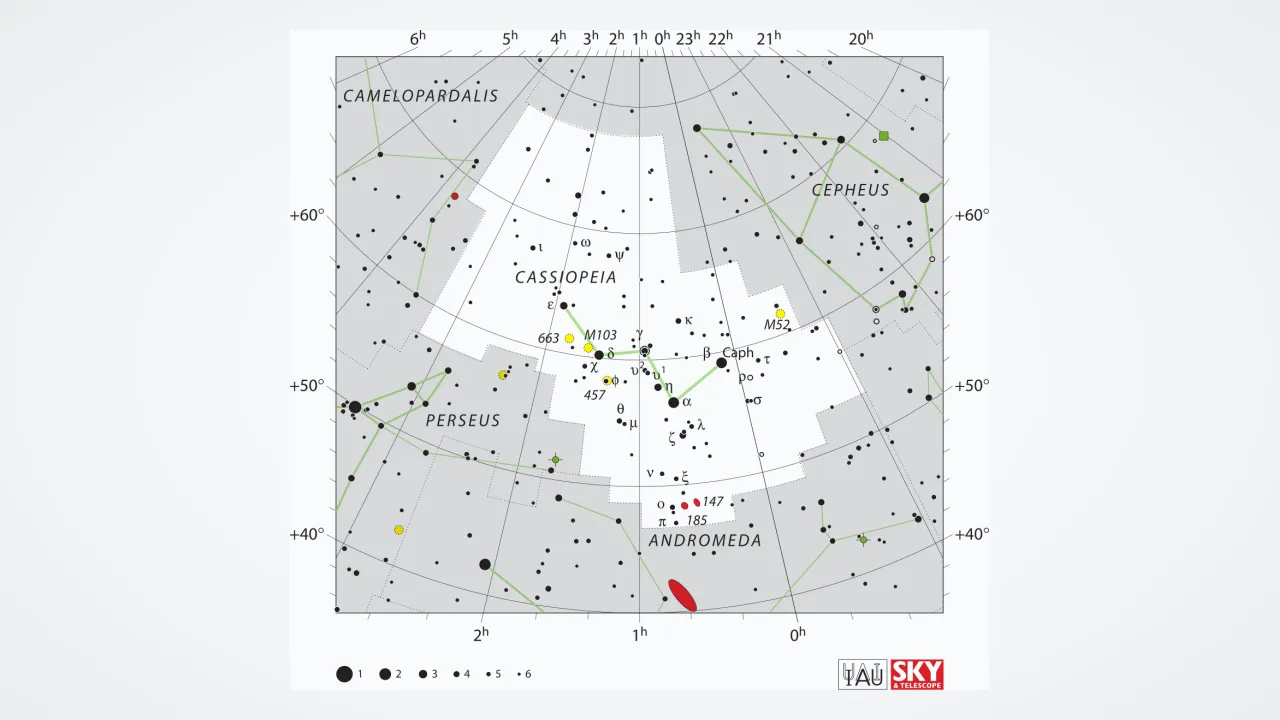
1. How many bright stars connect to form Cassiopeia's famous W or M zigzag?
2. Why does Cassiopeia sometimes look like a W and other times flip upside down like an M?
🤯 Mind-Blowing Fact • Grade 2
In the year 1572, an exploding star suddenly flared inside Cassiopeia so brightly that people spotted it in broad daylight!
✨ Word Sparks (Grade 2 Glossary)
Tap 🔊 to hear
orange giant
cool, swollen aging star glowing orange
horizon
line where Earth seems to meet sky
remnant
glowing cloud left after star explosion
🪝
If trees or hills hide the Big Dipper, what backup star pattern helps you find the North Star?
1
Opposite the Big Dipper
Imagine a giant seesaw balanced right on Polaris, the North Star! On one end rides the Big Dipper, and on the opposite end shines the five-star zigzag of Cassiopeia. Whenever autumn nights push the Big Dipper low near the , Cassiopeia climbs high overhead!
2
Five Sparkling Jewels
Cassiopeia's five main stars—Schedar, Caph, Gamma Cassiopeiae, Ruchbah, and Segin—sit right inside the starry river of our Milky Way. Schedar, the brightest star at the bottom corner, glows warm orange because it is a swollen giant star.
3
Booming Star Ghosts
Hidden inside Cassiopeia are glowing clouds left behind by giant stars that exploded centuries ago as dazzling supernovae!
1. When the Big Dipper sits low near the northern horizon on autumn evenings, where is Cassiopeia?
2. What startling event did stargazers witness in Cassiopeia back in November 1572?
🤯 Mind-Blowing Fact • Grade 3
Apollo astronauts memorized Gamma Cassiopeiae under the nickname 'Navi'—Ivan spelled backward—after astronaut Virgil 'Gus' Grissom's middle name as a space navigation star!
✨ Word Sparks (Grade 3 Glossary)
Tap 🔊 to hear
variable star
star whose brightness changes over time
open cluster
family of hundreds of young sibling stars
spiral arm
curved starry lane pinwheeling around a galaxy
🪝
How did a surprise star inside Cassiopeia in 1572 overturn two thousand years of ancient science?
1
A W Swimming in Star Clouds
Sweep binoculars through Cassiopeia's famous five-star W and the background explodes into thousands of glittering pinpoint stars! Because Cassiopeia lies directly along the plane of our Milky Way galaxy, looking toward the Queen means gazing straight into the star-rich Perseus .
2
Tycho's World-Changing Supernova
For almost two thousand years, scholars taught that the starry heavens never changed. Then on November 11, 1572, young Danish astronomer Tycho Brahe gasped at a blazing new point of light beside Cassiopeia's W—brighter than Venus! Measuring it night after night, Tycho proved this supernova sat far beyond the Moon, launching modern observational astronomy.
3
A Fast-Spinning Middle Star
Gamma Cassiopeiae, the center peak of the W, is a wild ! Spinning over 250 miles per second, it bulges at its middle and flings hot gas rings into space that make its brightness rise and fall.
4
Open Clusters Galore
Stargazers also love spotting the Owl Cluster (NGC 457), whose twin bright eyes and outstretched starry wings resemble a friendly owl or dragonfly!
1. Why did Tycho Brahe's 1572 supernova in Cassiopeia shock scientists across Europe?
2. Why does Gamma Cassiopeiae (the middle star of the W) fling glowing disks of gas into space?
🤯 Mind-Blowing Fact • Grade 4
Astronomers calculated that the single Cassiopeia A supernova explosion blasted roughly 70,000 Earth-masses of pure iron outward into our galaxy!
✨ Word Sparks (Grade 4 Glossary)
Tap 🔊 to hear
neutron star
city-sized ultra-dense crushed core of giant star
Be star
rapidly spinning blue star shedding gas disk
X-ray astronomy
studying superheated space gas using X-ray telescopes
🪝
Where did the calcium in your bones and the iron in your blood come from—and how did a supernova cloud in Cassiopeia show us the answer?
1
Cosmic Recycling in Cassiopeia A
Every atom of calcium strengthening your teeth and iron carrying oxygen in your blood was forged inside a dying star! Nowhere is that cosmic alchemy clearer than Cassiopeia A (Cas A), an expanding 10-light-year shell of glowing debris 11,000 light-years away. Though thick Milky Way dust dimmed its visible blast around the year 1680, Cas A blazes today as one of the brightest radio and X-ray supernova remnants in the entire sky.
2
Mapping Elements with Space Telescopes
When NASA's Chandra X-ray Observatory and James Webb Space Telescope zoomed into Cas A, they color-coded elements blasted outward at over 3,000 miles per second—revealing green filaments of silicon, red clouds of iron, yellow sulfur, and at the dead center, an ultra-dense wrapped in a thin carbon atmosphere!
3
Diverse Stars Forming One W
Like Orion, Cassiopeia's five W-stars sit at wildly different depths: subgiant Caph lies closest at 55 light-years, white star Ruchbah at 99 light-years, orange K-giant Schedar at 228 light-years, eruptive blue Be-star Gamma Cas at 550 light-years, and blue-white giant Segin at 442 light-years.
4
Intergalactic View From Alpha Centauri
Imagine boarding a starship to Alpha Centauri, 4.37 light-years away, and looking back home: our own yellow Sun would shine brightly at magnitude 0.5 right off the eastern end of Cassiopeia's W!
1. Why didn't 17th-century stargazers write huge headlines when Cassiopeia A exploded around 1680, even though Tycho's 1572 supernova was famous?
2. If you traveled to nearby Alpha Centauri and looked back at Earth's sky, where would our Sun appear?
🤯 Mind-Blowing Fact • Grade 5
In 2008, astronomers pointed telescopes at dusty clouds near Cassiopeia and caught actual 1572 light rays from Tycho's Supernova that took a 436-year detour bouncing off interstellar dust!
✨ Word Sparks (Grade 5 Glossary)
Tap 🔊 to hear
light echo
delayed flash reflected off distant space dust
nucleosynthesis
forging chemical elements inside stars and supernovae
hypergiant
ultra-rare star hundreds of thousands times Sun's brightness
🪝
How do two very different supernova remnants inside Cassiopeia reveal the two fundamental ways stars explode across the cosmos?
1
Circumpolar Crown of the Perseus Arm
Positioned above +50 degrees north declination across 598 square degrees, Cassiopeia remains circumpolar throughout mid-northern latitudes, wheeling opposite Ursa Major across the north celestial pole. Named in classical antiquity for the boastful Ethiopian queen of myth—and envisioned by Sámi reindeer herders of northern Scandinavia as Sarvvis's antlers and by Arab navigators as the Tinted Hand—its prominent W asterism frames a rich cross-section of our Milky Way's outer Perseus Spiral Arm, dotted with luminous H II star-forming regions like the Heart and Soul Nebulae (IC 1805 and IC 1848).
2
Two Supernova Archetypes Side by Side
Remarkably, Cassiopeia houses textbook remnants of both major supernova classes! Tycho's Supernova of November 1572 (SN 1572, 8,000–9,800 light-years away) was a thermonuclear Type Ia explosion: a carbon-oxygen white dwarf accreted matter past the 1.44-solar-mass Chandrasekhar limit and detonated completely, leaving zero central remnant behind. Astronomers even confirmed this centuries later by catching ''—original 1572 flashes bouncing off distant dust clouds into modern spectrographs! By contrast, Cassiopeia A (~11,000 light-years distant, light arriving c. 1680) was a Type IIb core-collapse explosion of a stripped massive supergiant, leaving a hot carbon-atmosphere neutron star inside an inside-out shell of silicon, sulfur, argon, calcium, and iron.
3
Prototype Eruptive Star Gamma Cassiopeiae
At the central vertex of the W shines Gamma Cassiopeiae, the very first Be ('B-emission') star ever identified, discovered spectroscopically by Angelo Secchi in 1866. Rotating above 400 kilometers per second—near rotational breakup—this 15-solar-mass star ejects a glowing equatorial decretion disk while emitting enigmatic hard X-rays.
4
Yellow Hypergiant Rho Cassiopeiae
Nearby lurks naked-eye monster Rho Cassiopeiae, one of fewer than a dozen known yellow in our Milky Way—shining 500,000 times brighter than our Sun from over 8,000 light-years away and periodically ejecting 10,000 Earth-masses of gas in single outbursts!
5
Nucleosynthesis Laboratory
From open clusters M52 and M103 to JWST's intricate infrared portraits of Cas A's 'Green Monster' shock wall, Cassiopeia anchors humanity's understanding of galactic .