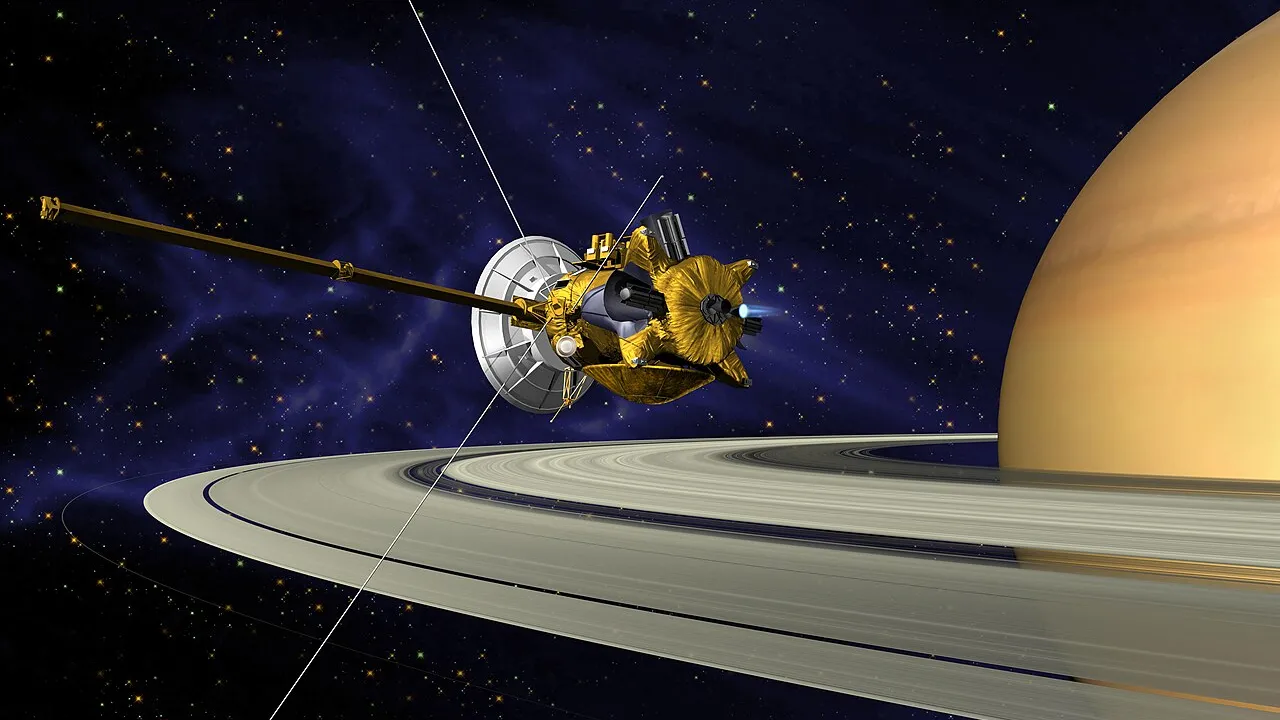
1. What did the round Huygens probe do when Cassini reached Saturn?
2. What amazing secret did Cassini discover spraying out of icy moon Enceladus?
🤯 Mind-Blowing Fact • Grade 2
Saturn's north pole wears a giant six-sided jet stream storm called 'the Hexagon'—wide enough to fit two whole Earths inside!
✨ Word Sparks (Grade 2 Glossary)
Tap 🔊 to hear
methane
gas on Earth, cold liquid on Titan
hexagon
flat geometric shape with six sides
orbiter
spacecraft built to circle a planet
🪝
Where in our Solar System does liquid methane fall like rain into real lakes and rivers?
1
Seven Years to Reach the Rings
Imagine building a spacecraft as tall as a school bus standing on its bumper! Launched in 1997 by NASA and European partners, Cassini-Huygens cruised nearly a billion miles before slipping into orbit around ringed Saturn in 2004.
2
Alien Rain and Rivers on Titan
In January 2005, Europe's saucer-shaped Huygens lander parachuted through thick orange clouds onto Saturn's biggest moon, Titan. At minus 290 degrees Fahrenheit, water freezes rock-hard like pebbles, while chilly liquid fills real rivers and lakes!
3
A Daring Grand Finale
For thirteen years, Cassini photographed Saturn's six-sided polar storm and tasted moon Enceladus's water geysers before diving bravely between Saturn and its rings!
1. What fills the chilly lakes and riverbeds that Cassini and Huygens discovered on moon Titan?
2. How long did the Cassini spacecraft spend orbiting and studying the Saturn system?
🤯 Mind-Blowing Fact • Grade 3
Tiny icy grains sprayed out by moon Enceladus's south-pole geysers actually create and feed Saturn's wide, ghostly outer E-ring!
✨ Word Sparks (Grade 3 Glossary)
Tap 🔊 to hear
organic molecules
carbon compounds linked to life chemistry
hydrothermal vent
warm mineral spring on ocean floor
planetary protection
keeping alien worlds clean of germs
🪝
Why did scientists purposefully steer the beloved Cassini spacecraft into Saturn's clouds at the end of its mission?
1
Teamwork Across Continents
Picture seventeen countries teaming up on one epic robotic flagship! NASA built the towering Cassini Saturn orbiter, the European Space Agency built the heat-shielded Huygens lander, and Italy's space agency crafted Cassini's gleaming dish antenna and radar.
2
Flying Straight Through Ocean Plumes
One of Cassini's greatest shocks came at tiny, bright-white moon Enceladus, only 310 miles wide. Geysers roared from warm cracks nicknamed 'tiger stripes' near its south pole! Cassini zoomed straight through the icy mist and detected salt, organic building blocks, and hydrogen gas from hot seafloor vents!
3
Twenty-Two Dives Inside the Rings
In 2017, with Cassini's rocket fuel running low, engineers designed a thrilling 'Grand Finale'—threading the spacecraft twenty-two times through the narrow 1,200-mile gap between Saturn's cloud tops and innermost rings!
4
Protecting Ocean Moons
To make sure Cassini could never crash onto Enceladus or Titan and spill stowaway Earth germs, controllers steered it into Saturn's sky like a blazing meteor on September 15, 2017.
1. Why did Cassini's discovery inside Enceladus's icy plumes excite scientists searching for life?
2. Why did NASA plunge Cassini into Saturn in 2017 instead of letting it drift forever?
🤯 Mind-Blowing Fact • Grade 4
If ESA engineer Boris Smeds hadn't caught the Doppler radio glitch while Cassini was cruising near Jupiter, humanity would have lost almost every single picture from Huygens's historic Titan landing!
✨ Word Sparks (Grade 4 Glossary)
Tap 🔊 to hear
synthetic-aperture radar
radio waves mapping ground beneath clouds
hydrocarbon
compound built from hydrogen and carbon
tiger stripes
four warm geyser cracks on Enceladus
🪝
How did an engineer on Earth spot a fatal radio flaw in flight and save the Huygens Titan landing with a clever orbital detour?
1
Four Gravity Slingshots to Saturn
Weighing over six tons fully fueled at its October 1997 launch, Cassini-Huygens was too heavy for any rocket to hurl straight to Saturn! Instead, navigators looped it twice past Venus, once past Earth, and once past giant Jupiter—picking up blistering speed across a 2.2-billion-mile curved highway to brake into Saturn orbit on July 1, 2004.
2
Boris Smeds Rescues Huygens in Mid-Flight
Halfway to Saturn in 2000, ESA engineer Boris Smeds ran a grueling radio test and uncovered a shocking design bug: as Cassini sped past Titan during Huygens's planned parachute drop, Doppler frequency shifts would scramble Huygens's data signal completely! Mission planners brilliantly reshaped Cassini's Saturn orbits to fly higher and slower past Titan—recovering 100 percent of Huygens's historic 2005 landing photos and wind recordings!
3
Radar-Mapping Hydrocarbon Seas
Over 127 close Titan flybys, Cassini's cloud-piercing mapped vast northern seas of liquid methane and ethane like Kraken Mare—deeper than Lake Superior—alongside a buried global liquid water ocean below Titan's ice crust.
4
Weighing Saturn's Young Rings
During its 2017 Grand Finale dives inside the rings, tiny gravity tugs revealed Saturn's dazzling main rings weigh less than half of moon Mimas—suggesting they may have formed just 100 million years ago when dinosaurs roamed Earth!
1. How did engineers fix Huygens's Doppler radio bug when the spacecraft was already millions of miles from Earth?
2. What surprising discovery about Saturn's rings came from Cassini's final 22 dives between the planet and rings?
🤯 Mind-Blowing Fact • Grade 5
Subsequent analysis of Cassini's Cosmic Dust Analyzer data from Enceladus's icy plumes even detected sodium phosphates—proving Enceladus's ocean contains all six core chemical elements (carbon, hydrogen, nitrogen, oxygen, phosphorus, and sulfur) required by life on Earth!
✨ Word Sparks (Grade 5 Glossary)
Tap 🔊 to hear
tholins
complex reddish organic haze molecules
serpentinization
warm rock-water reaction producing hydrogen fuel
magnetometer
instrument measuring magnetic field strength
🪝
How did Cassini-Huygens rewrite astrobiology by uncovering two drastically different ocean worlds orbiting the same ringed gas giant?
1
Flagship Architecture and VVEJGA Trajectory
Standing 6.7 meters tall and powered by three plutonium-238 radioisotope thermoelectric generators delivering 885 watts at launch, the 5,712-kilogram Cassini-Huygens spacecraft carried twelve orbiter instruments plus six aboard ESA's 318-kilogram Huygens atmospheric entry probe. Utilizing a Venus-Venus-Earth-Jupiter Gravity Assist trajectory across 6.7 years, Cassini fired its main bipropellant engine for 96 minutes on July 1, 2004 to enter Kronian orbit—discovering seven new moons, propeller moonlets sculpting ring gaps, and fierce lightning storms across 294 revolutions.
2
Huygens at Titan: Prebiotic Chemistry in Deep Freeze
On January 14, 2005, Huygens entered Titan's 1.5-bar nitrogen-methane atmosphere behind a 2.7-meter silica-tile heat shield, parachuting for two hours and twenty-seven minutes onto dark hydrocarbon-damp floodplains at Xanadu's edge. Paired with Cassini's Ku-band radar altimetry across Kraken, Ligeia, and Punga Maria, the mission unveiled a complete cryogenic hydrologic cycle operating at 94 kelvins—with methane rain, dendritic river valleys, organic tholin sand dunes, and a subsurface ammonia-water ocean inspiring NASA's upcoming nuclear-rotorcraft Dragonfly!
3
Enceladus's Hydrothermal Alkaline Ocean
Even more startling was 504-kilometer-wide Enceladus. After Cassini's noticed Saturn's magnetic field bending around the tiny moon in 2005, imaging and mass spectrometry confirmed supersonic water-vapor jets erupting from four warm tectonic sulci at the south pole! Diving just 49 kilometers above the vents in October 2015, Cassini's Ion and Neutral Mass Spectrometer and Cosmic Dust Analyzer detected sodium salts, macromolecular organics, nanometer-sized silica grains—which only form in alkaline water above 90 degrees Celsius—and molecular hydrogen, pointing to active vents on a rocky seafloor!
4
Proximal Orbits of the Grand Finale
Between April and September 2017, Cassini threaded the 2,000-kilometer D-ring gap at 122,000 kilometers per hour, mapping Saturn's astonishingly axisymmetric magnetic field, clocking deep differential wind currents 9,000 kilometers down, and weighing the rings at just 40 percent of Mimas's mass.
5
Final Atmospheric Entry
Transmitting real-time mass-spectrometer readings of Saturn's upper atmosphere until aerodynamic torque overwhelmed its thrusters on September 15, 2017, Cassini vaporized cleanly—safeguarding Enceladus and Titan as premier targets in the search for extraterrestrial life.