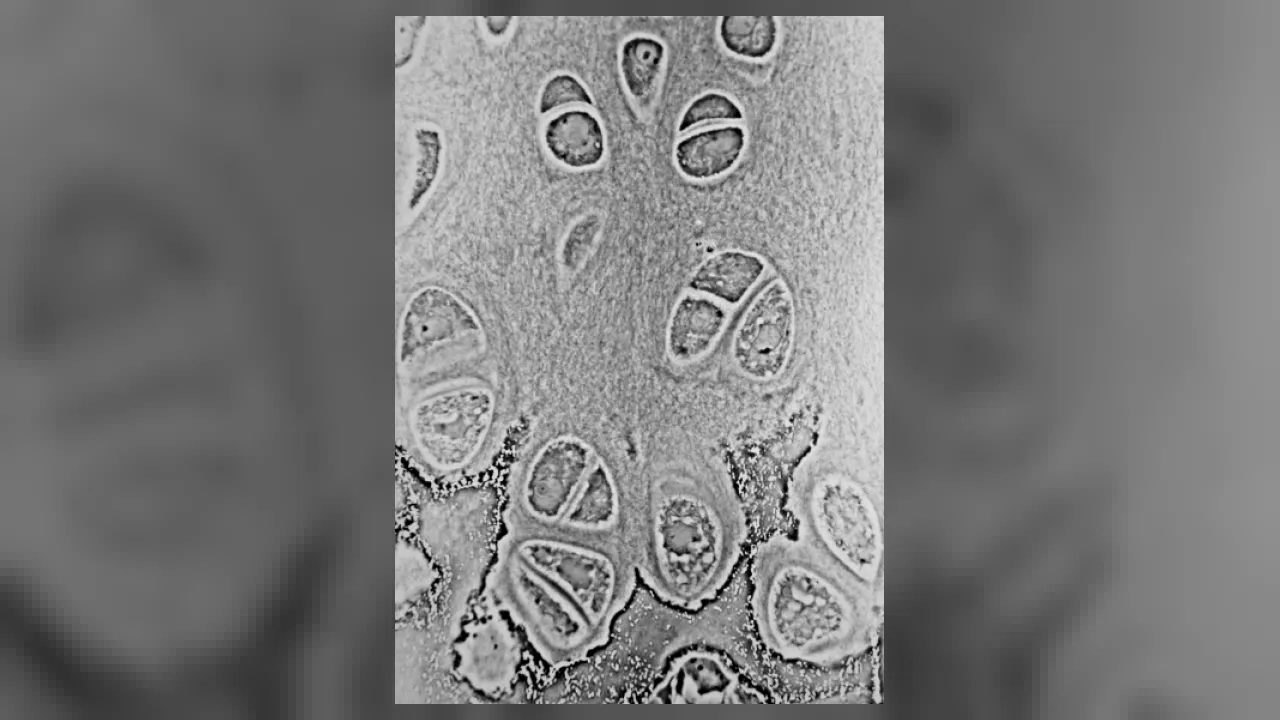
What material inside your knees is even more slippery than two ice cubes rubbing together?
1
Tough Yet Bendable
Pinch the soft top rim of your ear and let go—boing! That springy material is neither soft muscle nor rock-hard bone. It is cartilage, a special rubbery tissue that holds its shape while still bending safely.
2
Super-Slick Joint Caps
Inside your knees, hips, and shoulders, pearly white cartilage coats the ends of bones. Wet makes this cartilage more slippery than ice on ice, letting your legs swing thousands of times a day without wearing out.
3
Rings in Your Windpipe
Cartilage also forms C-shaped rings down your throat's so your airway stays wide open whenever you breathe!
1. Why does your windpipe have firm rings of cartilage wrapped around it?
2. Which ocean animals build their whole skeletons out of cartilage instead of bone?
🤯 Mind-Blowing Fact • Grade 3
You are actually about half an inch taller when you wake up in the morning than at bedtime because spinal cartilage discs plump back up with water overnight!
✨ Word Sparks (Grade 3 Glossary)
Tap 🔊 to hear
Hyaline Cartilage
Glassy smooth cartilage coating bone ends in joints
How do three different recipes of cartilage help you jump high, breathe easy, and grow taller?
1
A Sponge Full of Water
Bounce up and down on your heels and feel how smoothly your ankles, knees, and spine absorb the landing. Up to eighty percent of healthy joint cartilage is actually water trapped inside a springy mesh of protein fibers! When you land, tiny drops squeeze out to cushion the force, then soak right back in when you lift your foot.
2
Three Smart Flavors
Your body mixes three kinds of cartilage for different jobs. Glassy coats moving joints, connects your ribs to your breastbone so your chest expands, and forms childhood . Elastic cartilage puts the spring in your outer ears, while extra-tough builds thick shock-absorbing discs between your spinal bones.
3
Living Without Blood Vessels
Unlike bone or skin, cartilage contains zero blood vessels or nerves. That is why bending your ear never hurts, and why worn cartilage heals much more slowly than a scraped knee.
4
Exercise Feeds Your Joints
Because cartilage has no blood vessels, gentle movement like walking and biking squeezes nutrient-rich joint fluid in and out like a kitchen sponge!
1. Why are people slightly taller right when they wake up in the morning?
2. Why does injured cartilage take longer to repair itself than skin or bone?
🤯 Mind-Blowing Fact • Grade 4
A flap of elastic cartilage in your throat called the epiglottis folds down like a trapdoor every time you swallow so water and food go down your food pipe instead of your lungs!
✨ Word Sparks (Grade 4 Glossary)
Tap 🔊 to hear
Chondrocytes
Living cells that build and maintain cartilage tissue
Avascular
Containing no blood vessels inside the tissue
Epiglottis
Elastic cartilage throat flap protecting your breathing tube
🪝
How can a tissue with zero blood vessels withstand millions of footsteps and build your adult height?
1
Cells Floating in a Gel Matrix
Run your fingers down the bridge of your nose: the upper half feels rock-solid where nasal bones sit, while the lower half flexes easily thanks to cartilage. Microscopically, specialized cells called weave an extraordinary extracellular matrix around themselves. Tough collagen ropes provide tensile strength so cartilage will not tear, while water-loving molecules called proteoglycans trap pressurized water like millions of microscopic water balloons.
2
Matching Structure to Biomechanics
Anatomists classify human cartilage into three tailored varieties. Pearly hyaline cartilage lines synovial joints as articular cartilage, achieving friction five times lower than ice sliding on ice. Yellowish elastic cartilage packs stretchy elastin fibers into your external pinna (ear) and the —the clever throat flap that flips down when you swallow so food stays out of your lungs. Dense fibrocartilage reinforces your knee menisci and intervertebral spinal discs against heavy compression.
3
Fueling Childhood Bone Growth
Cartilage is also the secret engine behind how you grow taller! Near the ends of kids' long leg and arm bones sit epiphyseal growth plates—narrow bands where rapidly multiply, stack into columns, and gradually mineralize into brand-new bone.
4
Why Staying Active Protects Joints
Because cartilage is —meaning it lacks blood vessels— rely entirely on diffusion. Rhythmic motion during play and exercise pumps fresh synovial fluid into the matrix while flushing away cellular waste.
1. How do living chondrocytes inside joint cartilage receive food and oxygen without blood vessels?
2. Which elastic cartilage structure flips down like a lid whenever you swallow?
🤯 Mind-Blowing Fact • Grade 5
Scottish anatomist William Hunter wrote in 1743 that damaged joint cartilage is exceedingly tricky to heal—a puzzle modern biomedical engineers are now solving with 3D-printed living cell gels!
✨ Word Sparks (Grade 5 Glossary)
Tap 🔊 to hear
Lacunae
Tiny pockets inside cartilage housing living chondrocyte cells
Proteoglycans
Bottlebrush molecules trapping water for bouncy shock absorption
Endochondral Ossification
Bone growth process replacing cartilage templates with mineral
🪝
What molecular engineering lets a paper-thin layer of water-rich cartilage outlast steel bearings in friction tests?
1
Viscoelastic Armor of the Skeleton
Every stride of a marathon runner subjects the human knee to forces exceeding three times body weight, yet healthy bone ends glide effortlessly for decades without grinding. The credit belongs to articular cartilage—a specialized connective tissue measuring just two to four millimeters thick that combines hydraulic shock absorption with a coefficient of friction as low as 0.002, far outperforming polished metal bearings.
2
Chondrocytes and Proteoglycan Hydraulics
Isolated inside tiny fluid pockets called , cartilage-building chondrocytes occupy less than five percent of the tissue's volume. The remaining ninety-five percent consists of a remarkable extracellular matrix: arched Type II collagen fibrils form a tension-resistant cage around bottlebrush-shaped aggrecan . Because these proteoglycans carry dense negative electrical charges, they attract sodium ions and osmotically draw up to eighty percent water by weight, generating swelling pressure that resists crushing loads.
3
Histological Trio: Hyaline, Elastic, and Fibrocartilage
By varying fiber ratios, the body customizes three histological classes. Hyaline cartilage constructs the embryonic skeleton, costal rib cartilages, tracheal rings, and epiphyseal plates where lengthens growing bones. Elastic cartilage weaves branching elastin networks into the auricle, auditory tube, and laryngeal epiglottis. Fibrocartilage alternates thick Type I collagen bundles with chondrocyte rows to withstand immense shear and compression inside intervertebral discs, the pubic symphysis, and knee menisci.
4
The Challenge of Avascular Repair
Cartilage is simultaneously avascular, aneural, and alymphatic. Nutrients must diffuse slowly from surrounding perichondrium membranes or synovial fluid pumped by cyclical joint loading, severely limiting adult chondrocytes' ability to divide after deep athletic injuries.
5
From William Hunter to Bioengineered Scaffolds
In 1743, Scottish anatomist William Hunter famously observed to the Royal Society that ulcerated joint cartilage rarely heals on its own—an insight that today inspires biomedical engineers 3D-printing living chondrocyte hydrogels to regenerate damaged joints.