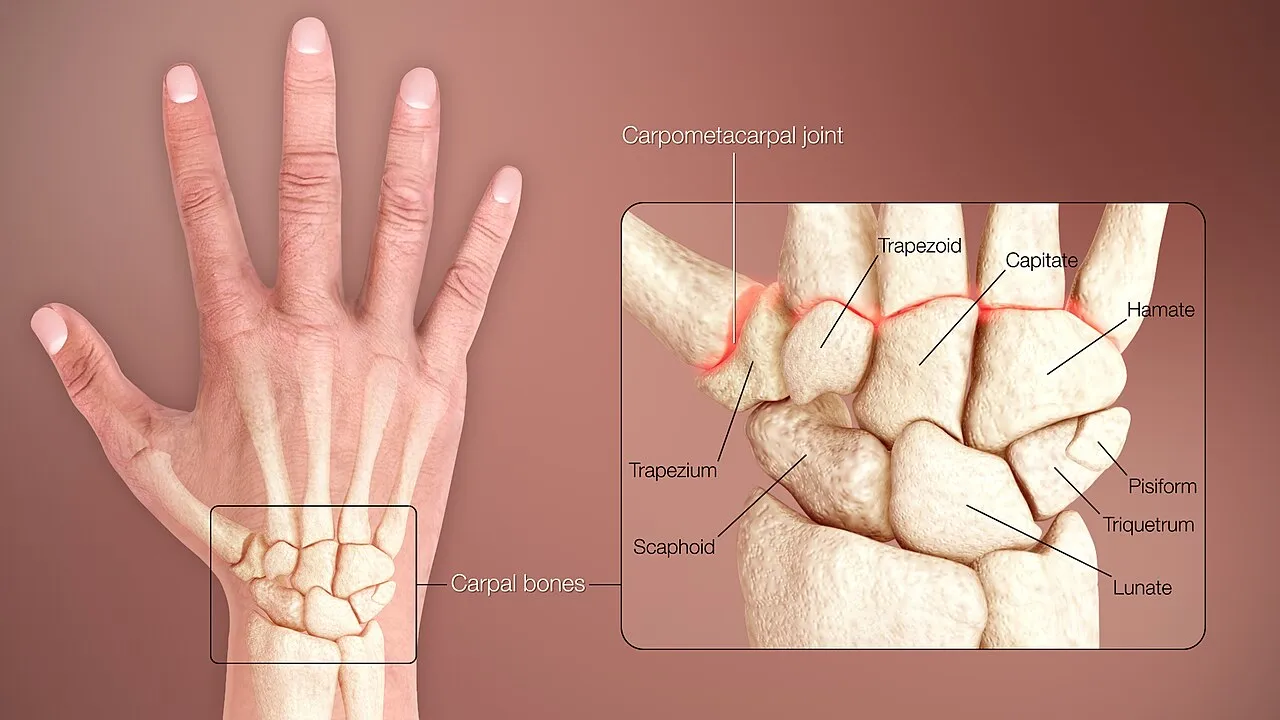
2. Where are your pebble-like carpal bones located?
🤯 Mind-Blowing Fact • Grade 2
Your thumb only has two finger bones, while each of your other four fingers has three!
✨ Word Sparks (Grade 2 Glossary)
Tap 🔊 to hear
Opposable
Able to swing across and touch other fingers
Flexible
Easy to bend and move without breaking
Skeleton
The strong frame of bones inside your body
🪝
Why can your hands tie shoelaces AND hang from playground monkey bars?
1
A Team of Twenty-Seven
Open your hand wide, then curl it into a tight fist. Twenty-seven separate bones work together inside every hand to make that motion happen! Because you have so many small bones, your hands can bend in dozens of directions.
2
Three Bone Neighborhoods
Scientists sort hand bones into three groups. Eight round carpal bones form your wrist. Five long bones stretch across your flat palm, and fourteen smaller bones build your thumb and four fingers.
3
Clever Opposable Thumbs
Touch your thumb to each fingertip one by one. A special joint at the base of your thumb lets it swing across your palm so you can pinch tiny buttons or grip heavy bats.
1. How many carpal bones work together inside one wrist?
2. How is your thumb bone count different from your other fingers?
🤯 Mind-Blowing Fact • Grade 3
The smallest carpal bone in your wrist, called the pisiform, is roughly the size and shape of a garden pea!
✨ Word Sparks (Grade 3 Glossary)
Tap 🔊 to hear
Metacarpals
Five long bones forming the middle palm bridge
Phalanges
Small hinged bones inside fingers and toes
Carpal Tunnel
Narrow wrist passageway guiding cords and nerves
🪝
How do three different bone groups team up to let you play piano or build LEGO castles?
1
Precision Engineering in Your Grasp
Tap a pencil on your desk or zip up your jacket. Those everyday actions look easy, yet they require fifty-four bones across both hands moving in smooth harmony. Together, your hands hold more than one-quarter of all 206 bones in an adult skeleton.
2
Carpals: The Wrist Puzzle
At the base of your hand sit eight marble-sized carpal bones arranged in two neat rows of four. They glide gently past one another whenever you wave side to side or turn a doorknob, giving your wrist strength without stiffness.
3
Metacarpals and Phalanges
Radiating outward from the wrist are five that form the sturdy bridge of your palm. Beyond your knuckles sit fourteen —three slim bones in every finger and two sturdier ones inside your thumb.
4
Pulled Like Puppet Strings
Surprisingly, the strongest muscles that curl your fingers are not in your hand at all! They sit up in your forearm and pull long, tough cords through a narrow wrist tunnel to move each finger bone.
1. Which group of five bones forms the sturdy bridge inside the palm of your hand?
2. Where are the main muscles that bend your fingers powerfully located?
🤯 Mind-Blowing Fact • Grade 4
Pediatric doctors can estimate a growing child's skeletal age just by taking a quick X-ray of their wrist to see how many carpal bones have hardened!
✨ Word Sparks (Grade 4 Glossary)
Tap 🔊 to hear
Scaphoid
Boat-shaped wrist bone located near the thumb base
Saddle Joint
Curved thumb joint allowing two-direction swinging motion
Ossification
Natural process turning soft cartilage into hard bone
🪝
Why are eight tiny wrist bones better for human hands than one solid chunk of bone?
1
Built for Both Power and Delicacy
Watch a concert violinist dance across thin strings, then picture a rock climber hanging from a tiny stone ledge. Both feats rely on the exact same twenty-seven bones packed into each human hand. If your wrist and palm were fused into one solid plate, your hand would be stiff like a wooden paddle, unable to cup water or thread a needle.
2
Two Rows of Gliding Carpals
Your wrist owes its remarkable range of motion to eight uniquely shaped carpal bones stacked in two interlocking rows. Named after shapes early anatomists recognized—such as the boat-shaped , moon-shaped lunate, and pea-shaped pisiform—these bones slide smoothly over slick cartilage cushions, absorbing shock whenever you catch a fast-moving ball.
3
From Palm Arches to Fingertips
Five tubular metacarpals fan out from the distal carpal row to build a curved palm arch. At your knuckles, they meet fourteen phalanges divided into proximal, middle, and distal segments. The thumb connects to a saddle-shaped carpal called the trapezium, allowing it to rotate across the palm in true opposition.
4
Growing Bones Over Time
When babies are born, their carpal wrist bones are actually made of soft, rubbery cartilage that hardly shows up on X-rays! Throughout childhood, mineral crystals gradually harden each carpal one by one until full adult bone strength arrives during the teen years.
1. Why don't a newborn baby's carpal wrist bones clearly appear on a standard X-ray?
2. Which special carpal bone forms a saddle joint that lets your thumb swing across your palm?
🤯 Mind-Blowing Fact • Grade 5
Wilhelm Röntgen's famous 1895 discovery photo of the very first medical X-ray in human history was a clear skeletal image of his wife's hand bones and wedding ring!
✨ Word Sparks (Grade 5 Glossary)
Tap 🔊 to hear
Articulate
Meet at a movable joint for smooth motion
Pollex
Anatomical Latin name for the human thumb
Intrinsic Muscles
Tiny muscles located completely inside the hand itself
🪝
How does a twenty-seven-bone biomechanical marvel balance pinpoint surgical accuracy with crushing grip strength?
1
An Evolutionary Masterpiece of Dexterity
Every time you sketch a portrait, button a shirt, or swing a tennis racket, fifty-four intricately articulated bones across your two hands execute rapid biomechanical calculations. Accounting for more than 26 percent of the 206 bones in the adult human skeleton, the ossa manus combine rigid structural levers with gliding micro-joints to achieve unmatched dexterity in the animal kingdom.
2
Architecture of the Carpus
At the wrist's core lies the carpus, an eight-bone mosaic arranged into proximal and distal rows of four. The proximal row—scaphoid, lunate, triquetrum, and sesamoid pisiform— with the forearm's radius to enable flexion, extension, and side-to-side deviation. Beneath a fibrous roof band, these bones form the concave carpal arch, creating a protected passageway called the carpal tunnel for the median nerve and nine flexor tendons.
3
Metacarpal Arches and Phalangeal Levers
Distal to the carpus, five numbered metacarpals create longitudinal and transverse arches that allow the palm to cup around spherical objects. Fourteen phalanges extend into the digits: each finger carries proximal, middle, and distal phalanges linked by hinge joints, whereas the (thumb) relies on two sturdier phalanges anchored to the trapezium's biaxial saddle joint.
4
Power Grips Versus Precision Pinches
Biomechanists classify human hand movements into power grips, where fingers clamp objects firmly against the palm using extrinsic forearm muscles, and precision grips, where tiny nestled between the metacarpals fine-tune fingertip pressure down to fractions of an ounce.
5
Discovery and Medical Imaging History
In December 1895, German physicist Wilhelm Röntgen captured the world's very first medical X-ray image—revealing the dark silhouettes of his wife Anna Bertha's carpals, metacarpals, and phalanges, instantly transforming orthopedic medicine forever.