Brooklyn Bridge
A Giant Web of Steel and Stone
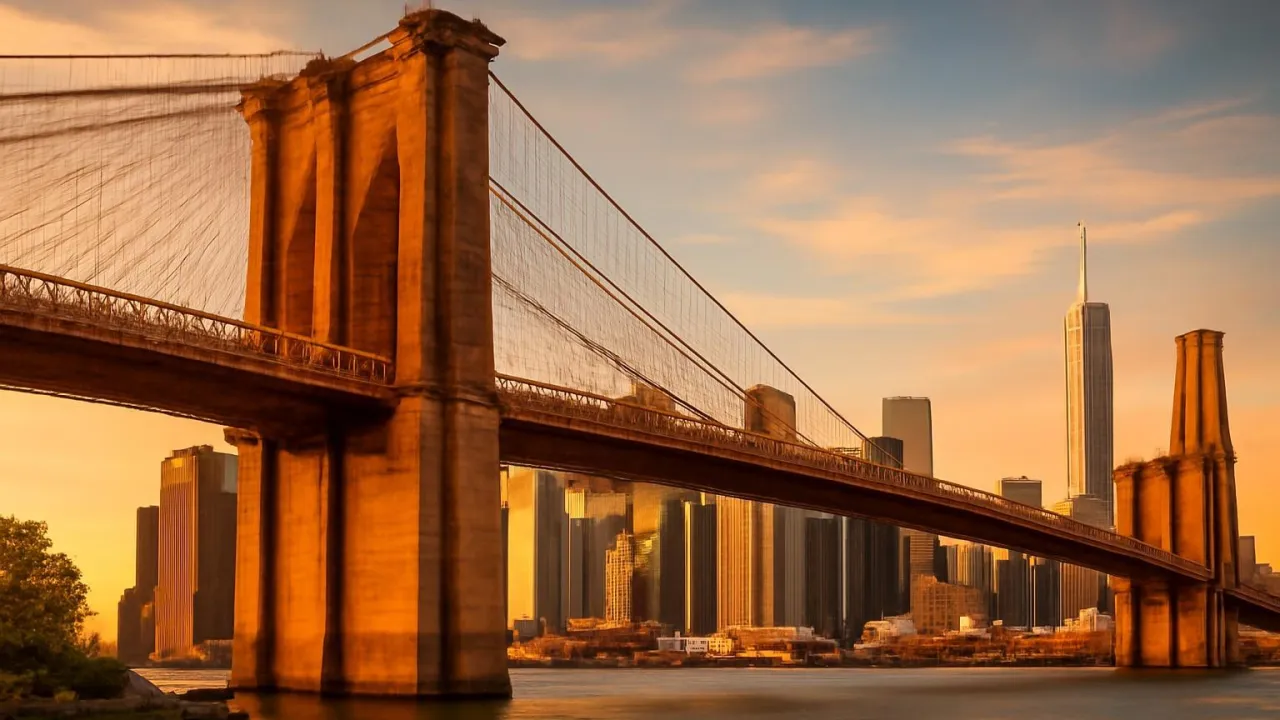
If you lined up all the wires in the Brooklyn Bridge’s four main cables, they would stretch nearly 14,000 miles—more than halfway around the Earth!
1 Engineering Ambition in the Gilded Age
As the clang of hammers echoed over the East River in 1869, the Brooklyn Bridge began as a bold vision to unite Manhattan and Brooklyn. John A. Roebling, a pioneering civil engineer, designed the bridge to be the world’s longest suspension span, but after his sudden death, his son Washington Roebling took over, even directing construction while bedridden. The bridge’s two neo-Gothic towers, each rising 276 feet (84 meters), were constructed from limestone, granite, and Rosendale cement, anchoring the structure firmly in the riverbed.
2 Suspension Science: Steel, Tension, and Innovation
The Brooklyn Bridge’s main span measures 1,595 feet (486 meters), supported by four massive steel-wire cables, each containing 5,434 parallel wires. These cables, a marvel of 19th-century engineering, create tension that holds up the deck, transferring loads through the towers and down to caisson foundations sunk 78 feet below water. The bridge’s also includes diagonal stays and systems to add stability and resist wind forces, making it a prototype for future long-span bridges.
3 Building Beneath the River: Challenges and Risks
Workers faced extreme dangers while building the caissons—giant airtight chambers—under the river, including , fires, and collapses. Washington Roebling himself suffered from ‘caisson disease,’ now known as the bends. Despite these hardships, the bridge’s construction introduced new safety standards and engineering techniques, such as pneumatic caissons and the use of steel as a primary material, setting a precedent for future megastructures.
4 A Symbol of Progress and Connectivity
When the Brooklyn Bridge opened on May 24, 1883, it was celebrated as a triumph of science, engineering, and human determination. It instantly became a symbol of New York City’s growth, connecting communities and economies across the East River. The bridge’s grand opening was attended by thousands, including President Chester A. Arthur, and it quickly became an essential artery for commerce and travel.
5 Legacy: Inspiring the World’s Bridges
Over 140 years later, the Brooklyn Bridge endures as both a National Historic Landmark and an icon of American ingenuity. Its steel-wire suspension system influenced the design of bridges worldwide, from the Golden Gate to the Akashi Kaikyō. The bridge remains vital for millions of pedestrians, cyclists, and vehicles each year, offering breathtaking city views and a living lesson in physics, architecture, and history.
1. How did the Brooklyn Bridge’s cables help change bridge construction worldwide?
2. What dangerous challenge did workers face inside the caissons?