🇺🇸 U.S. HISTORY
🏛️ Educator, Author & Tuskegee Founder • 1856–1915
VA History & Social Science SOL K.1, 1.2, 2.4, VS.1–VS.10, USI & USII
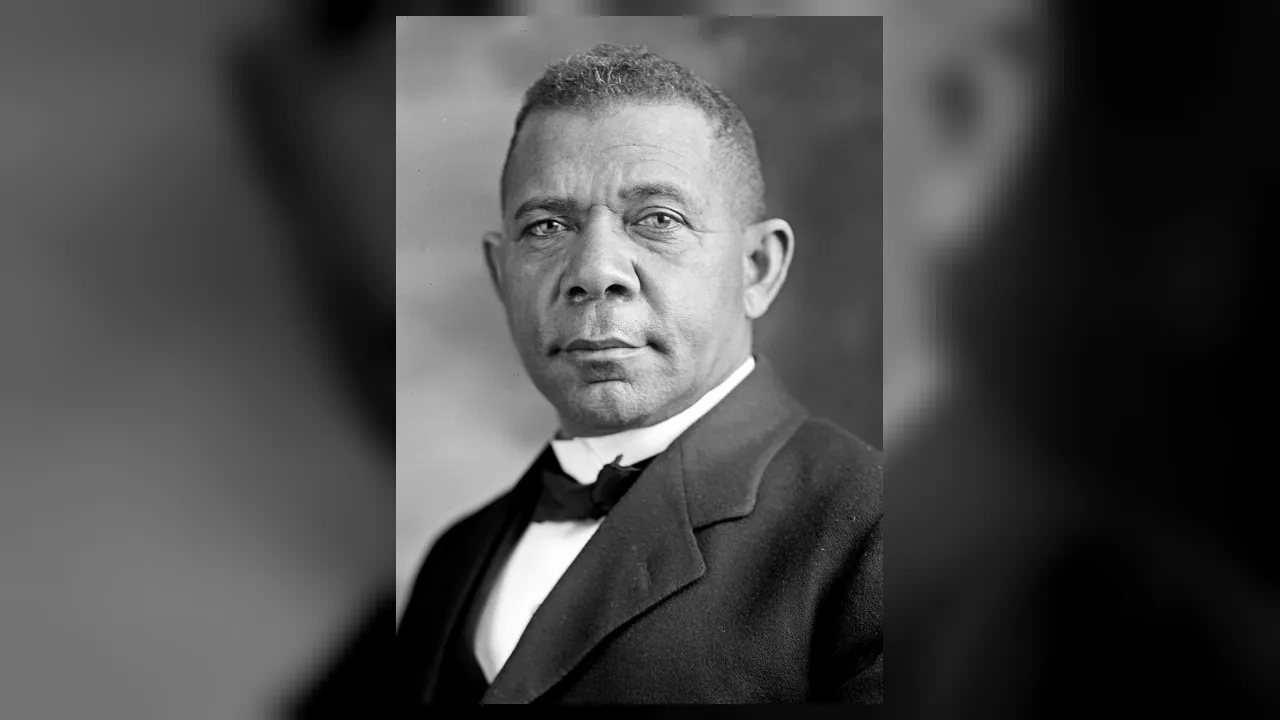
Booker T. Washington
Virginia-Born Educator Who Built Tuskegee University
Grade 2 • Developing • 112 words
⏳ Era / Statehood1856–1915 • Reconstruction & Progressive Education Era
🗺️ Region / CapitalFranklin County & Hampton, Virginia & Tuskegee, Alabama
📜 Key MilestoneWalked 500 miles for school & founded Tuskegee Institute in 1881
⚡ Historical SparkBuilt Tuskegee from one shed into a world-famous campus and helped launch nearly 5,000 rural schools
🤯 Mind-Blowing Fact • Grade 1
On his very first day at school, when the teacher asked for a last name, young Booker calmly chose the proud name 'Washington' right on the spot!
✨ Word Sparks (Grade 1 Glossary)
Tap 🔊 to hear
speller
A beginner book for learning words
campus
The grounds and buildings of a college
brick
A baked clay block for building walls
🪝
Would you walk hundreds of miles just for the chance to go to school and read books?
1
Dreaming of Books
Born enslaved on a small cabin floor in Virginia, young Booker could not go to school. Once freedom came, he got a blue spelling book and learned every letter!
2
A Five-Hundred-Mile Trip
At sixteen, Booker heard about a great school in Hampton, Virginia. He walked and rode nearly five hundred miles across mountains to study there!
3
Building Tuskegee
Later, Booker started a famous school in Tuskegee, Alabama. Students even baked the red clay to build their own classrooms!
1. In which state was Booker T. Washington born and educated at Hampton?
2. How did Booker T. Washington's early students at Tuskegee get classrooms?
🤯 Mind-Blowing Fact • Grade 2
In 1940, Booker T. Washington became the very first African American ever honored on a United States postage stamp!
✨ Word Sparks (Grade 2 Glossary)
Tap 🔊 to hear
tuition
Money paid for lessons at school
institute
A school focused on learning and skills
determination
Refusing to quit when goals are hard
🪝
How did a boy who worked in dark salt mines before sunrise grow up to build over a hundred school buildings?
1
Learning by Lamplight
Imagine waking at four o'clock in the morning to pack salt barrels in West Virginia, then hurrying to night classes with your treasured Webster's blue-back speller! Born enslaved in Franklin County, Virginia, in 1856, Booker T. Washington gained freedom at age nine after the Civil War ended.
2
Journey to Hampton, Virginia
At sixteen, hearing miners talk about Hampton Normal and Agricultural on Virginia's coast, Booker walked and hitched wagon rides five hundred miles east. Working as a school janitor to pay , he graduated with honors!
3
Founder of Tuskegee Institute
In 1881, twenty-five-year-old Booker traveled to Tuskegee, Alabama, opening a teachers' school inside a leaky shed. Before long, Tuskegee boasted over a hundred student-built brick buildings and scientist George Washington Carver!
1. Which Virginia school did sixteen-year-old Booker T. Washington travel 500 miles to attend?
2. Which famous plant scientist did Booker T. Washington invite to teach at Tuskegee in 1896?
🤯 Mind-Blowing Fact • Grade 3
Booker T. Washington's birthplace in Hardy, Franklin County, Virginia, is preserved today by the National Park Service as Booker T. Washington National Monument!
✨ Word Sparks (Grade 3 Glossary)
Tap 🔊 to hear
vocational
Training in practical trades and career skills
autobiography
A true book written about oneself
entrepreneur
Someone who starts and runs a business
🪝
Why did cleaning one classroom three times over become the turning point of Booker T. Washington's life?
1
From Virginia Cabin to West Virginia Mines
Picture a nine-year-old boy standing beside his mother in Franklin County, Virginia, in spring 1865 as a Union officer reads the Emancipation Proclamation aloud—announcing they are finally free! Moving across the mountains to Malden, West Virginia, young Booker shoveled coal and packed salt furnaces before dawn while teaching himself letters from number marks on salt barrels and a tattered spelling book.
2
The Famous Entrance Test at Hampton
Determined to attend Hampton Institute in Tidewater Virginia in 1872, sixteen-year-old Booker walked and worked his way five hundred miles across the Blue Ridge Mountains, arriving tired and penniless. When head teacher Mary Mackie asked him to sweep a recitation room as a test of character, Booker swept it three times and dusted every bench four times! Passing with flying colors, he earned a janitor job that paid his way.
3
Brick by Brick at Tuskegee
Recommended by Hampton principal Samuel Chapman Armstrong in 1881, Washington opened Tuskegee Institute in Alabama on July 4 with thirty eager students. Combining reading, math, and history with carpentry, farming, printing, and brickmaking, Tuskegee empowered thousands of teachers and .
4
Five Thousand Rosenwald Schools
Later, Washington wrote his bestselling Up from Slavery (1901), dined with President Theodore Roosevelt at the White House, and partnered with philanthropist Julius Rosenwald to build nearly 5,000 rural community schools across fifteen southern states!
1. How did Booker T. Washington first figure out his earliest reading symbols while working at the salt furnaces in West Virginia?
2. With whom did Booker T. Washington team up to help build nearly 5,000 new public schools for Black children across the rural South?
🤯 Mind-Blowing Fact • Grade 4
When Tuskegee students failed three times in a row trying to fire their first brick kiln, Booker T. Washington pawned his prized gold pocket watch for $15 to fund a fourth try—which succeeded and launched a thriving campus brickyard!
✨ Word Sparks (Grade 4 Glossary)
Tap 🔊 to hear
endowment
Invested funds supporting a school long term
kiln
A super-hot oven used to bake bricks
normal school
A college specifically training future schoolteachers
🪝
How did Booker T. Washington transform a $2,000 teaching grant with zero land or buildings into an internationally admired university?
1
Emancipation in Virginia's Piedmont
Stand on a quiet tobacco farm in Franklin County, Virginia, near the Blue Ridge foothills in April 1865, where nine-year-old Booker listens to his mother, Jane, whisper prayers of joy as emancipation arrives. During slavery, carrying his enslaver's daughters' books only as far as the schoolhouse door had convinced young Booker that stepping inside a classroom must be 'about the same as getting into paradise.' Moving to Malden, West Virginia, he labored in salt works and coal shafts while attending night classes and choosing the surname Taliaferro Washington.
2
Hampton Institute and 'Head, Hand, and Heart'
In autumn 1872, sixteen-year-old Washington traveled five hundred miles across Virginia—unloading pig-iron ships on Richmond docks and sleeping beneath wooden sidewalks to save pennies—until reaching Hampton Normal and Agricultural Institute. Embracing Hampton's philosophy of educating 'head, hand, and heart' so graduates could achieve economic independence and teach rural communities, he graduated in 1875 and returned as an instructor.
3
Building Tuskegee and Recruiting Carver
When Alabama legislators approved $2,000 solely for teachers' salaries at a proposed in Tuskegee—with zero funds for land or buildings—twenty-five-year-old Washington borrowed $250 from Hampton's treasurer in 1881 to purchase an abandoned hundred-acre plantation. After three failed attempts, Washington pawned his own gold pocket watch so students could master brickmaking! By 1915, Tuskegee encompassed over 100 buildings, 1,500 students, 200 faculty—including agricultural chemist George Washington Carver—and a $2 million .
4
National Influence, Debate, and Rosenwald Legacy
Author of the classic Up from Slavery (1901) and founder of the National Negro Business League, Washington became the first African American invited by a president—Theodore Roosevelt—to dine officially with his family at the White House in October 1901. While scholars like W.E.B. Du Bois debated Washington's gradualist emphasis on economic self-reliance over immediate political protest, Washington also quietly funded court challenges against unfair disenfranchisement laws and launched the transformative Rosenwald school-building program.
1. Which president invited Booker T. Washington to dine officially at the White House in October 1901?
2. How did Booker T. Washington and W.E.B. Du Bois differ publicly in their main strategies for advancing African American progress around 1900?
🤯 Mind-Blowing Fact • Grade 5
Historians studying Booker T. Washington's private papers after his death discovered that while speaking cautiously in public to protect southern schools, he had secretly used code names and personal funds to finance Supreme Court lawsuits against unfair voting and labor laws!
✨ Word Sparks (Grade 5 Glossary)
Tap 🔊 to hear
pedagogy
The art and method of teaching students
crop rotation
Alternating plants yearly to restore healthy soil
disenfranchisement
Unfairly taking away citizens' right to vote
🪝
How did Booker T. Washington navigate the treacherous constraints of the Jim Crow era to build enduring educational institutions across fifteen states?
1
Virginia Emancipation and the 500-Mile Odyssey to Hampton
Stand beside the reconstructed log kitchen cabin on the Burroughs tobacco plantation in Franklin County, Virginia—preserved today as Booker T. Washington National Monument—where Booker was born enslaved in April 1856. Freed at age nine upon Union victory in 1865, he trekked across the Alleghenies with his mother, Jane Ferguson, to join his stepfather in Malden, West Virginia. Packing salt and mining coal from 4:00 a.m. while mastering literacy by lamplight, sixteen-year-old Booker overheard miners praising Hampton Normal and Agricultural Institute in coastal Virginia. In autumn 1872, walking, riding stagecoaches, and unloading pig iron along Richmond's James River wharves—sleeping beneath a raised boardwalk to conserve coins—he reached Hampton, passed head teacher Mary F. Mackie's famous classroom-sweeping character test, and graduated with honors in 1875.
2
Founding Tuskegee Institute From Scratch (1881)
Recommended by Hampton Principal Samuel Chapman Armstrong when former craftsman Lewis Adams and banker George Campbell secured a $2,000 Alabama legislative appropriation for teacher salaries at Tuskegee, twenty-five-year-old Washington arrived in June 1881 to find neither land nor buildings. Opening classes on July 4, 1881, inside a leaky shanty beside Butler Chapel AME Zion Church, he borrowed $250 to buy the abandoned 100-acre Weythumpka plantation. Insisting students combine classical with architectural drafting, foundry work, farming, and brickmaking—even pawning his personal gold watch after three collapsed kilns—Washington enabled students to erect forty major campus structures while manufacturing bricks prized by white and Black builders across Macon County.
3
Atlanta Exposition Address, Carver, and Institutional Scale
In 1895, amid escalating Jim Crow violence and across the South, Washington delivered his famous 'Atlanta Compromise' address at the Cotton States and International Exposition, urging economic cooperation ('Cast down your bucket where you are') to protect fledgling Black schools and businesses from white backlash. The following year, he recruited Iowa State botanist George Washington Carver to direct Tuskegee's Agricultural Experiment Station, dispatching the 'Jesup Agricultural Wagon' to teach with nitrogen-fixing peanuts and sweet potatoes to sharecroppers. By Washington's death in 1915, Tuskegee commanded 2,000 acres, over 100 buildings, and a $2 million endowment.
4
Up from Slavery, Debate With Du Bois, and Covert Litigation
Washington's 1901 memoir Up from Slavery became a global bestseller translated into dozens of languages, and his October 1901 White House dinner with President Theodore Roosevelt marked an unprecedented milestone. While Northern intellectuals led by W.E.B. Du Bois in The Souls of Black Folk (1903) sharply critiqued Washington's public accommodation for ceding immediate suffrage and higher liberal education, archival letters discovered after Washington's death revealed a dual strategy: behind the scenes, Washington secretly financed and coordinated federal lawsuits challenging grandfather clauses, jury exclusion, and peonage laws (such as Bailey v. Alabama, 1911).
5
The Rosenwald School Revolution
In 1912, partnering with Sears, Roebuck president Julius Rosenwald and Tuskegee architects, Washington launched a matching-grant initiative that constructed 4,977 modern rural schools, shops, and teachers' homes across fifteen states by 1932—educating more than 660,000 children, including future leaders Maya Angelou and Congressman John Lewis.
1. What surprising discovery did historians make when examining Booker T. Washington's private archives after his death in 1915?
2. How many rural schools and educational buildings grew out of the matching-grant partnership Booker T. Washington launched with Julius Rosenwald in 1912?