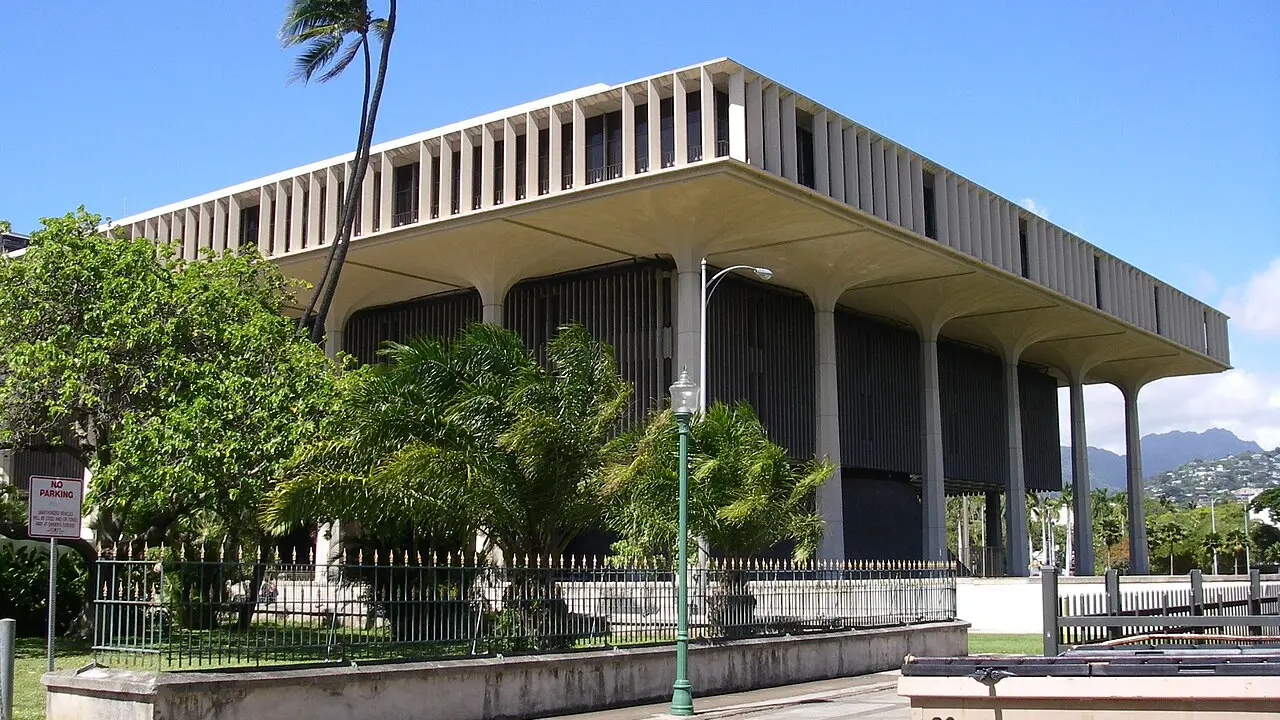
⚡ Historical SparkAmerica's fiftieth and newest state—the only U.S. state made completely of tropical volcanic islands
🤯 Mind-Blowing Fact • Grade 1
Hawaii has beaches with white sand, black lava sand, red sand, and even rare sparkling green sand!
✨ Word Sparks (Grade 1 Glossary)
Tap 🔊 to hear
island
Land completely surrounded by water everywhere
lava
Hot melted rock flowing from volcanoes
aloha
Hawaiian greeting sharing love, hello, goodbye
🪝
How did hot melted rock under the ocean build sunny green islands?
1
Islands in the Blue Sea
Say '!' as warm ocean waves splash black and golden sand beaches! Hawaii is our fiftieth state, made completely of out in the big Pacific Ocean.
2
Volcanoes and Rainbows
Deep underwater, volcanoes piled up cooled rock until tall mountains poked above the waves. Misty rain and bright sun paint colorful rainbows almost every day!
3
Sunny Honolulu
Honolulu on the of Oahu is the state capital. Sea turtles glide past colorful coral reefs.
1. Which ocean surrounds all of the islands of Hawaii?
2. What is the capital city of the State of Hawaii?
🤯 Mind-Blowing Fact • Grade 2
Hawaii's official state fish has a fun Hawaiian name twenty-one letters long: humuhumunukunukuapua'a!
✨ Word Sparks (Grade 2 Glossary)
Tap 🔊 to hear
navigator
Traveler who steers ships across oceans
kingdom
Country ruled by a king or queen
volcano
Mountain opening where melted rock erupts
🪝
How did brave ancient sailors find tiny Hawaiian islands without compasses or maps?
1
Star Navigators of the Pacific
Look up at twinkling stars above rolling ocean swells! More than a thousand years ago, skilled Polynesian sailed double-hulled canoes across thousands of miles of open sea, reading stars, waves, and seabirds to reach Hawaii.
2
Eight Main Islands and Fiftieth State
Eight main islands—including Oahu, Maui, Kauai, and the Big Island of Hawaii—form an island chain. On August 21, 1959, Hawaii joined the United States as our fiftieth and newest state!
3
Palaces, Flowers, and Volcanoes
Before becoming a state, Hawaii was an independent . Visitors in Honolulu can still tour Iolani Palace, the only royal palace in the United States!
1. How did ancient Polynesian sailors find their way across the Pacific Ocean to Hawaii?
2. What number state did Hawaii become when it joined the Union on August 21, 1959?
🤯 Mind-Blowing Fact • Grade 3
Honolulu's Iolani Palace installed electric lights in 1886—five years before electricity was installed in the White House in Washington, D.C.!
✨ Word Sparks (Grade 3 Glossary)
Tap 🔊 to hear
hotspot
Deep plume of heat building volcanic islands
bilingual
Using two different languages officially together
memorial
Special place built to honor history
🪝
Which Hawaiian mountain is actually taller from bottom to top than Mount Everest?
1
A Conveyor Belt of Volcanoes
Watch glowing orange lava hiss as it meets cool ocean surf in Hawaii Volcanoes National Park! Deep beneath the Pacific Plate sits a stationary '' of rising heat. As the tectonic plate drifts slowly northwest, the hotspot punches up one volcanic island after another like pancakes on a moving griddle.
2
Taller Than Everest From the Seafloor
On the Big Island, Mauna Loa is Earth's largest active volcano by volume, while neighbor Mauna Kea rises 13,796 feet above the waves. Measured from its base on the deep ocean floor, however, Mauna Kea stands over 33,000 feet tall—taller base-to-peak than Mount Everest!
3
Hawaiian Language and Royal History
Hawaii has two official languages: English and Ōlelo Hawaiʻi, whose written alphabet uses just twelve letters plus the ʻokina stop. King Kamehameha I united the islands in 1810, and Honolulu's Iolani Palace even had electric lights before the White House.
4
Remembering Pearl Harbor
Near Honolulu on Oahu, Pearl Harbor National honors the service members of December 7, 1941, when the United States entered World War II.
1. Why are northwestern Hawaiian islands like Kauai older than the Big Island of Hawaii in the southeast?
2. How can Mauna Kea be taller from base to peak than Mount Everest?
🤯 Mind-Blowing Fact • Grade 4
Native Hawaiians designed wedge-shaped land divisions called ahupuaʻa stretching from misty mountaintops down to coral reefs so every community could share forest, farm, and ocean resources sustainably!
✨ Word Sparks (Grade 4 Glossary)
Tap 🔊 to hear
windward
Mountain side facing into incoming moist winds
leeward
Dry mountain side sheltered from winds
basalt
Dark volcanic rock formed from cooled lava
🪝
Why do lush rainforests and dry deserts sit just miles apart on the very same Hawaiian island?
1
Trade Winds and Dramatic Microclimates
Hike the eastern side of Kauai or Maui and waterfalls plunge down emerald cliffs soaked by northeast trade winds! As moist ocean air rises up steep volcanic slopes, it cools and drops hundreds of inches of rain. Once that air crosses the summit to the western side, it descends warm and dry—creating sunny beaches and semi-arid landscapes just a short drive away.
2
Life Arriving by Wind, Wing, and Wave
Because the Hawaiian archipelago rose from bare rock more than 2,300 miles from the nearest continent, no land animals could walk there. Every native plant, fern, insect, and bird—such as brightly colored Hawaiian honeycreepers and the nēnē goose, Hawaii's state bird—descended from ancestors carried by wind currents, ocean waves, or migrating birds!
3
Ahupuaʻa Stewardship, Kingdom, and Statehood
Native Hawaiians organized land sustainably into wedge-shaped sections called ahupuaʻa running from mountain ridges down to coral reefs, sharing forest timber, taro fields, and coastal fishponds. Unified under King Kamehameha I and later governed by monarchs including Queen Liliʻuokalani, Hawaii became a U.S. territory in 1898 and entered the Union as the fiftieth state on August 21, 1959.
4
Telescopes and Pacific Crossroads
High above tropical clouds atop Mauna Kea and Haleakalā, crystal-clear skies host some of Earth's most powerful astronomical observatories.
1. Why is the northeastern windward side of a Hawaiian island usually much greener and wetter than its southwestern leeward side?
2. How did native plants and birds originally reach the isolated Hawaiian islands millions of years ago?
🤯 Mind-Blowing Fact • Grade 5
Two everyday geology words used by volcano scientists around the entire planet—pāhoehoe for smooth ropy lava and ʻaʻā for rough blocky lava—come directly from the Hawaiian language!
✨ Word Sparks (Grade 5 Glossary)
Tap 🔊 to hear
archipelago
Chain of islands formed across an ocean
seamount
Underwater volcanic mountain below ocean waves
refraction
Bending of ocean swells around distant islands
🪝
What makes the world's most isolated inhabited archipelago a premier natural laboratory for shield volcanism, adaptive radiation, and oceanic navigation?
1
Mantle Plume Tectonics and Shield Volcanoes
Stretching 1,500 miles across the central Pacific from the Big Island of Hawaiʻi northwestward to Kure Atoll—the only U.S. state situated south of the Tropic of Cancer—the Hawaiian records eighty million years of plate motion along the Hawaiian-Emperor chain. Because Hawaiian magma is low-silica, fluid basalt rather than sticky continental magma, eruptions generally flow in broad sheets called pāhoehoe (smooth, ropy lava) and ʻaʻā (rough, jagged clinker)—geological terms adopted worldwide from the Hawaiian language—building gently sloped shield volcanoes like Mauna Loa and Kīlauea.
2
Adaptive Radiation and Marine Sanctuaries
Separated by roughly 2,400 miles from North America, Hawaii's extreme geographic isolation drove extraordinary adaptive radiation: a single ancestral finch species evolved into dozens of specialized Hawaiian honeycreepers, while tiny tarweed seeds diversified into giant alpine silversword plants. Surrounding waters encompass Papahānaumokuākea Marine National Monument, protecting coral atolls, Hawaiian monk seals, and humpback whale calving grounds.
3
Polynesian Wayfinding, Constitutional Monarchy, and Statehood
Beginning around 1000 CE or earlier, Polynesian voyagers navigated across thousands of miles of open Pacific using celestial star compasses and ocean-swell , establishing sophisticated ahupuaʻa watershed management and stone walled loko iʻa fishponds. Unified by King Kamehameha I in 1810, the Kingdom of Hawaiʻi established constitutional governance, public literacy, and global diplomatic treaties before 1898 U.S. annexation, pivotal World War II history at Pearl Harbor on December 7, 1941, and admission as the fiftieth state on August 21, 1959.
4
Global Climate Monitoring at Mauna Loa
Since 1958, scientists at Mauna Loa Observatory—11,135 feet high in clean mid-Pacific air—have continuously measured atmospheric carbon dioxide, producing the famous Keeling Curve fundamental to modern Earth system science.
5
Hōkūleʻa and Living Cultural Renaissance
Since the 1970s, the traditional voyaging canoe Hōkūleʻa has sailed around the globe without modern instruments, celebrating Indigenous ocean science alongside Hawaii's leadership in astronomy, marine biology, and tropical agriculture.