🇺🇸 U.S. HISTORY
🏛️ 31st U.S. State • The Golden State
VA History & Social Science SOL K.1, 1.2, 2.4, VS.1–VS.10, USI & USII
State of California
Giant Redwoods, Golden Bridges, and Big Ideas
Grade 2 • Developing • 94 words
⏳ Era / StatehoodAdmitted September 9, 1850 (31st State)
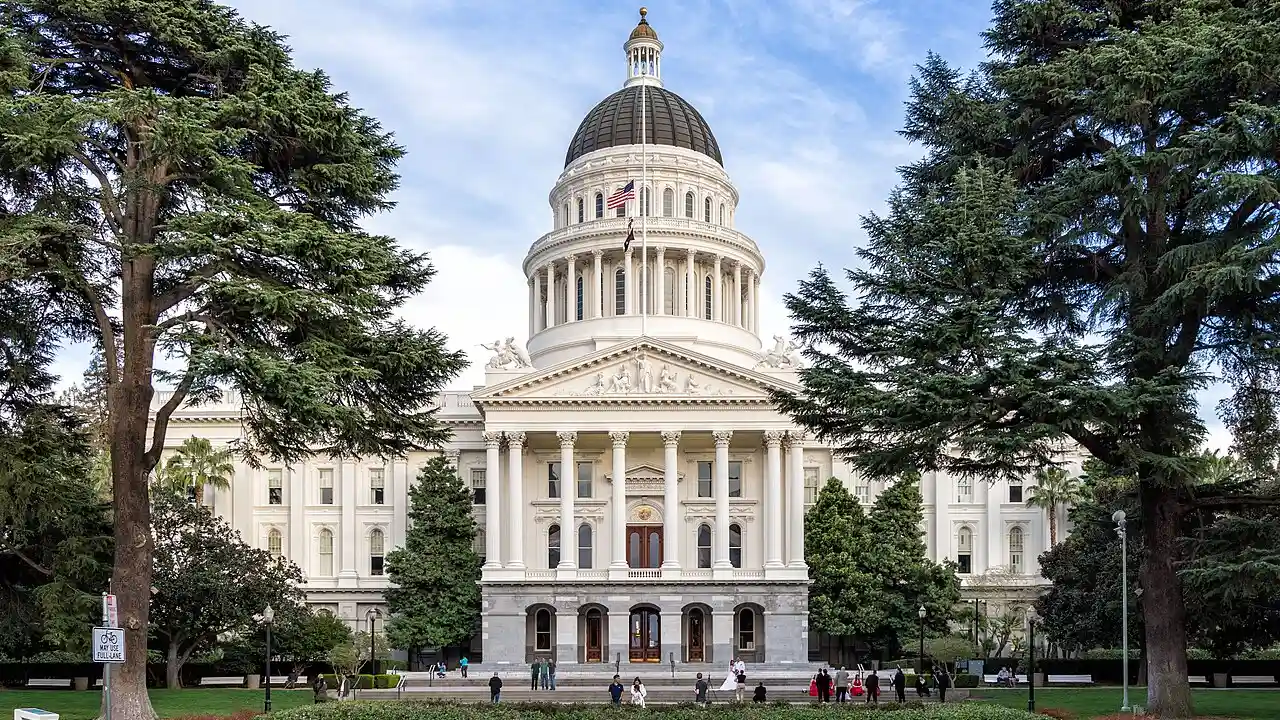
🗺️ Region / CapitalPacific Coast U.S. • Capital: Sacramento
📜 Key MilestoneRedwood & Sequoia Forests, Central Valley Farms, Gold Rush & Silicon Valley
⚡ Historical SparkMost populous U.S. state, growing the tallest trees on Earth and leading America in both farm harvests and computer innovation
🤯 Mind-Blowing Fact • Grade 1
Some giant sequoia trees in California have trunks so wide that cars used to drive right through tunnels carved in fallen logs!
✨ Word Sparks (Grade 1 Glossary)
Tap 🔊 to hear
redwood
Towering evergreen tree along the foggy coast
valley
Low land nestled between hills or mountains
harbor
Sheltered ocean water where ships dock safely
🪝
Where do trees grow taller than the Statue of Liberty?
1
Trees in the Clouds
Tilt your head way back under a foggy green forest! Coast in California are the tallest living trees on Earth. Sea lions bark along rocky Pacific Ocean beaches nearby.
2
Shiny Gold and Bright Bridges
Long ago, shiny gold flakes in a river brought thousands of people to Sacramento, now the state capital. Near San Francisco, the bright orange-red Golden Gate Bridge spans sparkling waves.
3
Sunny Farms
Sunny grow sweet strawberries, oranges, and crunchy almonds for families everywhere!
1. Which ocean waves splash along California's long western coast?
2. What is the capital city of the State of California?
🤯 Mind-Blowing Fact • Grade 2
Golden poppies carpet California hillsides each spring in bright orange blooms, inspiring its nickname, the Golden State!
✨ Word Sparks (Grade 2 Glossary)
Tap 🔊 to hear
nugget
A small natural lump of shiny gold
orchard
A farm filled with rows of fruit trees
basin
A low bowl-shaped area of land
🪝
How did tiny yellow nuggets in a stream help turn California into the thirty-first state?
1
The Great Gold Rush
Splash cold river water inside a metal pan and look for a golden gleam! In 1848, workers found shiny gold at Sutter's Mill near Sacramento. Soon thousands of 'Forty-Niners' rushed west, and California became the thirty-first state in 1850.
2
Highest Peak and Lowest Basin
California holds incredible records! Snowy Mount Whitney is the tallest mountain in the lower forty-eight states, while nearby Death Valley is the lowest, hottest spot in North America.
3
Orchards, Movies, and Computers
More people live in California than in any other U.S. state. Its sunny Central Valley feeds the nation, while engineers in Silicon Valley invent new computers and apps.
1. Why were people who rushed to California in 1849 called Forty-Niners?
2. Which California tree species grows taller than any other tree on Earth?
🤯 Mind-Blowing Fact • Grade 3
General Sherman, a giant sequoia in California's Sequoia National Park, is the largest single-stem tree on Earth by volume and weighs more than ten blue whales!
✨ Word Sparks (Grade 3 Glossary)
Tap 🔊 to hear
snowpack
Deep mountain snow that melts in spring
granite
Hard, speckled rock formed deep underground
conservation
Protecting wild lands, water, and living creatures
🪝
How can North America's lowest desert basin sit less than ninety miles from the contiguous nation's tallest mountain?
1
Extreme Heights and Depths
Imagine standing 282 feet below sea level on glistening salt flats at Badwater Basin in Death Valley, then gazing west toward snowy 14,505-foot Mount Whitney in the Sierra Nevada! Separated by only about eighty-five miles, California holds both the lowest and highest points in the contiguous United States.
2
From Gold Rush to Statehood
Long home to diverse Native California tribes, the region later saw Spanish missions and Mexican ranchos before gold glittered in the American River in January 1848. Population boomed so rapidly that California entered the Union directly as the thirty-first state on September 9, 1850, with Sacramento later fixed as its capital.
3
Yosemite Cliffs and Giant Sequoias
Ice Age glaciers carved Yosemite Valley's sheer cliffs, including El Capitan and Half Dome, inspiring conservationists to protect America's scenic public parks. High on Sierra slopes grow giant sequoias—the largest trees on Earth by trunk volume.
4
Feeding and Connecting the World
Watered by melting Sierra , the 450-mile-long Central Valley produces hundreds of crops—from grapes and lettuce to walnuts—while Silicon Valley, Los Angeles, and busy Pacific ports drive technology, aerospace, and entertainment.
1. Where does much of the water used by California's Central Valley farms come from each spring?
2. What record does Mount Whitney hold in the lower forty-eight contiguous states?
🤯 Mind-Blowing Fact • Grade 4
Golden Gate Bridge engineers chose its famous orange-red primer color because it stands out clearly against cool blue water and thick San Francisco fog!
✨ Word Sparks (Grade 4 Glossary)
Tap 🔊 to hear
transform
Plate boundary where two plates slide sideways
microclimate
Local weather pattern differing from nearby areas
commodity
Useful farm crop or raw material traded
🪝
Why does fog, fault lines, and transcontinental rails make California one of Earth's most dynamic landscapes?
1
Sliding Tectonic Plates Along the San Andreas
Feel the solid coastal cliffs beneath Point Reyes and you are actually standing on the Pacific Plate! Running roughly eight hundred miles through California, the San Andreas Fault is a boundary where the Pacific Plate creeps northwest past the North American Plate at about two inches per year—roughly as fast as your fingernails grow. Over millions of years, tectonic forces thrust up the Coast Ranges and the granite backbone of the Sierra Nevada.
2
Coastal Fog, Rain Shadows, and Microclimates
Cold ocean currents off northern California condense summer moisture into cool fog that drips from the needles of 370-foot coast redwoods, supplying water even during dry months. Farther inland, moist Pacific air rises over the Sierra Nevada, dropping deep snow before descending bone-dry into the rain shadow of Death Valley.
3
Statehood, Rails, and Engineering Wonders
Following the 1848 gold discovery at Coloma, California joined the Union on September 9, 1850, under the Compromise of 1850. By 1869, workers blasted tunnels through Sierra granite from Sacramento to link the First Transcontinental Railroad. In 1937, engineers completed the Golden Gate Bridge, painted 'International Orange' so ships could spot its suspension towers through thick bay fog.
4
America's Largest State Economy and Population
Home to nearly thirty-nine million residents, California leads U.S. agriculture with over four hundred commodities while pioneering microchips, solar power, robotics, and space probes at laboratories like NASA's Jet Propulsion Laboratory in Pasadena.
1. How do coast redwoods get extra moisture during dry California summers?
2. Why is Death Valley so dry compared to the western slopes of the Sierra Nevada?
🤯 Mind-Blowing Fact • Grade 5
In 1864, President Abraham Lincoln signed the Yosemite Grant protecting California's Yosemite Valley and giant sequoias, inspiring the idea of America's national parks!
✨ Word Sparks (Grade 5 Glossary)
Tap 🔊 to hear
endemic
Native species found naturally nowhere else
batholith
Massive underground body of cooled granite rock
transistor
Tiny electronic switch powering modern computer chips
🪝
How did Indigenous ecological stewardship, 1850 constitutional statehood, and Mediterranean climate geography forge America's most populous state?
1
Biodiversity Hotspot and Indigenous Stewardship
Spanning 163,696 square miles along North America's western margin, the California Floristic Province is one of only thirty-six recognized global biodiversity hotspots—home to marvels ranging from coastal Sequoia sempervirens to Mojave Joshua trees and giant kelp forests offshore. Before European arrival in the sixteenth century, California supported one of the densest, most linguistically diverse Indigenous populations north of Mexico, including Chumash ocean canoe builders, Ohlone bay gatherers, Miwok valley stewards, and Yurok salmon fishers.
2
Gold, the Compromise of 1850, and Sacramento
Just nine days before the 1848 Treaty of Guadalupe Hidalgo ended the Mexican-American War, carpenter James Marshall spotted placer gold in the tailrace of Sutter's Mill on the South Fork of the American River. Within two years, more than 300,000 migrants arrived by clipper ship and overland trail. Bypassing territorial status, delegates drafted a constitution in Monterey, and Congress admitted California as the thirty-first state on September 9, 1850, establishing Sacramento—at the confluence of the Sacramento and American rivers—as permanent capital in 1854.
3
Batholiths, Rain Shadows, and Hydraulic Infrastructure
Geologically, California's landscape reflects Mesozoic subduction that intruded the granite of the Sierra Nevada, followed by Cenozoic transform motion along the San Andreas Fault system. Because California has a Mediterranean climate—wet winters paired with dry summers, and most precipitation falling in the north while major cities sit further south—engineers constructed vast aqueduct networks linking the Sacramento-San Joaquin Delta and Sierra reservoirs to farms and municipalities.
4
Conservation Milestones in Yosemite
In 1864, President Abraham Lincoln signed the Yosemite Grant protecting Yosemite Valley and the Mariposa Grove of Giant Sequoias—the first time the federal government set aside scenic parkland for public preservation, laying the intellectual groundwork for the National Park System.
5
Silicon chips, Deep Space, and Global Ports
In the twentieth and twenty-first centuries, and integrated-circuit breakthroughs in the Santa Clara Valley birthed Silicon Valley, while JPL in Pasadena guided robotic rovers across Mars and the ports of Los Angeles and Long Beach anchored trans-Pacific trade.