⚡ Historical SparkEngineered the giant rockets that carried astronauts to the Moon and helped lead landmark American civil rights milestones
🤯 Mind-Blowing Fact • Grade 1
Alabama's state bird, the yellowhammer woodpecker, flashes bright yellow feathers under its wings when it flies!
✨ Word Sparks (Grade 1 Glossary)
Tap 🔊 to hear
capital
The main city where state leaders meet
rocket
A powerful spacecraft that blasts into space
river
A wide ribbon of flowing fresh water
🪝
Where did scientists build giant rockets to fly to the Moon?
1
Rivers and Pines
Listen to the tap of a bright yellow woodpecker in tall pine trees! Welcome to Alabama in the sunny South. Wide wind past green hills down to warm ocean beaches.
2
Rocket City
Look up in the city of Huntsville! Huge white stand tall like skyscrapers. Smart engineers built Moon rockets right here.
3
Brave Helpers
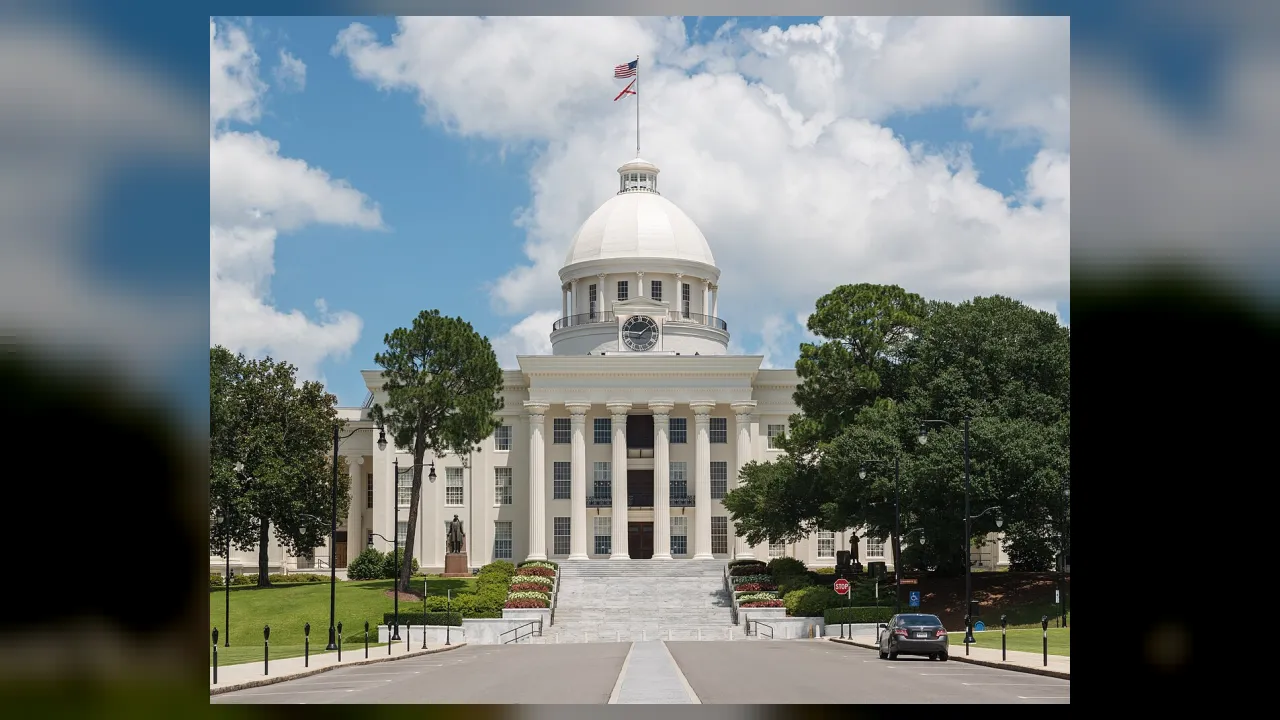
In Montgomery, the state , brave leaders stood up for fair rules for everyone. Alabama shines with science, music, and courage.
2. What amazing machines were built in Huntsville, Alabama?
🤯 Mind-Blowing Fact • Grade 2
George Washington Carver invented more than three hundred useful products from peanuts in his Alabama laboratory!
✨ Word Sparks (Grade 2 Glossary)
Tap 🔊 to hear
coast
Land right next to the ocean water
engineer
A person who designs and builds machines
soil
Rich top dirt where green plants grow
🪝
How did one southern state help grow better farms and launch astronauts into space?
1
From Mountains to the Coast
Feel the warm breeze blowing off Mobile Bay on the Gulf ! Alabama became the twenty-second state in 1819. Its land stretches from forested Appalachian foothills in the north down to white sandy beaches in the south.
2
Smart Ideas in Tuskegee and Huntsville
At Tuskegee, scientist George Washington Carver taught farmers how peanuts and sweet potatoes keep healthy. Years later, in Huntsville designed the mighty Saturn V rocket that carried astronauts to the Moon.
3
Standing Up for Fairness
In the capital city of Montgomery, Rosa Parks and other peaceful citizens worked together so all Americans would be treated fairly. Their courage changed history across the nation.
1. Which scientist in Tuskegee showed farmers how peanuts help keep soil healthy?
2. Which body of water touches Alabama's southern shore?
🤯 Mind-Blowing Fact • Grade 3
Alabama's rivers hold more species of freshwater snails, mussels, and turtles than any other state in America!
✨ Word Sparks (Grade 3 Glossary)
Tap 🔊 to hear
navigable
Deep and wide enough for boats
mineral
A natural solid material found in rock
agricultural
Connected to farming crops and raising animals
🪝
Why is Alabama famous for both ancient river biodiversity and space-age engineering?
1
A Land of Winding Waterways
Paddle a canoe down the Coosa or Tombigbee River and watch turtles sunbathe on mossy logs! Admitted on December 14, 1819, Alabama is the twenty-second U.S. state. More than a thousand miles of rivers wind from northern limestone valleys down to the Port of Mobile.
2
Iron, Steel, and Farms
Around Birmingham, workers discovered iron ore, coal, and limestone lying close together underground. Those three turned Birmingham into a major steel-making center. Farther south, rich dark soil across the Black Belt region supports thriving farms.
3
Rocket City and Tuskegee Pioneers
In northern Alabama, NASA's Marshall Space Flight Center in Huntsville developed the giant Saturn V rockets for the Apollo Moon landings. Meanwhile, Tuskegee University trained the heroic Tuskegee Airmen and hosted George Washington Carver's labs.
4
Landmarks of Equal Rights
Alabama's capital, Montgomery, and the nearby town of Selma became historic centers of the Civil Rights Movement during the 1950s and 1960s, inspiring laws that protected voting and equal citizenship.
1. What three natural resources near Birmingham helped make it a major steel center?
2. In what year did Alabama join the United States as the twenty-second state?
🤯 Mind-Blowing Fact • Grade 4
In Sylacauga, Alabama, quarries produce pure white marble used inside the Lincoln Memorial and the U.S. Supreme Court building in Washington, D.C.!
✨ Word Sparks (Grade 4 Glossary)
Tap 🔊 to hear
delta
Wetland formed where rivers meet the sea
legume
A pod plant that enriches farm soil
boycott
Peacefully refusing a service to protest unfairness
🪝
How do underground minerals, river deltas, and aerospace labs connect Alabama's past and future?
1
Five Distinct Geographic Regions
Stand atop Cheaha Mountain, rising 2,407 feet at the southern tip of the Appalachian chain, and gaze across lush ridges of longleaf pine. When Alabama entered the Union as the twenty-second state on December 14, 1819, settlers relied on its remarkable river network. Those waterways empty into the Mobile-Tensaw River , a vast wetland ecosystem teeming with wading birds, fish, and aquatic plants before meeting the Gulf Coast.
2
Geology That Built Industry and Soil
Ancient seas and mountain-building forces shaped Alabama's economy. Red Mountain near Birmingham held iron ore right beside coal seams and limestone beds, every raw ingredient needed to forge steel rails and bridges. South of the hills stretches a crescent of dark, fertile chalk-rich prairie soil originally named the Black Belt for the color of its topsoil.
3
Scientific Innovation at Tuskegee and Huntsville
After decades of single-crop cotton farming exhausted southern fields, Tuskegee Institute botanist George Washington Carver promoted crop rotation using nitrogen-fixing like peanuts and cowpeas. During World War II, Tuskegee also trained America's first African American military aviators. Soon after, Huntsville became home to NASA's Marshall Space Flight Center, where engineers tested the 363-foot Saturn V rocket and later designed parts of the International Space Station.
4
Civic Courage in Montgomery and Selma
In Montgomery and Selma, peaceful citizens challenged unfair segregation laws through the 1955 bus and the 1965 voting rights march, helping secure constitutional protections for all Americans.
1. Why did planting legumes like peanuts help restore exhausted southern farm fields?
2. What is the highest natural point in the State of Alabama?
🤯 Mind-Blowing Fact • Grade 5
Moundville Archaeological Park along Alabama's Black Warrior River preserves twenty-nine flat-topped earthen mounds from one of ancient North America's largest planned cities!
✨ Word Sparks (Grade 5 Glossary)
Tap 🔊 to hear
watershed
Land area draining into a shared river
biodiversity
Rich variety of living species in nature
propulsion
Force that pushes a vehicle forward
🪝
What links ancient Paleozoic reefs, nitrogen-fixing botany, and deep-space propulsion inside one southeastern state?
1
Watersheds and Biodiversity Hotspots
Mist rises at dawn over the Mobile-Tensaw River Delta, a sprawling labyrinth of cypress swamps, bayous, and marshes covering more than 260,000 acres above Mobile Bay. Because northern Alabama escaped coverage by Ice Age glaciers, its ancient river basins—including the Tennessee, Coosa, Tallapoosa, Alabama, and Tombigbee—preserved extraordinary evolutionary lineages. Biologists rank Alabama first among all U.S. states in freshwater fish, mussel, snail, and turtle diversity, earning it the title 'America's Amazon.'
2
Indigenous Heritage and Statehood in 1819
Long before European exploration, Mississippian Moundville peoples built monumental earthen plazas along the Black Warrior River around 1000 to 1450 CE, while Creek, Cherokee, Chickasaw, and Choctaw nations stewarded the woodlands. Following territorial growth after the War of 1812, Congress admitted Alabama as the twenty-second state on December 14, 1819, with Montgomery later becoming its permanent capital in 1846.
3
Mineral Geology and Agricultural Chemistry
In Jones Valley, Paleozoic sedimentary strata placed hematite iron ore, bituminous coal, and fluxing limestone side by side—a rare geological triad that fueled Birmingham's rapid rise as an industrial foundry hub after 1871. Farther south, Booker T. Washington founded Tuskegee Institute in 1881, recruiting researcher George Washington Carver, whose experiments in soil chemistry and crop diversification transformed southern agriculture.
4
Constitutional Turning Points
During the mid-twentieth century, Alabama communities stood at the forefront of American constitutional history. The 1955–1956 Montgomery Bus Boycott, sparked by Rosa Parks and organized by local civic leaders including Dr. Martin Luther King Jr., alongside the 1965 Selma-to-Montgomery marches across the Edmund Pettus Bridge, directly catalyzed the federal Voting Rights Act of 1965.
5
Propulsion Engineering in Huntsville
Meanwhile, Huntsville evolved from a quiet cotton-mill town into a premier aerospace center when NASA established the Marshall Space Flight Center in 1960. Engineers there developed the Saturn V launch vehicle, the Space Shuttle system, the Hubble Space Telescope's engineering support, and NASA's Space Launch System for modern lunar exploration.