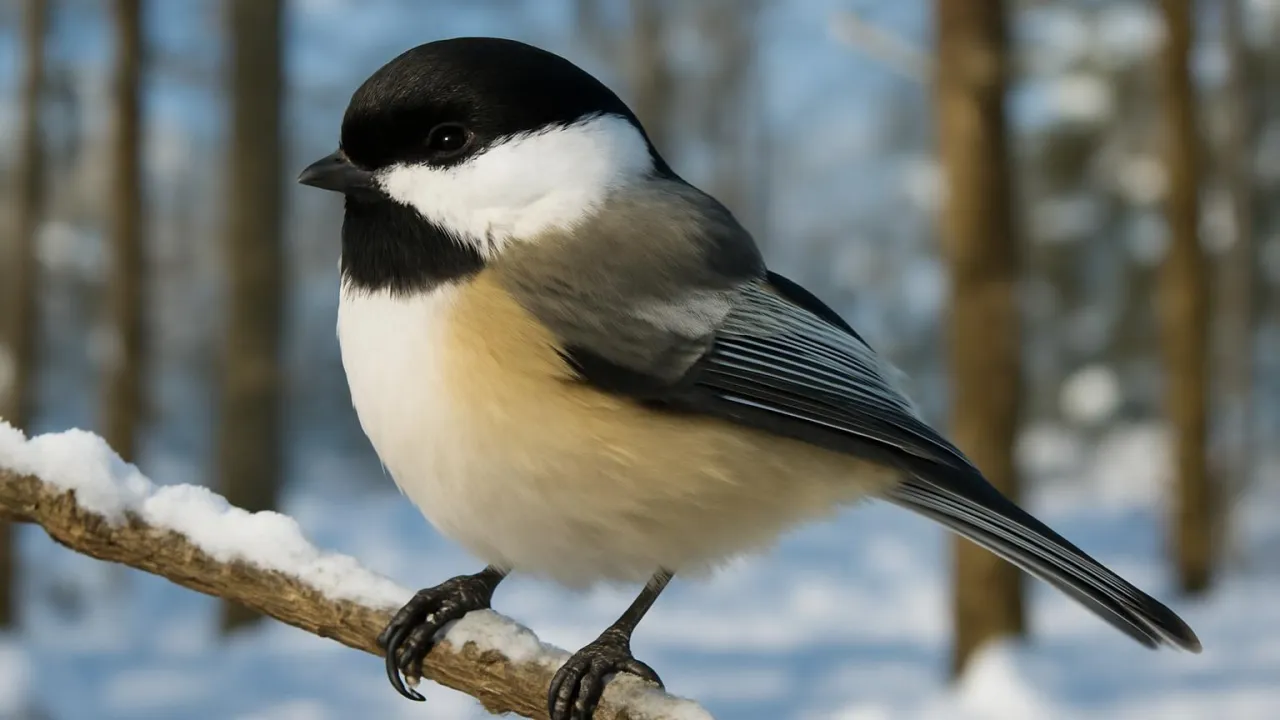
Chickadees can remember hundreds of places where they hide food for winter.
✨ Word Sparks (Grade 2 Glossary)
Tap 🔊 to hear
feathers
Soft parts that cover a bird’s body
habitat
The place where an animal lives
call
The sound a bird makes to talk
🪝
Can you hear the chickadee’s call saying, 'chick-a-dee-dee-dee' in the trees?
1
A Small Bird with a Black Cap
The black-capped chickadee has a black cap and white cheeks on its small head. It has soft gray covering its body and a tiny shape. It moves quickly from branch to branch in the forest. Its sounds like 'chick-a-dee-dee-dee' and is easy to hear.
2
Where Chickadees Live
Chickadees live in forests and sometimes near homes with trees and bushes. They build nests in holes in trees or birdhouses to stay safe. They stay in their homes all year, even when it is cold outside. Their thick help keep them warm during snowy winters.
3
What Chickadees Eat
Chickadees eat insects, seeds, and berries to get energy to move and fly. They hop and fly fast to find food in trees and bushes. In winter, they hide seeds in many places to eat later. Their sharp beaks help crack open seeds and catch bugs.
The number of 'dee' notes in a chickadee’s call signals how big the danger is.
✨ Word Sparks (Grade 3 Glossary)
Tap 🔊 to hear
camouflage
Colors that help animals hide in nature
predator
An animal that hunts other animals
nutrients
Food parts that help animals grow strong
🪝
Did you know the black-capped chickadee uses its call to warn friends about danger?
1
Unique Features of Chickadees
The black-capped chickadee has a distinctive black cap and white cheeks that help it blend into the forest. Its soft gray feathers provide against tree bark. This bird’s sharp eyes help spot quickly. Its small size allows it to move easily through branches.
2
Habitat and Survival
Chickadees live in North American forests and sometimes in suburban backyards. They build nests in tree holes or birdhouses to stay safe from . Their thick feathers keep them warm during cold winters. Chickadees also store food in many hiding spots to survive when insects are scarce.
3
Diet and Adaptations
These birds eat insects, seeds, and berries, gaining to stay active. Their sharp beaks are perfect for cracking open seeds and catching small bugs. Chickadees can remember hundreds of hiding places, which helps them find food in winter. Their quick movements help avoid .
4
Communication and Behavior
Chickadees use their famous 'chick-a-dee-dee-dee' call to warn others about nearby. The number of 'dee' notes changes with the level of danger. This communication helps the flock stay safe. Chickadees are social birds that often travel in small groups.
1. Why do chickadees add more 'dee' notes to their call?
2. How do chickadees survive cold winters?
🤯 Mind-Blowing Fact • Grade 4
Black-capped chickadees can remember hundreds of seed hiding spots across seasons.
✨ Word Sparks (Grade 4 Glossary)
Tap 🔊 to hear
ecosystem
A community of plants and animals living together
insulate
To keep warm by blocking cold air or heat
caching
Hiding food to eat later when food is scarce
🪝
How does the black-capped chickadee’s call warn friends about different dangers?
1
Physical Traits and Adaptations
The black-capped chickadee’s black cap and white cheeks provide excellent camouflage in forested areas, helping it avoid predators. Its small size and agile flight allow it to quickly navigate dense branches and escape threats. Thick feathers the bird against harsh winter temperatures, ensuring survival in cold climates.
2
Habitat and Geographic Range
This bird inhabits forests across much of North America, including Canada and the northern United States. It also adapts well to suburban backyards with trees and shrubs. Chickadees build nests in tree cavities or birdhouses, which protect them from predators and harsh weather. Their presence supports local by controlling insect populations.
3
Diet and Ecological Role
Chickadees consume a varied diet of insects, seeds, and berries, playing a key role in controlling insect pests. Their seed behavior helps disperse plant seeds, aiding forest regeneration. By serving as prey for larger birds and mammals, chickadees fit into the food web as both predator and prey, maintaining balance.
4
Communication and Social Behavior
The chickadee’s distinctive 'chick-a-dee-dee-dee' call changes based on the level of danger, with more 'dee' notes signaling greater threats. This sophisticated communication alerts flock members to predators like hawks or owls. Chickadees often travel in small groups during winter, increasing their chances of survival through shared vigilance and warmth.
1. What does more 'dee' notes in a chickadee’s call mean?
2. How do chickadees help forests grow?
🤯 Mind-Blowing Fact • Grade 5
The chickadee’s brain grows larger in winter to remember hundreds of hidden seed locations.
✨ Word Sparks (Grade 5 Glossary)
Tap 🔊 to hear
hippocampus
Brain part that helps remember places and things
plumage
The feathers covering a bird’s body
vocalization
Sounds birds make to communicate with others
🪝
Did you know the black-capped chickadee’s brain is specially adapted to remember hundreds of seed locations?
1
Scientific Classification and Habitat
The black-capped chickadee, scientifically named Poecile atricapillus, belongs to the Paridae family, which includes small songbirds. It is native to North America, primarily inhabiting boreal and mixed forests across Canada and the northern United States. This bird also thrives in suburban areas with abundant tree cover, showcasing its adaptability to human-altered landscapes.
2
Physiological Adaptations and Survival
Physiologically, the chickadee has dense that provides excellent insulation against subzero temperatures, allowing survival in harsh winters. Its , a brain region responsible for spatial memory, enlarges seasonally to help remember hundreds of seed cache locations. This remarkable memory supports its food caching behavior, crucial for winter survival when insects are scarce.
3
Ecological Role and Behavior
Ecologically, black-capped chickadees control insect populations by feeding on larvae and adult insects, benefiting forest health and agriculture. Their seed caching inadvertently aids in plant dispersal and forest regeneration. Socially, their complex , including the number of 'dee' notes, communicate predator threats, enhancing group survival through cooperative vigilance.
4
Conservation and Human Interaction
Currently, black-capped chickadees are not endangered and maintain stable populations due to their adaptability. However, habitat loss from deforestation and urbanization poses future risks. Conservation efforts focus on preserving forest habitats and promoting bird-friendly backyard environments with native plants and feeders. These birds also serve as indicators of ecosystem health in northern forests.
5
Quantitative Comparisons and Interesting Facts
Measuring about 5 inches (13 cm) in length and weighing around 0.3 ounces (9 grams), chickadees are small but agile. They can survive winter temperatures as low as -40 degrees Fahrenheit (-40 degrees Celsius). Their can increase in size by up to 30 percent during caching season. Their call’s 'dee' notes can range from one to seven, signaling different levels of predator threat.