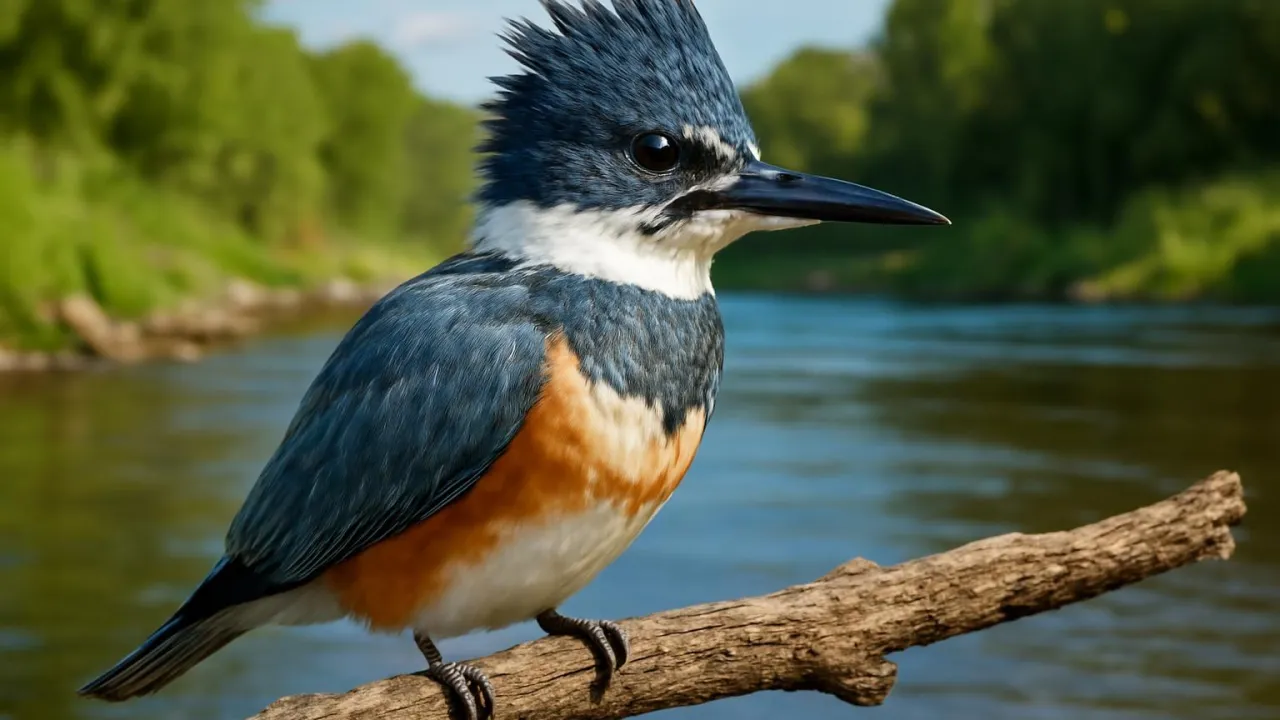
Belted Kingfishers can spot fish underwater from high above before diving in!
✨ Word Sparks (Grade 2 Glossary)
Tap 🔊 to hear
crest
Feathers that stick up on a bird's head
perch
A branch or place where birds sit
dive
To jump headfirst into water quickly
🪝
Have you ever seen a bird dive quickly to catch fish in a river?
1
Bright Blue and Gray Bird
The Belted Kingfisher has bright blue and gray feathers with a white belly. It has a big on its head that stands up. Its sharp beak helps it catch fish easily.
2
Lives Near Water
This bird lives near rivers, lakes, and streams where water is clean and clear. It likes to on branches or posts close to the water. It needs these spots to watch for fish swimming below.
3
Catches Fish by Diving
The kingfisher quickly into the water to catch fish with its beak. It can see fish swimming underwater before it dives. After catching fish, it flies back to its to eat.
Belted Kingfishers can see underwater clearly by adjusting their eyes before diving!
✨ Word Sparks (Grade 3 Glossary)
Tap 🔊 to hear
camouflage
Colors that help animals hide
predator
An animal that hunts other animals
ecosystem
A community of living things and places
🪝
Did you know the Belted Kingfisher uses its sharp beak and keen eyesight to catch fish?
1
Colorful Camouflage
The Belted Kingfisher has blue-gray feathers that help it blend with water and sky. Its white belly reduces shadows when seen from below. This protects it from while hunting.
2
Habitat and Nesting
This bird lives near freshwater rivers and lakes across North America. It digs tunnels in riverbanks to build nests safely away from . These burrows protect its eggs and young chicks.
3
Fishing Adaptations
The kingfisher’s sharp, pointed beak is perfect for catching slippery fish. Its strong wings allow quick dives and fast flight. Its eyes can adjust to see clearly underwater during hunting.
4
Role in the Ecosystem
As a , the kingfisher controls fish populations and keeps balanced. It also helps spread nutrients by feeding near water. This bird’s presence indicates healthy aquatic habitats.
1. Why does the kingfisher have blue-gray feathers?
2. Where does the kingfisher build its nest?
🤯 Mind-Blowing Fact • Grade 4
The kingfisher’s eye can adjust to see clearly both in air and underwater during fast dives.
✨ Word Sparks (Grade 4 Glossary)
Tap 🔊 to hear
adaptation
A body change that helps survival
food web
How animals eat and depend on each other
conservation
Protecting nature and animals' homes
🪝
How does the Belted Kingfisher’s unique hunting style affect river ecosystems?
1
Adaptations for Hunting
The Belted Kingfisher’s sharp beak and strong wings allow it to dive swiftly into water, catching fish with precision. Its eyes have special to reduce glare and see underwater clearly, which helps it spot prey from above. These adaptations evolved to improve its fishing success and survival in diverse habitats.
2
Ecosystem Role and Food Web
As a predator, the kingfisher controls fish populations, preventing overpopulation and maintaining balance in aquatic ecosystems. It also serves as prey for larger birds and mammals, linking multiple levels of the . This bird’s presence indicates a healthy, functioning ecosystem that supports many species.
3
Nesting Behavior and Geography
Belted Kingfishers nest by digging burrows in soft riverbanks, which protects their young from predators and floods. They are found throughout North America, from Alaska to Mexico, favoring clean freshwater habitats. Human activities like pollution and development can threaten their nesting sites and food availability.
4
Human Impact and Conservation
Pollution and habitat destruction reduce water quality and fish availability, threatening kingfisher populations. efforts focus on protecting waterways and riverbanks to preserve nesting sites and food sources. Educating people about clean water and habitat protection helps maintain healthy kingfisher habitats for future generations.
1. Why is the kingfisher important to river ecosystems?
2. How do humans help kingfishers survive?
🤯 Mind-Blowing Fact • Grade 5
Belted Kingfishers can dive at speeds near 25 miles per hour using binocular vision to catch fish precisely underwater.
✨ Word Sparks (Grade 5 Glossary)
Tap 🔊 to hear
nictitating membrane
A clear eyelid that protects eyes underwater
sexual dimorphism
Males and females look different
riparian zone
The land next to rivers and streams
🪝
What complex physical and ecological traits make the Belted Kingfisher a master fisher across North America?
1
Taxonomy and Physical Traits
The Belted Kingfisher, scientifically named Megaceryle alcyon, belongs to the family Alcedinidae, known for their fishing skills. Measuring about 13 inches long with a wingspan near 25 inches, it displays where females have a rusty band across the chest. Its dense plumage provides insulation during cold weather, and its large crest is a distinctive feature used in communication.
2
Physiological Mechanics of Hunting
This bird’s eyes possess a unique that protects them underwater while maintaining visibility. Its binocular vision allows precise depth perception to judge fish distance accurately before diving. Powerful wing muscles enable rapid acceleration and hovering before plunge-diving, reaching speeds up to 25 miles per hour during the dive.
3
Nesting, Range, and Conservation
Belted Kingfishers excavate horizontal burrows up to 8 feet deep in soft earth riverbanks, providing safe nesting sites. Their range spans most of North America, from Alaska and Canada down to Mexico, favoring clean freshwater habitats. Conservation concerns include water pollution and habitat loss, prompting efforts to maintain and water quality.
4
Ecological Role and Human Interaction
As a mid-level predator, the kingfisher regulates fish populations, contributing to aquatic ecosystem stability. It also serves as prey for raptors, linking trophic levels within food webs. Human activities such as dam construction and water contamination can disrupt its habitat, but environmental protections and education help sustain populations.
5
Quantitative Comparisons and Unique Features
The kingfisher’s dive speed can reach approximately 25 miles per hour, allowing it to catch fish up to 6 inches long. Its body weight averages around 4.5 ounces, optimized for agile flight and rapid maneuvers. Temperature tolerance ranges from freezing northern winters to warm southern summers, showcasing remarkable adaptability across diverse climates.