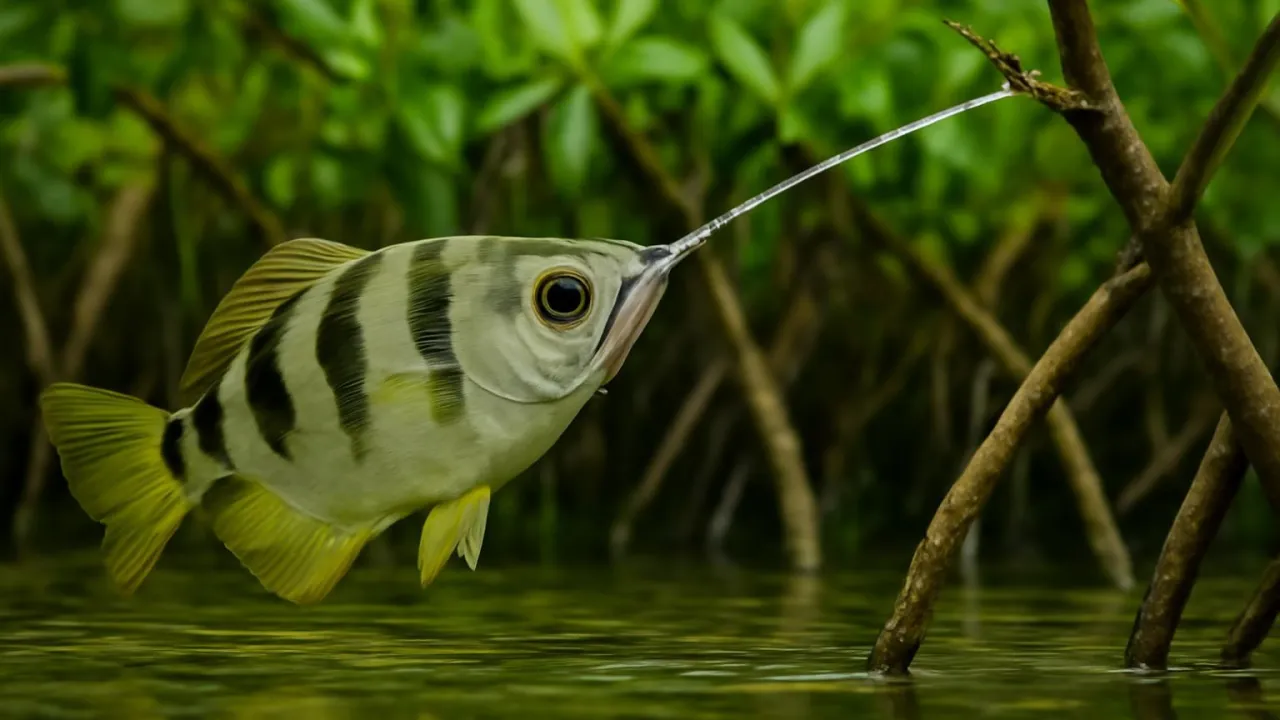
Banded archerfish can hit moving bugs almost every time they try!
✨ Word Sparks (Grade 2 Glossary)
Tap 🔊 to hear
jet
A fast stream of water
brackish
A mix of fresh and salty water
mangrove
A tree that grows in wet places
🪝
Did you know some fish can hunt in the air?
1
Water Shooter
The banded archerfish spits strong of water to knock bugs off branches. It aims with its mouth and shoots at insects above the water. When the bug falls, the fish quickly eats it. This is a very smart way to catch food!
2
Home in the Mangroves
Banded archerfish live in warm, waters near trees. These trees grow where rivers meet the sea. The fish hide among roots and leaves to stay safe. They like places with lots of bugs to hunt.
3
A Striped Swimmer
This fish is silver with bold black stripes on its sides. Its eyes look upward to spot insects. Its mouth points up, perfect for shooting water. The banded archerfish grows to about one foot long.
Banded archerfish can shoot water jets up to six feet to hit their prey!
✨ Word Sparks (Grade 3 Glossary)
Tap 🔊 to hear
camouflage
Colors that help hide from danger
predator
An animal that hunts other animals
adaptation
A special body part or skill for survival
🪝
How does a fish shoot down insects with amazing aim?
1
Nature’s Water Archer
The banded archerfish uses its mouth like a water gun to hunt insects. It carefully aims and spits a powerful jet of water, knocking bugs off leaves or branches. This hunting trick is called 'shooting.' The fish must judge distance and angle to hit its target.
2
Mangrove Maze
Banded archerfish live in brackish waters where rivers meet the sea. They love mangrove forests, which have tangled roots and lots of hiding places. These areas are full of insects for the fish to hunt. The roots also protect young fish from .
3
A Body Built for Aiming
The archerfish’s mouth tilts upward, helping it shoot water at prey above. Its eyes are placed high on its head for better aiming. Black bands run across its shiny silver body, giving it among the shadows. It can grow up to twelve inches long.
4
A Clever Hunter
Archerfish can learn to adjust their aim if a bug moves. They use their tongue and mouth roof to form a tube for shooting. This lets them catch food other fish can’t reach. Sometimes, they even jump out of the water to grab prey directly!
1. What helps archerfish aim at insects above water?
2. Where do banded archerfish find most of their food?
🤯 Mind-Blowing Fact • Grade 4
Archerfish can learn to recognize different shapes and even remember human faces!
✨ Word Sparks (Grade 4 Glossary)
Tap 🔊 to hear
ecosystem
A community of living things and their home
brackish
Water that is part salty, part fresh
groove
A long, narrow space or channel
🪝
Imagine if you could knock snacks from a tree using only water!
1
The Archerfish’s Water Weapon
The banded archerfish is famous for its ability to shoot jets of water at insects perched on branches above the water. This incredible skill requires the fish to calculate the exact distance and angle to hit its target, which can be over six feet away. By forming a special with its tongue and mouth roof, the archerfish creates a tight tube to shoot water with surprising force. This adaptation allows it to catch prey that other fish cannot reach, giving it a unique advantage in its habitat.
2
Mangrove Forests: A Perfect Home
Banded archerfish are most commonly found in mangrove swamps and river mouths throughout Southeast Asia and northern Australia. Mangrove roots create a maze of hiding spots for both young and adult fish, protecting them from predators like larger fish and birds. The mix of salty and fresh water in these areas supports a rich variety of insects and small animals. The archerfish’s hunting method helps control insect populations, making it an important part of the mangrove .
3
Stripes and Survival
The banded archerfish’s silver body is marked with four or five bold black bands, which help it blend into the dappled light of mangrove waters. Its eyes are positioned high on its head, giving it a wide field of vision for spotting prey above. Its upward-tilted mouth is perfectly designed for shooting water jets. This combination of features is a great example of how physical adaptations help a species survive in its environment.
4
Ecosystem Connections
By preying on insects and small animals above the water, archerfish help balance the food web in mangrove . Their unique hunting style means they don’t compete directly with most other fish for food. However, habitat destruction and pollution threaten mangrove forests, which could harm archerfish populations. Protecting mangroves helps not just archerfish, but many other animals that rely on these special wetlands.
1. Why are mangrove roots important for archerfish?
2. How does the archerfish help its ecosystem?
🤯 Mind-Blowing Fact • Grade 5
Archerfish can compensate for light refraction and hit targets with nearly perfect accuracy from two meters away!
✨ Word Sparks (Grade 5 Glossary)
Tap 🔊 to hear
refraction
When light bends as it passes through water or air
binocular vision
Using both eyes together to judge distance
arthropod
An animal with jointed legs, like insects or spiders
🪝
What if you could hit a target with a single squirt of water from your mouth?
1
A Master of Aerial Hunting
The banded archerfish, Toxotes jaculatrix, is renowned for its remarkable ability to shoot precise jets of water at terrestrial insects and spiders perched above the water’s surface. This behavior is not only rare among fish but also involves advanced spatial calculations, as the archerfish must account for the bending of light at the air-water boundary—a phenomenon called . By rapidly closing its gill covers and pressing its tongue against a groove in the roof of its mouth, the fish creates a narrow tube that propels water with enough force to dislodge prey up to two meters (about six feet) away. This unique hunting strategy allows the archerfish to access food sources that are unavailable to most aquatic predators.
2
Physiology and Precision
The archerfish’s upward-facing mouth and large, high-set eyes are crucial adaptations for its specialized hunting method. Its eyes are capable of , allowing precise depth perception and aim when targeting prey above the water. The fish’s muscular tongue and mouth groove form a pressurized channel for water jets, and its brain can even learn to adjust for moving targets or changes in distance. Studies have shown that archerfish can hit targets with nearly 100% accuracy after only a few attempts, demonstrating both innate skill and learned behavior.
3
Mangrove Marvels and Geographic Range
Banded archerfish inhabit brackish and coastal waters throughout Southeast Asia, the Philippines, Indonesia, Papua New Guinea, and northern Australia. They thrive in mangrove swamps, tidal creeks, and river mouths, where the mix of salt and fresh water supports diverse insect life. Juvenile archerfish often remain in sheltered mangrove roots to avoid predators, while adults may venture into open water. The presence of archerfish is an indicator of healthy mangrove ecosystems, as these habitats are sensitive to pollution and deforestation.
4
Ecological Role and Human Impact
Archerfish play a vital role in mangrove food webs by controlling populations of insects and small , which in turn affects plant health and nutrient cycles. Their unique feeding habits reduce competition with other fish species and help maintain ecological balance. However, threats such as mangrove destruction for coastal development, water pollution, and climate change are putting pressure on archerfish populations. Conservation efforts to protect mangrove forests are essential for preserving not only archerfish but also the countless other species that depend on these wetlands.
5
Scientific Discovery and Curiosity
The banded archerfish has fascinated scientists for decades, inspiring research into animal learning, vision, and biomechanics. In laboratory experiments, archerfish have been trained to recognize geometric shapes and even individual human faces, demonstrating impressive cognitive abilities. Their water jets can reach speeds of up to 5 meters per second (over 11 mph), and the force is carefully adjusted depending on the distance to the prey. The study of archerfish continues to reveal surprising insights into the evolution of animal intelligence and adaptation.