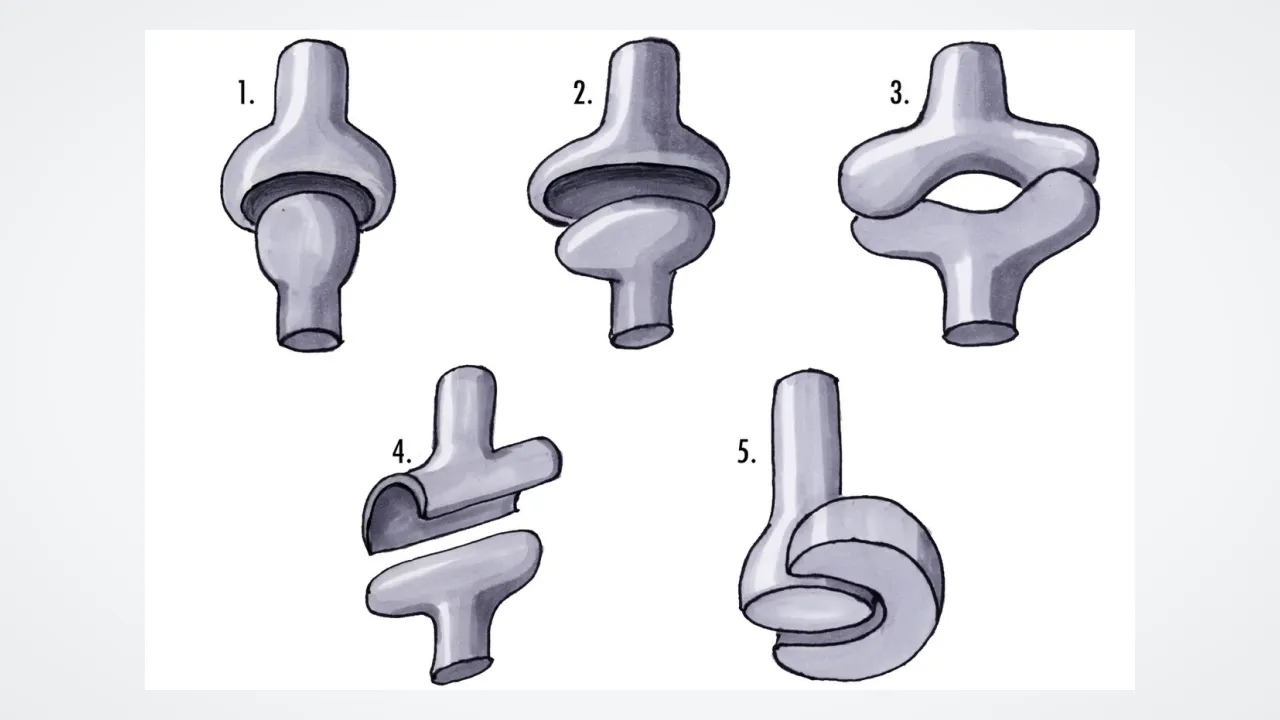
1. Where are the four big ball-and-socket joints in your body?
2. What shapes fit together inside a ball-and-socket joint?
🤯 Mind-Blowing Fact • Grade 2
Even inside your middle ear, two tiny rice-sized hearing bones meet at a miniature ball-and-socket joint!
✨ Word Sparks (Grade 2 Glossary)
Tap 🔊 to hear
Shallow
Not very deep from top to bottom
Thighbone
Long strong bone inside your upper leg
Range of Motion
How far a joint can safely move
🪝
Why can your shoulder spin in bigger circles than your hip, even though both are ball-and-socket joints?
1
Built Like a Joystick
Wiggle a video game joystick forward, backward, sideways, and all the way around. Your shoulders and hips work the exact same way! Inside each one, the smooth, rounded head of your arm or thigh bone nestles into a curved cup of bone.
2
Shallow Cup for Reach
Your shoulder socket is , almost like a golf ball resting on a wide tee. That shallow dish lets pitchers throw fastballs and swimmers windmill their arms overhead with ease.
3
Deep Cup for Strength
Your hip socket is much deeper, hugging the tightly so it can carry your whole body weight whenever you run and jump!
1. Why is your hip socket shaped much deeper than your shoulder socket?
2. What everyday object moves most like a ball-and-socket joint?
🤯 Mind-Blowing Fact • Grade 3
The Latin name for your deep hip socket is 'acetabulum,' which means 'little vinegar cup' because ancient Romans thought it looked just like a dipping bowl on their dinner tables!
✨ Word Sparks (Grade 3 Glossary)
Tap 🔊 to hear
Synovial Fluid
Slippery liquid lubricating the inside of joints
Labrum
Rubbery cartilage rim deepening a joint socket
Humerus
Long bone of your upper arm
🪝
What keeps the smooth bone ball inside your shoulder and hip from popping out or squeaking?
1
Champions of Movement
Try bending your elbow sideways—it won't budge! Now try swinging your whole arm from the shoulder: forward, backward, out to the side, and even twisting like a screwdriver. Ball-and-socket joints are the only major joints able to move along all three directions of space.
2
Cartilage, Fluid, and Suction Rims
Inside both your shoulder and hip, glassy cartilage coats the ball and socket, bathed in slick enclosed inside a watertight joint capsule. Around the outer edge of each bone cup sits a rubbery cartilage ring called a that deepens the socket like a gentle suction seal.
3
Shoulder Mobility Versus Hip Stability
At the shoulder, the round top of your (upper arm bone) is nearly three times wider than the shallow glenoid socket of your shoulder blade. Four rotator cuff muscles hug it snugly in place. At the hip, the deep pelvic cup wraps more than halfway around your femur head.
4
Twisting on Its Own Axis
Besides swinging up, down, and sideways, ball-and-socket joints let your limbs rotate inward and outward so you can turn keys or pivot on soccer turf!
1. What is the job of the rubbery ring called the labrum around your shoulder and hip sockets?
2. Why did ancient Roman doctors name the hip socket 'acetabulum'?
🤯 Mind-Blowing Fact • Grade 4
Inside the very center of your hip's ball-and-socket joint hides a secret safety tether called the ligament of the head of the femur, carrying a tiny artery directly into the bone ball!
✨ Word Sparks (Grade 4 Glossary)
Tap 🔊 to hear
Triaxial
Able to move freely along three axes
Circumduction
Swinging a limb in a smooth cone-shaped circle
Rotator Cuff
Four shoulder muscles hugging the arm bone centered
🪝
How do engineers of the human skeleton solve the classic trade-off between extreme flexibility and weight-bearing strength?
1
Triaxial Freedom in Three Planes
Reach high overhead to grab a rebound, then pivot on one foot to pass the basketball downcourt. Both motions showcase synovial joints—better known as ball-and-socket joints. Unlike hinge joints restricted to a single plane, a spherical bone head nested inside a concave socket permits flexion-extension (forward and back), abduction-adduction (away from and toward your midline), internal-external rotation, and full-circle .
2
The Glenohumeral Joint: Built for Reach
Your shoulder's glenohumeral joint prioritizes maximum reach so your hands can manipulate tools anywhere in front of or above your head. Because the scapula's shallow glenoid fossa covers barely one-third of the humeral head's surface, passive ligaments alone cannot hold it steady. Instead, four dynamic muscles—the —continuously fire tiny adjustments to keep the ball centered on the socket.
3
The Coxofemoral Hip Joint: Built for Load
Down in the pelvis, three fused pelvic bones form the deep hemispherical acetabulum, enclosing the spherical head of the femur. Reinforced by a vacuum-like fibrocartilage labrum, a tether inside the joint called the ligamentum teres, and the body's thickest external ligaments, your hips effortlessly absorb forces several times your body weight with every jog.
4
Inspiring Robotics and Prosthetics
Biomedical engineers copy human ball-and-socket geometry out of titanium and ultra-smooth ceramics to build camera gimbals, robotic arms, and artificial hip replacements!
1. Because the shoulder's glenoid socket is very shallow, what keeps the upper arm bone centered during big throws?
2. How many axes (planes of space) can a true ball-and-socket joint move around?
🤯 Mind-Blowing Fact • Grade 5
In the 1960s, British surgeon Sir John Charnley invented the modern artificial hip replacement using a polished metal ball and ultra-slick polymer socket—an operation that now helps over a million people walk comfortably every year!
✨ Word Sparks (Grade 5 Glossary)
Tap 🔊 to hear
Degrees of Freedom
Independent directions in which a joint rotates
Acetabulum
Deep cup-shaped hip socket inside the pelvis
Arthroplasty
Medical surgery rebuilding or replacing a worn joint
🪝
Why did upright human evolution reshape our hip and shoulder ball-and-socket joints into opposite extremes of biomechanics?
1
Kinematics of Spheroidal Articulations
In orthopedic biomechanics, an articulatio spheroidea—or ball-and-socket joint—represents the pinnacle of synovial mobility. Possessing three rotational , spheroidal joints combine sagittal flexion-extension, coronal abduction-adduction, and transverse axial rotation; blended sequentially, these axes trace a spacious conical envelope known as circumduction.
2
Divergent Evolutionary Blueprints: Shoulder vs. Hip
When early hominins transitioned to habitual bipedalism, natural selection drove our two pairs of macromolecular ball-and-socket joints toward opposite engineering priorities. Freed from locomotion weight-bearing, the glenohumeral shoulder evolved a laterally oriented, pear-shaped glenoid cavity with minimal bony constraint—allowing overhead throwing velocities above ninety miles per hour while relying on the supraspinatus, infraspinatus, teres minor, and subscapularis (the rotator cuff) for dynamic concavity-compression.
3
Atmospheric Cohesion and Acetabular Load Sharing
Conversely, the coxofemoral hip joint bears three to five times body weight during running gait. Formed by the fusion of the ilium, ischium, and pubis, the lunate cartilage surface of the plus its circumferential fibrocartilaginous labrum creates a negative intra-articular fluid seal, resisting distraction forces while distributing compressive stress evenly across hyaline cartilage.
4
A Miniature Surprise Inside the Ear
Beyond the four giant appendicular limb joints, human anatomy hides an astonishing microscopic ball-and-socket articulation deep inside each middle ear cavity: the incudostapedial joint. Linking the lenticular process of the anvil-shaped incus to the concave head of the stirrup-shaped stapes—the tiniest bone in the human body—this sub-millimeter synovial joint comes complete with hyaline cartilage caps, a delicate elastic capsule, and lubricating fluid. Its triaxial micro-gliding cushions sudden acoustic pressure spikes from booming thunderclaps while transmitting whisper-quiet eardrum vibrations cleanly to the inner ear's cochlea.
5
Sir John Charnley and Modern Arthroplasty
Because weight-bearing hip cartilage endures tens of millions of loading cycles across a human lifespan, wear or injury once meant permanent mobility loss. In the early 1960s at Wrightington Hospital in England, orthopedic pioneer Sir John Charnley revolutionized biomedical engineering by inventing low-friction total hip . Pairing a small, mirror-polished stainless-steel femoral head with an ultra-high-molecular-weight polyethylene acetabular socket fixed with bone cement, Charnley's triaxial design restored pain-free strides to millions and launched modern joint replacement science.