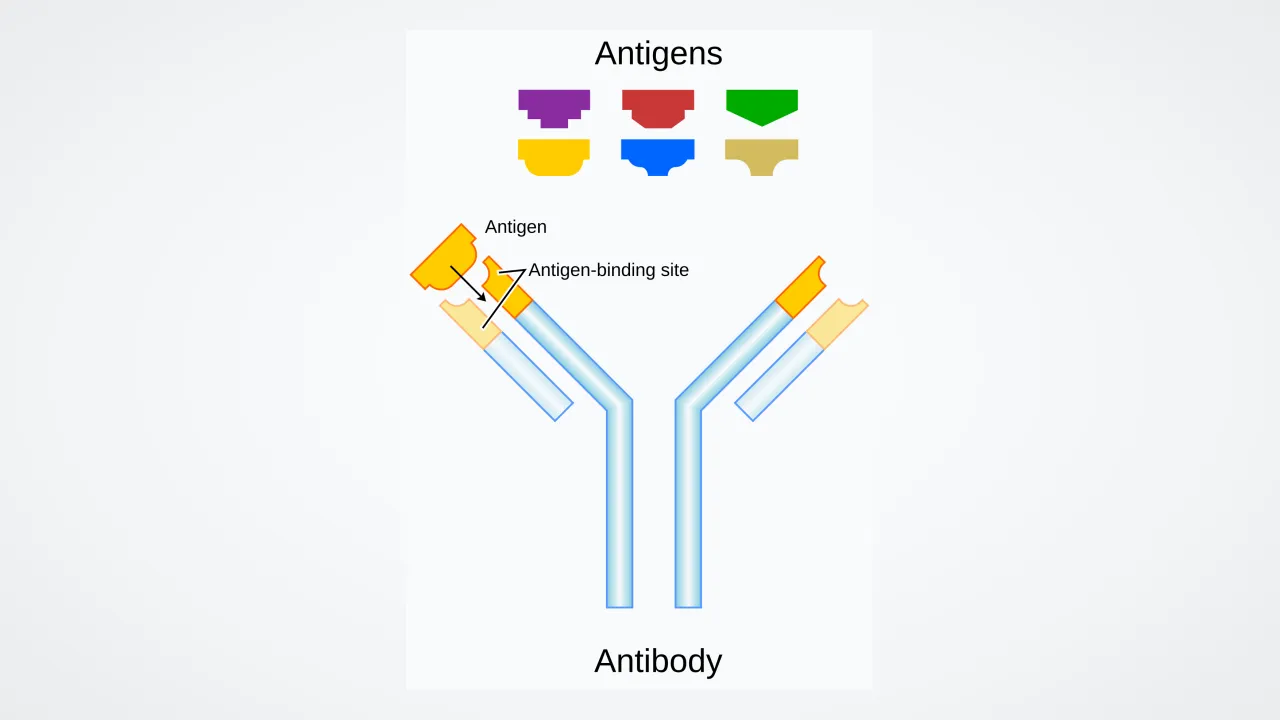
1. Which letter of the alphabet does an antibody look like?
2. Where inside your body do B-cells grow up?
🤯 Mind-Blowing Fact • Grade 2
Antibodies even guard your tears, spit, and nose mucus to stop germs before they get deep inside you!
✨ Word Sparks (Grade 2 Glossary)
Tap 🔊 to hear
Protein
Tiny building block doing jobs in cells
Saliva
Watery liquid inside your mouth protecting teeth
Spleen
Fist-sized organ filtering blood and storing defenders
🪝
How does one tiny cell build thousands of custom germ-catchers every second?
1
Meet Your Master Builders
Picture millions of tiny workshops waiting inside your and lymph nodes. Each B-cell wears sample sensors on its outside coat, watching for one specific germ floating in your body fluids.
2
Locking Onto Invaders
Once a B-cell bumps into its matching germ, it copies itself into a busy factory team. Those cells pump clouds of Y-shaped called antibodies into your blood and .
3
Blocking and Flagging
Antibodies coat every side of the germ so it cannot slip inside your healthy cells. They also wave like bright flags so hungry cleanup cells can gobble the germs right up!
1. What happens when antibodies cover the outside of a virus?
2. How do antibodies help cleanup cells in your immune system?
🤯 Mind-Blowing Fact • Grade 3
Scientists first named B-cells after a special bird organ called the bursa of Fabricius, though in humans they mature inside bone marrow!
✨ Word Sparks (Grade 3 Glossary)
Tap 🔊 to hear
Antigen
Surface marker that triggers an immune response
Plasma Cell
Activated B-cell pumping out thousands of antibodies
Neutralize
Make a germ or toxin completely harmless
🪝
Why does a chickenpox vaccine protect you for years even though the shot only takes a second?
1
Millions of Custom Locks
Before you ever catch a sniffle, your bone marrow prepares millions of slightly different B-cells. Each one carries surface receptors shaped to fit one distinct —a tiny marker on bacteria, viruses, or pollen grains. Most B-cells wait quietly in lymph nodes until their exact match drifts by.
2
Turning Into Plasma Factories
When a B-cell meets its matching and gets a go-ahead signal from a helper T-cell, an amazing transformation begins! Many of its copies swell into —microscopic protein factories that launch up to two thousand Y-shaped antibodies every second.
3
Three Smart Ways Antibodies Help
Free-floating antibodies patrol blood and mucus like guided boomerangs. Their twin tips toxins, clump stray bacteria into easy-to-catch bundles, and tag microbes so macrophages can swallow them swiftly.
4
Memory B-Cells Never Forget
Other copies become long-lived memory B-cells. That is how vaccines work: they introduce a harmless practice so memory B-cells can flood your body with antibodies the instant a real germ appears!
1. What do activated B-cells turn into when they start mass-producing antibodies?
2. How does a vaccine prepare your B-cells before you ever meet a real germ?
🤯 Mind-Blowing Fact • Grade 4
Newborn babies borrow a starter kit of IgG antibodies from their mothers before birth to protect them while their own B-cells learn the ropes!
✨ Word Sparks (Grade 4 Glossary)
Tap 🔊 to hear
Immunoglobulin
Scientific name for an antibody defense protein
Variable Region
Custom antibody tip shaped for one antigen
Agglutination
Clumping microbes together using two-armed antibodies
🪝
How does a tiny Y-shaped molecule grab slippery bacteria with two arms while signaling cleanup crews with its stem?
1
Anatomy of an Immunoglobulin
Zoom in millions of times on an antibody—known scientifically as an —and you will see four linked protein chains arranged like the letter Y. The two upper tips form sculpted to grip one exact molecular shape, while the sturdy lower stem forms a constant region that plugs into immune cell docks.
2
Clonal Selection and Teamwork
Humoral immunity—protection inside body fluids—begins when one B-cell out of millions snags a matching pathogen marker on its surface receptor. After displaying clues to a helper T-cell, that single chosen B-cell divides rapidly inside a lymph node, producing both rapid-fire plasma cells and long-lasting memory B-cells.
3
Five Specialized Antibody Classes
Not every neighborhood in your body needs the same tool, so B-cells craft five classes of : IgM, IgG, IgA, IgE, and IgD. Star-shaped IgM responds first in blood, IgG provides long-term protection and even crosses the placenta to shield newborns, and IgA guards airways, tears, and digestive linings.
4
Neutralization, Clumping, and Opsonization
Because each Y-shaped molecule has two grabbing hands, antibodies easily cross-link floating microbes into tangled clumps—a process called . Meanwhile, their sturdy lower stems stick outward like easy-to-grip handles, letting hungry macrophages latch on and clear the entire bundle swiftly.
1. Why is having two grabbing tips on each Y-shaped antibody so useful?
2. Which class of antibody guards moist surfaces like saliva, tears, and nasal passages?
🤯 Mind-Blowing Fact • Grade 5
Nobel laureate Susumu Tonegawa proved that B-cells literally cut and remix their own DNA segments so twenty thousand human genes can build billions of distinct antibodies!
✨ Word Sparks (Grade 5 Glossary)
Tap 🔊 to hear
V(D)J Recombination
Gene-shuffling process creating diverse antibody tips
Affinity Maturation
Fine-tuning antibodies to grip germs much tighter
Opsonization
Coating microbes with antibodies for easy swallowing
🪝
With fewer than twenty-five thousand human genes, how can your B-cells manufacture billions of distinct antibodies for microbes yet to evolve?
1
Solving the Genetic Puzzle of Diversity
For decades, biologists puzzled over how humans could synthesize billions of unique antibodies when our entire genome holds only about twenty thousand protein-coding genes. In 1976, Susumu Tonegawa discovered the answer: developing B-cells in bone marrow physically cut, shuffle, and splice Variable, Diversity, and Joining gene segments—a combinatorial lottery called that builds a vast library of B-cell receptors.
2
Somatic Hypermutation and Affinity Maturation
When a naive B-cell encounters its cognate antigen and receives helper T-cell signals inside a lymph node follicle, it enters a germinal center. There, an enzyme deliberately introduces tiny point variations into the antibody's variable-region genes. Clones whose altered tips bind the pathogen ten or a hundred times tighter win survival signals, sharpening antibody accuracy in real time.
3
Molecular Architecture and Class Switching
Every immunoglobulin monomer pairs two identical heavy chains with two identical light chains linked by disulfide bridges. Through class-switch recombination, a B-cell keeps its hard-won antigen-binding Fab tips unchanged while swapping its lower Fc stem—shifting from pentameric IgM early in an infection to versatile IgG in plasma or dimeric IgA across mucosal epithelia.
4
Humoral Effector Mechanisms
Plasma cells expand their rough endoplasmic reticulum until each cell secretes roughly two thousand antibody molecules per second. In extracellular fluids, Fab arms sterically block viral entry proteins, while exposed Fc stems trigger by phagocytes and activate serum complement proteins that dismantle bacterial envelopes.
5
From Serum Therapy to Monoclonal Medicine
In 1890, Emil von Behring and Shibasaburo Kitasato demonstrated that cell-free blood serum carried protective antitoxins, earning Behring the first Nobel Prize in Physiology or Medicine. In 1965, Max Cooper and Robert Good pinpointed B-cells as a distinct lymphocyte lineage, laying the foundation for modern monoclonal antibodies used worldwide in diagnostics and targeted medicine.