🌌 COSMOS
🔭 Main Circumstellar Torus • Inner Solar System
VA Science SOL 1.6, 4.5, 4.6 (Solar System, Stars & Space Exploration)
Asteroid Belt
The Rocky Ring Between Mars and Jupiter
Grade 3 • Fluent • 152 words
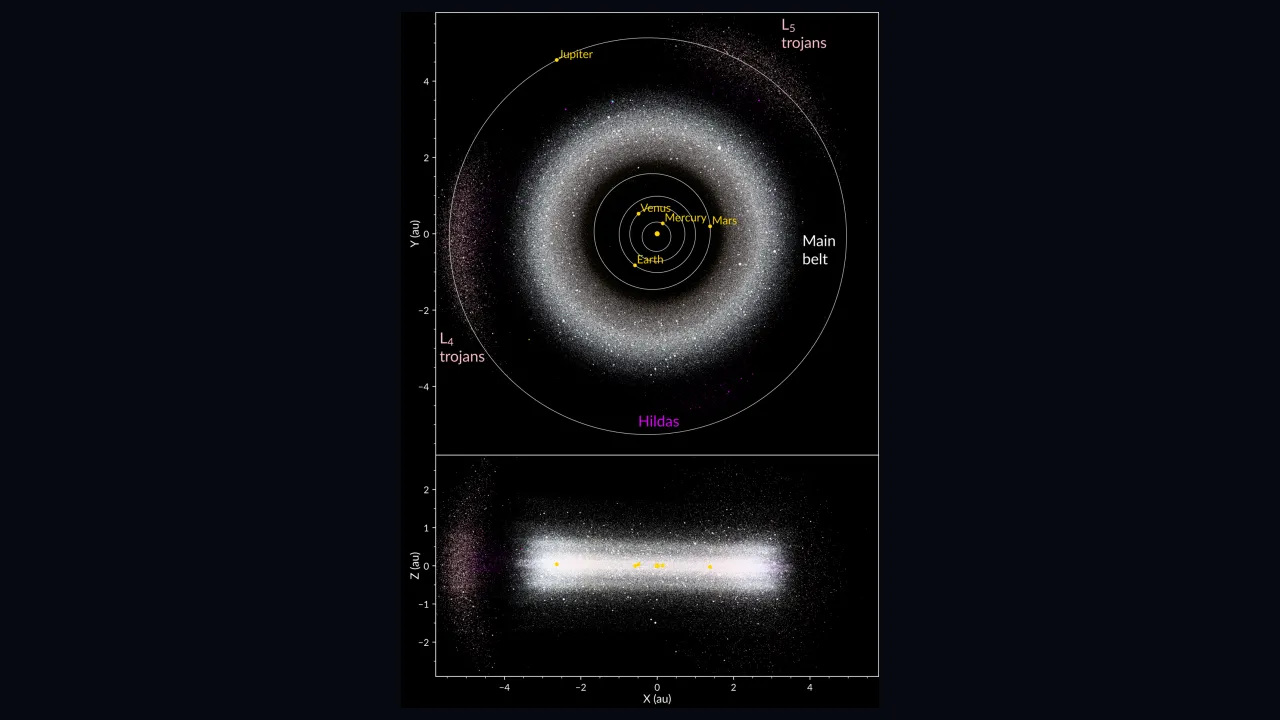
🌌 Cosmic Location & DistanceBetween the orbits of Mars and Jupiter • 2.1 to 3.3 AU from the Sun
🪐 Scale / Diameter~110 million miles (180 million km) wide band • ~3% of the Moon's mass
☄️ Composition & OrbitCarbon-rich, silicate stony, and iron-nickel asteroids • 3 to 6-year orbits
⚡ Cosmic SparkPreserves ancient rocky building blocks left over from the birth of the planets
🤯 Mind-Blowing Fact • Grade 1
If you squished every single rock in the Asteroid Belt together into one ball, it would still be much smaller than Earth's Moon!
✨ Word Sparks (Grade 1 Glossary)
Tap 🔊 to hear
asteroid
A rocky object that orbits around the Sun
crater
A bowl-shaped dent made by a space crash
gravity
An invisible pull between objects in the universe
🪝
Can a spaceship fly through millions of space rocks without crashing?
1
A Giant Ring of Rocks
Blast off past rusty red Mars! Ahead lies a giant ring of tumbling space rocks called the Belt. Millions of rocky chunks circle the Sun right before huge Jupiter.
2
Big Shapes and Small Pebbles
Most look lumpy like giant baked potatoes! Some are tiny pebbles, while the biggest one, Ceres, is round like a mini planet.
3
Lots of Empty Room
Movies show spaceships dodging tight crowds of rocks. In real life, float super far apart with tons of safe, open space!
1. Between which two planets does the Asteroid Belt circle the Sun?
2. Is the Asteroid Belt packed tightly together like a wall of rocks?
🤯 Mind-Blowing Fact • Grade 2
Asteroids in the belt float an average of 600,000 miles apart—more than twice the distance from Earth to the Moon!
✨ Word Sparks (Grade 2 Glossary)
Tap 🔊 to hear
dwarf planet
A round world smaller than the eight planets
metal
Shiny, hard material like iron or nickel
leftover
Extra pieces remaining after something is built
🪝
Why didn't the millions of rocks in the Asteroid Belt build a brand-new planet?
1
Leftover Building Blocks
Picture a cosmic construction site from 4.6 billion years ago! When our Sun was young, dust and rocks clumped together to build Earth and Mars. Between Mars and Jupiter, however, millions of rocks kept circling as the Asteroid Belt.
2
Jupiter's Mighty Pull
Why didn't these rocks join into a planet? Giant Jupiter orbits right next door! Jupiter's strong gravity stirred the rocks up so fast that they smashed apart instead of sticking together.
3
Worlds Inside the Belt
Today the belt holds dark carbon rocks, stony boulders, and shiny chunks. Ceres is the belt's champion, holding almost one-third of all the mass in the entire ring!
1. What stopped the Asteroid Belt from forming a full-sized planet?
2. Which round object is the largest member of the Asteroid Belt?
🤯 Mind-Blowing Fact • Grade 3
NASA's Dawn spacecraft orbited two giant Asteroid Belt worlds—rocky Vesta and icy-crusted Ceres—on a single mission powered by glowing blue xenon ion thrusters!
✨ Word Sparks (Grade 3 Glossary)
Tap 🔊 to hear
planetesimal
An early rocky building block of a planet
vacuum
Empty space containing almost no air or matter
metallic
Made mostly of metals like iron and nickel
🪝
What secrets from the birth of our Solar System are locked inside tumbling asteroid rocks?
1
Crossing into the Main Belt
In 1972, NASA's Pioneer 10 became the first spacecraft to brave the Asteroid Belt between Mars and Jupiter. Engineers worried hidden gravel might dent the probe, yet Pioneer sailed across 110 million miles unharmed! Even with millions of asteroids inside, the belt is mostly vast, peaceful .
2
A Planet That Never Was
Four and a half billion years ago, rocky were merging into planets across the inner Solar System. Near giant Jupiter, however, intense gravitational tugs sped those rocks up. Instead of gently fusing when they met, colliding boulders shattered into jagged fragments.
3
Three Flavors of Space Rock
Astronomers sort belt asteroids into three main types. Dark carbon-rich C-type asteroids make up most of the outer belt, stony S-type rocks crowd the inner edge, and heavy M-type asteroids appear to be exposed iron cores of smashed baby worlds.
4
Four Giant Rulers
Four worlds—Ceres, Vesta, Pallas, and Hygiea—contain roughly half of the belt's entire mass, acting like time capsules from our Solar System's earliest days.
1. Which spacecraft was the very first to fly safely through the Asteroid Belt in 1972?
2. What are metallic M-type asteroids thought to be?
🤯 Mind-Blowing Fact • Grade 4
More than 99.9 percent of the original mass that once swirled in the Asteroid Belt region was ejected long ago by Jupiter's migrating gravity, leaving behind just 3 percent of our Moon's mass today!
✨ Word Sparks (Grade 4 Glossary)
Tap 🔊 to hear
resonance
Repeated rhythmic gravity tugs between two orbiting bodies
silicate
Common rock-forming mineral made of silicon and oxygen
carbonaceous
Dark rock rich in carbon and ancient water
🪝
How did Jupiter sculpt invisible empty lanes right through the middle of the Asteroid Belt?
1
Mapping the Torus Between 2.1 and 3.3 AU
Stretch a tape measure outward from the Sun, where Earth sits at 1 astronomical unit and Mars orbits at 1.5. Between roughly 2.1 and 3.3 astronomical units swirls a doughnut-shaped zone called the Main Asteroid Belt. First glimpsed in 1801 when Italian astronomer Giuseppe Piazzi spotted Ceres, this region now counts over one million cataloged asteroids larger than half a mile across, plus countless smaller boulders.
2
Kirkwood Gaps and Orbital Resonance
Plot asteroid orbits carefully and sudden empty lanes leap out, named Kirkwood gaps after astronomer Daniel Kirkwood. Whenever an asteroid's orbital period forms an exact fraction of Jupiter's twelve-year orbit—such as three loops for every one of Jupiter's—the gas giant tugs it at the exact same spot repeatedly. Over millions of years, this orbital flings asteroids out of the gap, occasionally sending meteorites toward Earth!
3
A Frost Line Frozen in Stone
The belt preserves a chemical gradient from the early solar nebula. Warmer inner lanes host dry, -rich S-type asteroids, while cooler outer lanes past the ancient 'frost line' shelter dark C-type bodies containing clay minerals and locked-up water.
4
Cosmic Time Capsules
Because Earth's volcanoes and plate tectonics erased our planet's earliest rocks, probes like Dawn and Psyche visit main-belt worlds to read unaltered records of how rocky planets and oceans formed.
1. What creates the empty lanes known as Kirkwood gaps inside the Asteroid Belt?
2. Why do outer-belt C-type asteroids contain more water-bearing minerals than inner-belt S-type asteroids?
🤯 Mind-Blowing Fact • Grade 5
Subtle sunlight heating and re-radiating off a spinning asteroid—called the Yarkovsky effect—acts like a whisper-tiny thruster that can push rocks millions of miles into Kirkwood gaps over eons!
✨ Word Sparks (Grade 5 Glossary)
Tap 🔊 to hear
accretion
Gradual clumping of dust and rocks into planets
inclination
The tilt angle of an object's orbital path
spectroscopy
Studying split light colors to identify chemical materials
🪝
Why is the Asteroid Belt's chemical mix far too scrambled to have formed quietly in one place?
1
The Missing Planet Hypothesis Overturned
In the late eighteenth century, astronomers noticed a mathematical gap between Mars (1.52 AU) and Jupiter (5.20 AU) and organized the 'Celestial Police' to hunt for a missing planet. Giuseppe Piazzi discovered Ceres on January 1, 1801, soon followed by Pallas, Juno, and Vesta. Early researchers guessed a full planet had exploded there, yet modern mass measurements disproved that idea: the entire Asteroid Belt totals barely 3 percent of Earth's Moon—far too tiny to assemble a terrestrial world.
2
Gravitational Stirring and Mass Depletion
Instead of a shattered planet, the Main Belt between 2.1 and 3.3 astronomical units represents an arrested protoplanetary disk. As massive Jupiter coalesced nearby, secular and mean-motion resonances pumped up the orbital eccentricities and of local planetesimals. Relative collision speeds climbed to roughly five kilometers per second, turning gentle into catastrophic fragmentation and ejecting over 99.9 percent of the belt's primordial mass.
3
Asteroid Families and Kirkwood Highways
Even today, occasional collisions shatter parent bodies into 'asteroid families'—clusters like the Koronis, Eos, and Flora families that share nearly identical orbital elements and spectral fingerprints. Meanwhile, gentle thermal recoil from sunlight—the Yarkovsky effect—slowly nudges fragments into Jupiter's resonant Kirkwood gaps, launching rocks onto Earth-crossing paths as stony and iron meteorites.
4
Clues to Giant Planet Migration
reveals dry, igneous silicates in the inner belt right alongside volatile-rich carbonaceous bodies scattered inward from beyond Jupiter. Models such as the Grand Tack suggest young Jupiter migrated inward and then back outward, scrambling rocky inner planetesimals and icy outer bodies into a single cosmic museum.
5
Robotic Explorers of the Belt
From Galileo's flybys of Gaspra and Ida (where tiny moonlet Dactyl was discovered) to Dawn's orbital surveys of Vesta and Ceres and Psyche's journey to a metal-rich world, spacecraft treat the belt as a Rosetta Stone of planetary birth.