⚡ Everyday Impact SparkCo-designs custom controllers, smart wheelchairs, talking apps, and everyday gadgets so everyone can learn, work, and play without limits
🤯 Mind-Blowing Fact • Grade 1
Audiobooks, electric toothbrushes, and bendy drinking straws were all first invented as assistive tools to help people with disabilities!
✨ Word Sparks (Grade 1 Glossary)
Tap 🔊 to hear
Assistive tech
Tools helping people do tasks more easily
Switch
Easy-press button triggering a computer action
3D printer
Machine building solid objects layer by layer
🪝
How can someone play a video game using just a sip of air or a chin button?
1
Inventing Helpful Gear
Click, beep, zoom! An designer invents smart tools so everyone can join the fun. What if tiny buttons on a game controller are hard to press?
2
Big Buttons and Smart Switches
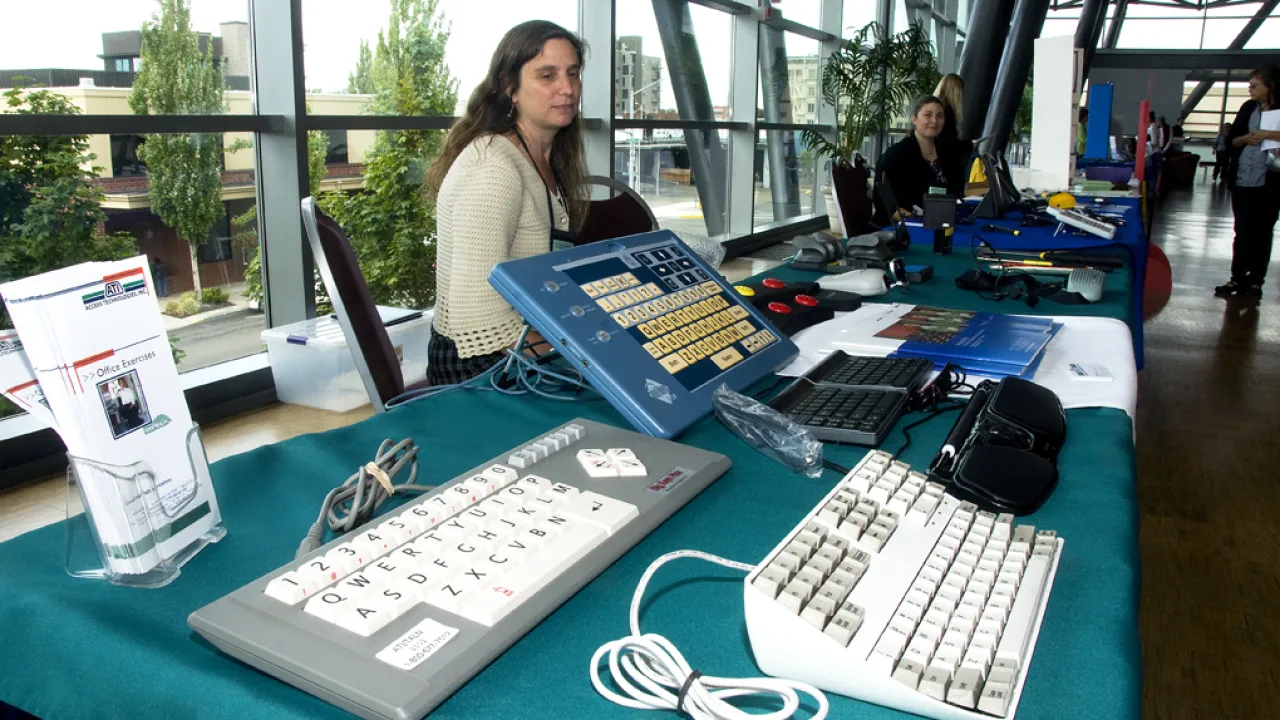
The designer builds big colorful pads, chin joysticks, or puff straws! Now kids who cannot move their fingers can race cars on screen with friends.
3
Testing Together
Using , designers team up with real users to test and improve every invention!
1. How might an assistive tech designer adapt a video game for a kid who cannot press tiny thumb buttons?
2. Which everyday kitchen item started out in the 1930s as an assistive invention to help hospital patients drink lying down?
🤯 Mind-Blowing Fact • Grade 2
Closed captions on TV shows and videos were originally engineered for deaf and hard-of-hearing viewers, and today millions of people use them in airports, classrooms, and libraries!
✨ Word Sparks (Grade 2 Glossary)
Tap 🔊 to hear
Accessible
Easy for people of all abilities to use
Prototype
Early test model built to try ideas
Co-design
Designing directly alongside the people using it
🪝
Why do sidewalks have sloped curb ramps at street corners—and how do they help everyone?
1
The Curb-Cut Effect
Roll smoothly down the corner ramp and cross the street! Sloped sidewalk curb cuts were first designed for wheelchair users, yet parents pushing strollers, travelers pulling suitcases, and kids on scooters use them every day. Assistive tech designers love when inventions make life smoother for everyone!
2
Low-Tech and High-Tech Solutions
Not every helpful tool needs a battery. Designers sculpt foam handle grips that steady shaky spoons alongside high-tech smart glasses that read grocery labels aloud into an earpiece.
3
Nothing About Us Without Us
Great designers never guess in a quiet room alone; they invite disabled kids and adults right into the lab as co-designers!
1. What do designers call it when an invention made for disabled users—like sidewalk curb ramps or TV captions—ends up helping everybody?
2. Why do assistive tech designers invite users with disabilities to test rough prototypes early?
🤯 Mind-Blowing Fact • Grade 3
Even the modern computer keyboard's ancestor—one of the earliest working typewriters in 1808—was built by Italian inventor Pellegrino Turri so his blind friend Countess Carolina Fantoni could write letters!
How can an infrared camera let someone type stories, browse websites, and compose music using solely their eyes?
1
Hardware, Software, and Makerspaces
Walk into an assistive technology lab and you will see soldering irons next to sewing machines, 3D printers humming beside laptops! Assistive tech designers blend mechanical engineering, industrial design, and computer coding to remove physical or digital barriers.
2
Sip-and-Puff and Eye-Gaze Magic
When spinal injuries affect hand and arm movement, designers create alternative inputs. Sip-and-puff tubes translate gentle air sips and puffs into wheelchair steering or mouse clicks, while harmless infrared bars follow where a user gazes on a screen!
3
Screen Readers and Haptic Feedback
Software accessibility designers write clean code so screen-reader programs speak website buttons aloud for blind users, and smartwatches tap gentle vibration patterns—called —to alert deaf users when a doorbell rings.
4
Customizing at Low Cost
Open-source 3D-printable designs now let schools and libraries print custom zipper pulls, key turners, and tablet mounts for pennies.
1. How does a 'sip-and-puff' assistive system let someone steer a power wheelchair or click a computer?
2. What are 'haptics' in a smartwatch or game controller designed for accessibility?
🤯 Mind-Blowing Fact • Grade 4
Voice recognition, predictive text on smartphones, and optical character recognition (scanning printed pages into digital text—invented by Ray Kurzweil for blind readers in 1976) all began as assistive technologies!
✨ Word Sparks (Grade 4 Glossary)
Tap 🔊 to hear
Iterative
Testing and improving step by step repeatedly
Alt-text
Hidden written description explaining digital images aloud
Open-source
Shared freely online so anyone can build
🪝
What happens when engineers stop trying to 'fix' people and start fixing clumsy everyday objects instead?
1
Rethinking Barriers Through Design
Suppose a library has only steep stone steps at its front door: is a wheelchair user stopped by their wheelchair, or by a building designed without a ramp? Assistive tech designers view disability as a mismatch between human diversity and poorly designed tools or spaces. Fix that mismatch—through a sleek ramp, an adaptive Xbox controller hub, or live speech-to-text captions—and talent shines unhindered!
2
Iterative Prototyping Cycles
Every breakthrough moves through rapid design cycles: empathize with users, sketch concepts, carve quick foam or cardboard mock-ups, 3D-print working prototypes, and test in real classrooms or kitchens. Often a two-millimeter change in button spring tension makes the difference between tiring out a user's thumb and effortless all-day control.
3
Digital Accessibility and Alt-Text
Half of modern assistive tech lives in invisible software standards called Web Content Accessibility Guidelines (WCAG). Accessibility engineers ensure high color contrast for low-vision readers, full keyboard navigation without a mouse, and descriptive image '' so screen readers describe photos clearly.
4
Community Makers and University Labs
Across Virginia university engineering clinics and nonprofit makerspaces, student and professional assistive tech designers partner with local occupational therapists and veterans to build custom kayaks, one-handed musical instruments, and smart-home controls.
1. What is 'alt-text' when an assistive tech or web accessibility designer builds a website?
2. Why do industrial designers carve quick clay or foam handle models before manufacturing a finished adaptive utensil?
🤯 Mind-Blowing Fact • Grade 5
Eye-tracking communication tablets pinpoint where you look within millimeters by calculating the angle between your pupil's center and a microscopic infrared reflection on your cornea called a 'Purkinje glint'!
✨ Word Sparks (Grade 5 Glossary)
Tap 🔊 to hear
Corneal reflection
Tiny light glint tracking exact eye gaze
Actuator
Motor component turning electric signals into motion
Brain-computer interface
System translating brain signals directly into commands
🪝
How are assistive tech designers combining corneal-reflection optics, AI computer vision, and brain-computer interfaces to redefine human-machine interaction?
1
Human Factors Engineering and Control Bandwidth
Rehabilitation engineers and Assistive Technology Designers frame every device around the Human Activity Assistive Technology (HAAT) model: matching a person's reliable motor or sensory signal—however subtle—through an interface processor to control real-world . Whether capturing micro-newton eyebrow twitches via piezoelectric switches, proportional hall-effect joysticks, or capacitive touch surfaces, engineers optimize signal-to-noise ratios while minimizing physical fatigue.
2
Pupil-Center Corneal Reflection and Dwell-Free Gaze
Modern eye-gaze computers project safe near-infrared light onto the user's eye, generating a tiny glint on the cornea called a Purkinje reflection. High-speed cameras measure the vector between pupil center and corneal glint sixty to one hundred twenty times per second, calculating exact screen gaze coordinates despite slight head motion, while predictive language models accelerate typing speed.
3
Accessible Digital Ecosystems and Computer Vision
In software engineering, accessibility architects build Semantic HTML and ARIA (Accessible Rich Internet Applications) trees that communicate live interface states to screen readers and refreshable braille displays, meeting Section 508 and WCAG standards. Simultaneously, on-device AI computer vision apps narrate street signs, currency denominations, and facial expressions in real time, while neural speech-to-text models transcribe multi-speaker classrooms for deaf professionals.
4
Non-Invasive and Implantable Brain-Computer Interfaces
At clinical research frontiers, biomedical assistive tech designers decode non-invasive electroencephalography (EEG) headsets and high-density motor-cortex neural arrays. Machine-learning decoders translate imagined handwriting or hand-grasp neural firing patterns into wireless Bluetooth commands, enabling individuals with severe paralysis to steer robotic arms or type fluent sentences at conversational speeds.
5
Inclusive Design as an Engine of Universal Innovation
Guided by the disability community's foundational principle 'Nothing About Us Without Us,' assistive tech designers partner with disabled engineers, occupational therapists, and everyday makers—proving time and again that solving tough accessibility barriers sparks universal breakthroughs that elevate technology for all humanity.