2. What are you actually feeling when you check the pulse on your wrist?
🤯 Mind-Blowing Fact • Grade 2
Most big arteries hide deep inside your arms and legs near your bones so bumps and scrapes cannot easily reach them!
✨ Word Sparks (Grade 2 Glossary)
Tap 🔊 to hear
pressure
strong pushing force of rushing liquid inside
smooth muscle
automatic muscle wrapping around blood vessel walls
branch
split from one big tube into smaller ones
🪝
Why are your arteries built with much thicker walls than your veins?
1
Built for High Pressure
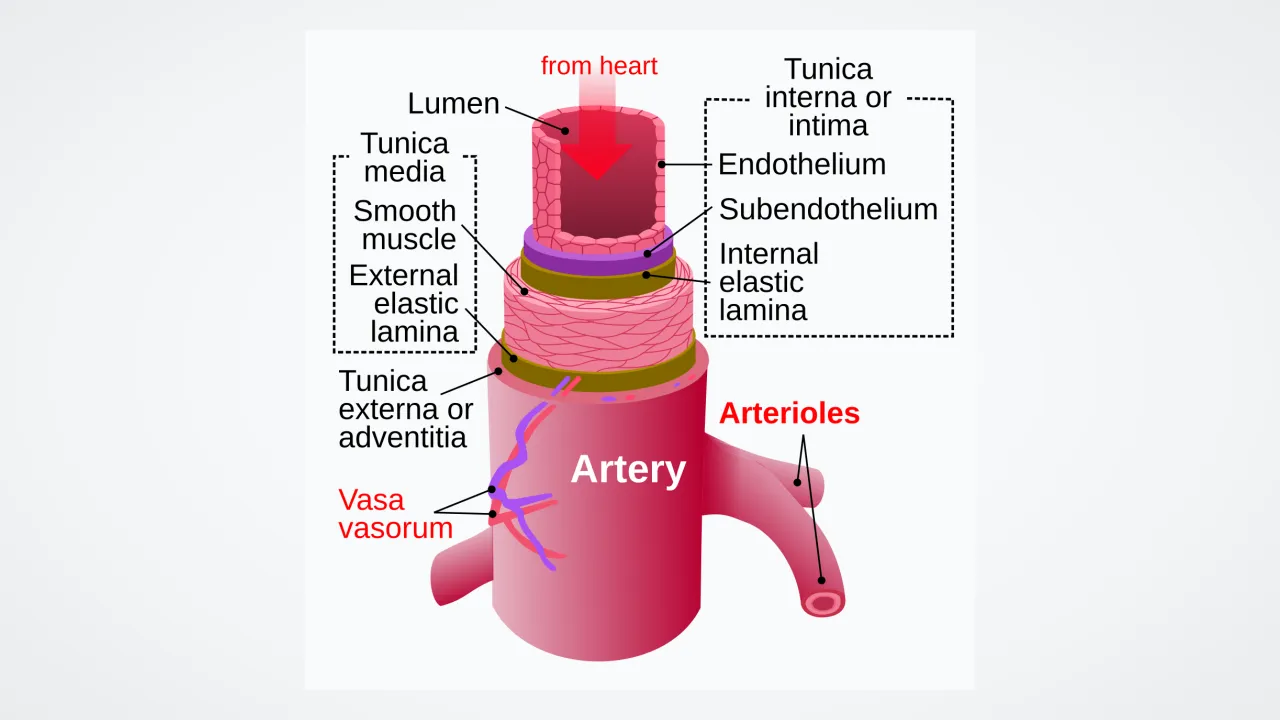
Turn a backyard hose on full blast and feel the rubber tube stiffen! Blood shooting out of your heart travels fast under strong . That is why arteries have thick, bouncy walls wrapped in .
2
Steering Blood Traffic
When you eat lunch, arteries leading to your stomach widen up to help digest food. When you race at recess, arteries leading to your leg muscles open wide instead!
3
One Famous Exception
Almost all arteries carry bright, oxygen-rich red blood. Only one—the pulmonary artery—carries oxygen-poor blood away from your heart right next door to your lungs!
1. Why do arteries need thicker, stronger walls than veins?
2. Which special artery carries oxygen-poor blood away from the heart to the lungs?
🤯 Mind-Blowing Fact • Grade 3
Ancient Greek scholars once thought arteries carried air instead of blood because arteries squeeze themselves empty right after death—giving 'artery' its old Greek name meaning 'windpipe'!
✨ Word Sparks (Grade 3 Glossary)
Tap 🔊 to hear
arteriole
tiny muscular artery branch controlling local blood
How do your arteries know whether to send extra blood to your legs for soccer or to your tummy for pizza?
1
Three Smart Coats in Every Wall
Slice an imaginary cross-section through an artery and you will find three neat layers! A glass-smooth inner lining lets blood cells zip past without snagging, a thick middle coat packs rings of smooth muscle and stretchy elastin, and a tough outer collagen jacket guards against tears.
2
From Highways to Side Streets
Leaving the giant aorta, large muscular arteries—like the in your neck and radial in your wrist—branch again and again into microscopic side streets called .
3
Smart Faucet Valves
work like adjustable faucets for every neighborhood of cells. When leg muscles burn oxygen during a sprint, rings of smooth muscle in leg arterioles relax and widen, flooding working muscles with fresh blood while quieter tissues share less.
4
Why Doctors Wrap a Cuff on Your Arm
When a nurse inflates a blood-pressure cuff around your upper arm, it measures two numbers in your brachial artery: peak pumping pressure over resting between-beat pressure!
1. How do tiny arterioles send extra blood to hard-working leg muscles during a race?
2. Why are major arteries usually tucked deep along the insides of joints and bones?
🤯 Mind-Blowing Fact • Grade 4
The pressure wave you feel as a wrist pulse races down arterial walls at 15 to 30 feet (5 to 9 meters) per second—ten times faster than the actual blood cells flowing inside!
✨ Word Sparks (Grade 4 Glossary)
Tap 🔊 to hear
nitric oxide
natural gas signal telling artery muscles to relax
lumen
open hollow tunnel inside a blood vessel
radial artery
thumb-side wrist artery used to count pulse
🪝
How can widening a tiny arteriole just a little bit multiply blood flow by sixteen times?
1
Elastic Conductors Versus Muscular Distributors
Press gently beside your windpipe or inside your wrist—that crisp beat travels along your arterial tree faster than the blood itself! Physiologists group arteries into three teamwork tiers. Near the heart, giant elastic arteries like the aorta and pulmonary trunk absorb powerful systolic surges. Farther out, medium muscular arteries—such as the femoral, brachial, and radial arteries—pack up to forty layers of circular smooth muscle to distribute blood cleanly to individual organs.
2
Arterioles and the Fourth-Power Rule
Before reaching capillaries, arteries narrow into microscopic arterioles less than a tenth of a millimeter wide. French physician Jean Léonard Marie Poiseuille discovered a mind-blowing fluid law: blood flow through a tube scales with the fourth power of its radius! That means if smooth muscle relaxes to make an arteriole twice as wide, sixteen times more blood rushes through to feed exercising muscles!
3
Nitric Oxide: A Tiny Gas Messenger
How does the smooth muscle coat know when to relax? When blood flows briskly or tissues crave oxygen, the inner endothelial lining releases puffs of a tiny gas molecule called , signaling surrounding muscle rings to loosen immediately.
4
Keeping Arteries Flexible for Life
Daily active play, colorful fruits and vegetables, and avoiding tobacco keep the delicate endothelial lining slick and elastic so blood glides effortlessly for decades.
1. According to Poiseuille's fluid law, what happens to blood flow if an arteriole doubles its inner radius?
2. What helpful signal molecule do inner endothelial cells release to widen arteries?
🤯 Mind-Blowing Fact • Grade 5
Your arterial endothelium—if spread flat from every artery and arteriole in your body—forms an active chemical-signaling surface heavier than several major glands!
✨ Word Sparks (Grade 5 Glossary)
Tap 🔊 to hear
tunica intima
innermost frictionless lining layer of an artery
autoregulation
tissue's ability to adjust its own blood flow
shear stress
gentle rubbing force of flowing blood on walls
🪝
How did a gas once known mainly as car-exhaust pollution win a Nobel Prize as your arteries' master regulator?
1
Three Concentric Tunics Engineered for Pressure
Operating at mean systemic pressures near 95 mmHg, human arteries combine hydraulic strength with active vasomotor control through three distinct wall layers. Inside, a single-cell squamous endothelium rests on a wavy internal elastic lamina to form the . Surrounding it, the thick tunica media blends concentric smooth muscle cells and elastin sheets, wrapped externally by a collagen-rich tunica adventitia anchored to surrounding connective tissue.
2
Resistance Arterioles and Poiseuille's Law
As conducting elastic arteries transition into distributing muscular arteries and finally terminal arterioles (10 to 100 micrometers wide), vascular resistance climbs steeply. Governed by the Hagen-Poiseuille equation—where flow is proportional to the fourth power of vessel radius—arterioles act as the cardiovascular system's primary resistance regulators, maintaining steady systemic blood pressure while stepping down 120 mmHg surges to a gentle 30 mmHg before blood enters fragile capillary beds.
3
Local Metabolic Autoregulation
Working skeletal or cardiac muscle doesn't even have to wait for brain nerves to request extra fuel: falling local oxygen, rising carbon dioxide, adenosine, and potassium ions directly relax nearby precapillary arterioles, matching perfusion precisely to metabolic demand within seconds.
4
The 1998 Nobel Prize for Nitric Oxide
For decades, physiologists searched for the mysterious 'endothelium-derived relaxing factor' triggered by blood . Pharmacologists Robert Furchgott, Louis Ignarro, and Ferid Murad stunned medicine by proving it was nitric oxide (NO)—a fleeting dissolved gas synthesized by endothelial cells—earning the 1998 Nobel Prize in Physiology or Medicine. Even after Galenic anatomy matured, modern vascular imaging revealed how Windkessel compliance and microvascular work together to protect delicate brain and kidney capillaries.
5
Galen Overturns the Air-Tube Myth
In the second century CE, physician Galen of Pergamon disproved centuries of belief that arteries held only air (pneuma), demonstrating experimentally that living arteries are brimming exclusively with pressurized blood.