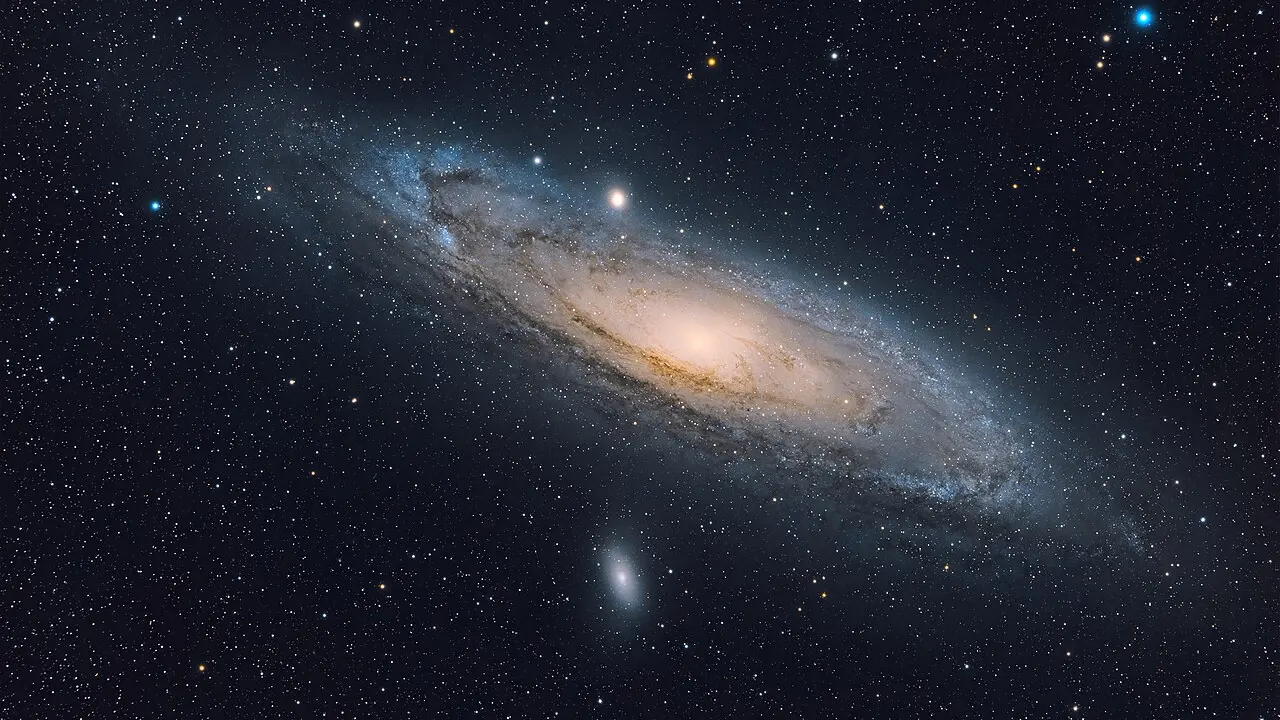
1. Why is spotting the Andromeda Galaxy on a dark night such a cool record?
2. About how many stars shine inside the giant Andromeda Galaxy?
🤯 Mind-Blowing Fact • Grade 2
If the full dim width of the Andromeda Galaxy shone brightly in our sky, it would stretch six times wider than the full Moon!
✨ Word Sparks (Grade 2 Glossary)
Tap 🔊 to hear
variable star
Star that brightens and dims in steady beats
chart
Careful map showing where stars sit
merge
Blend two separate things smoothly into one
🪝
How did one photograph of Andromeda make the known universe millions of times bigger overnight?
1
The Little Cloud Mystery
Over a thousand years ago in 964 CE, Persian astronomer Abd al-Rahman al-Sufi drew Andromeda as a 'little cloud' on his star . Later cataloged as Messier 31, astronomers argued for centuries: was it a small gas cloud inside our Milky Way, or a separate galaxy far outside?
2
Edwin Hubble writes 'VAR!'
In 1923, Edwin Hubble photographed Andromeda with California's giant Mount Wilson telescope and crossed out 'N' for nova to write 'VAR!' in red ink! Using pulsing stars studied by Henrietta Swan Leavitt, Hubble proved Andromeda sits millions of light-years outside our Milky Way!
3
Heading Our Way
Even cooler, Andromeda is gliding toward our Milky Way at 250,000 miles per hour for a slow cosmic dance four billion years from now!
1. What giant breakthrough did Edwin Hubble make by studying Andromeda in 1923?
2. Who recorded the earliest known book description of Andromeda as a 'little cloud' in 964 CE?
🤯 Mind-Blowing Fact • Grade 3
If our Sun were shrunk to the size of a ping-pong ball, the next nearest star would sit 700 miles away—explaining why two merging galaxies pass right through each other without stars colliding!
✨ Word Sparks (Grade 3 Glossary)
Tap 🔊 to hear
Local Group
Neighborhood family of Andromeda, Milky Way, and dwarfs
Cepheid
Pulsing star used as a cosmic distance ruler
mosaic
Giant picture stitched together from many smaller photos
🪝
When Andromeda and the Milky Way merge in four billion years, why won't their trillions of stars crash into each other?
1
Ruler of the Local Group
Our Milky Way and Andromeda anchor a neighborhood of more than eighty galaxies called the ! Spanning roughly 152,000 to 220,000 light-years across, Messier 31 (Andromeda) packs around one trillion stars—more than double our Milky Way's star count—along with at least thirty small satellite dwarf galaxies orbiting it like moons.
2
Henrietta Leavitt's Cosmic Yardstick
How did Edwin Hubble measure Andromeda's staggering 2.5-million-light-year distance? Earlier, Harvard astronomer Henrietta Swan Leavitt discovered that '' variable stars pulse slower when they are truly brighter! Timing a Cepheid's pulse in Andromeda revealed its exact candlepower and true distance.
3
Hubble's Sharpest Mosaic
Spending over a decade scanning Andromeda, NASA's Hubble Space Telescope assembled a 2.5-billion-pixel panorama resolving over 200 million individual stars!
4
Birth of 'Milkomeda'
Mutual gravity pulls Andromeda and the Milky Way together at 68 miles per second. In 4.5 billion years they will weave into one giant oval galaxy—yet stars sit so trillions of miles apart that almost zero stars will ever bump!
1. Whose discovery about pulsing Cepheid stars allowed Edwin Hubble to measure the distance to Andromeda?
2. Why will almost no stars collide when Andromeda and the Milky Way merge billions of years from now?
🤯 Mind-Blowing Fact • Grade 4
Invisible halos of tenuous gas surrounding Andromeda and the Milky Way stretch over a million light-years out from each galaxy—meaning our two galaxies' outer halos have already begun touching!
✨ Word Sparks (Grade 4 Glossary)
Tap 🔊 to hear
blueshift
Squeezing of light waves from an approaching object
redshift
Stretching of light waves from a receding object
halo
Huge spherical cloud of gas and dark matter
🪝
Why is the Andromeda Galaxy's starlight shifted toward blue while almost every other galaxy in the universe shifts toward red?
1
A Rare Cosmic Blueshift
Because space itself is expanding across the universe, nearly all distant galaxies stretch their light waves into redder colors—a '.' In 1912, astronomer Vesto Slipher measured Messier 31's spectrum at Lowell Observatory and got a shock: Andromeda's light was squished toward blue! Mutual gravity inside our Local Group overpowers cosmic expansion locally, pulling Andromeda toward the Milky Way at 68 miles per second (110 km/s).
2
Double Nucleus and Giant Black Hole
Zooming into Andromeda's center, the Hubble Space Telescope revealed two bright peaks of starlight right next to each other! Rather than two separate galaxy cores, millions of stars orbit in a stretched eccentric ring around a colossal supermassive black hole weighing over 100 million Suns—twenty-five times heavier than our Milky Way's Sagittarius A*!
3
Rings of Fire Seen in Infrared
Because Andromeda sits tilted at 77 degrees to our view, dust lanes trace concentric rings rather than open pinwheel arms—sculpted ~210 million years ago when compact companion galaxy M32 plunged straight through Andromeda's disk!
4
Giant Halo Touching Ours Already
Hubble ultraviolet quasars studies revealed Andromeda's invisible hot gas already extends 1.3 million light-years outward—meaning Andromeda's outer halo and the Milky Way's halo are already brushing edges right now!
1. Why does Andromeda show a 'blueshift' in its light spectrum when distant galaxies show a redshift?
2. What creates the illusion of a 'double nucleus' at the very heart of the Andromeda Galaxy?
🤯 Mind-Blowing Fact • Grade 5
Edwin Hubble's original 1923 glass photographic plate of Andromeda—with 'VAR!' scrawled in excited red grease pencil next to star V1—is preserved today as one of the most treasured artifacts in the history of science!
✨ Word Sparks (Grade 5 Glossary)
Tap 🔊 to hear
kiloparsec
Astronomical distance unit equal to 3,260 light-years
circumgalactic
Vast diffuse gas halo surrounding a galaxy's disk
elliptical galaxy
Smooth oval galaxy formed after spirals merge
🪝
How did Vesto Slipher's 1912 spectrograph, Hubble's 1923 Cepheid plate, and ten-year space panoramas make Messier 31 the Rosetta Stone of extragalactic astronomy?
1
Resolving the 1920 'Great Debate'
Documented in 964 CE by Abd al-Rahman al-Sufi and cataloged in 1764 as Messier 31, the 'Great Andromeda Nebula' stood at the center of astronomy's 1920 Shapley-Curtis Great Debate: were spiral nebulae mere gas eddies inside a single Milky Way universe, or independent 'island universes' of billions of stars? On October 5–6, 1923, using Mount Wilson's 100-inch Hooker reflector, Edwin Hubble identified Cepheid variable V1 in M31's outer arms. Applying Henrietta Swan Leavitt's period-luminosity relation immediately placed M31 far beyond any Milky Way boundary—modern Cepheid and tip-of-the-red-giant-branch calibrations refine its distance to 2.537 million light-years (778 ).
2
SA(s)b Structure, Ring Collisions, and P1/P2 Core
Spanning roughly 152,000 to 220,000 light-years with ~1 trillion stars, Andromeda displays tightly wound spiral arms heavily overprinted by a striking 10- star-forming dust ring imaged by Spitzer and Herschel—the dynamical Bullseye ripple left when satellite elliptical M32 punched through M31's disk ~210 million years ago! At its core, Hubble resolved peaks P1 and P2: an apocentric pileup inside an eccentric Keplerian stellar disk whipping around a 110-to-140-million-solar-mass supermassive black hole.
3
PHAT/PHAST Panchromatic Survey and Cannibalism
Completed in 2025 after more than a thousand Hubble orbits, the Panchromatic Hubble Andromeda Treasury and Southern Treasury (PHAT/PHAST) cataloged over 200 million individual stars across M31's tilted disk. Combined with ground-based Giant Stellar Stream surveys, age-metallicity maps reveal Andromeda experienced a far more turbulent merger ~2 billion years ago than our quieter Milky Way—scattering metal-rich stars across its halo.
4
Circumgalactic Halo Overlap (Project AMIGA)
Ultraviolet absorption spectroscopy of background quasars through Hubble's Project AMIGA mapped ionized silicon, carbon, and oxygen extending 1.3 to 2 million light-years around M31—confirming its medium already touches the Milky Way's halo!
5
Proper Motion and the Future Elliptical Merger
Combining Vesto Slipher's historic radial blueshift (-301 km/s heliocentric; ~110 km/s galactocentric) with micro-arcsecond transverse proper motions from Hubble and Gaia confirms M31 and our Milky Way—modulated by Triangulum (M33) and the Large Magellanic Cloud—will tidally coalesce over the next 4.5 to 6 billion years into a giant .