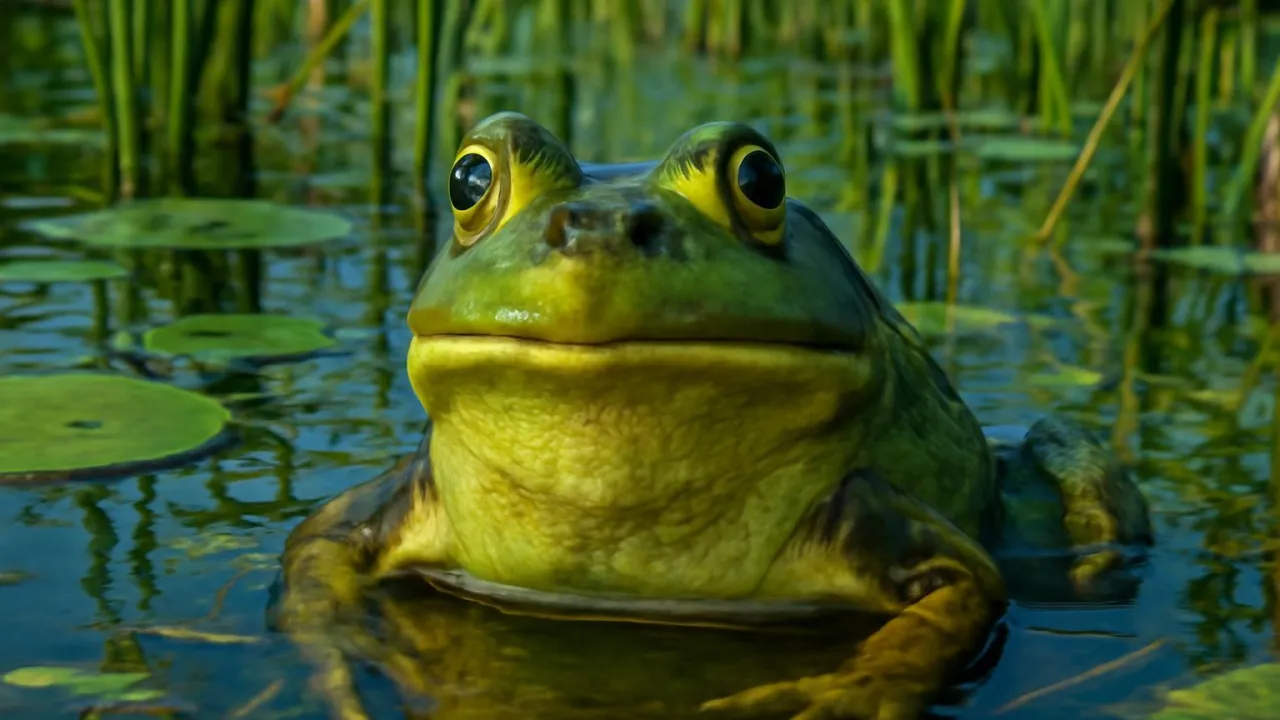
Bullfrogs can make sounds louder than a lawn mower!
✨ Word Sparks (Grade 2 Glossary)
Tap 🔊 to hear
tadpole
A baby frog that swims with a tail.
territory
A place a frog claims as its home.
mate
A frog’s partner to make frog babies.
🪝
Have you heard a bullfrog’s croak near a pond at night?
1
Big Frog in Water
The American bullfrog is large and green with smooth skin. It lives mostly near ponds and lakes where there is fresh water. Bullfrogs swim well and hop on land to find food and stay safe.
2
Life Near the Pond
Bullfrogs start life as tiny eggs in water. Then they grow into with tails to swim. After some weeks, they change into frogs with legs and no tails. This helps them live on land and in water.
3
A Loud Croak
Male bullfrogs croak loudly to find and mark . Their croak can be heard far away, especially on warm summer nights. This loud sound helps them stay safe from other frogs.
Bullfrog croaks can be heard up to a mile away in quiet places!
✨ Word Sparks (Grade 3 Glossary)
Tap 🔊 to hear
camouflage
Colors that help animals hide in nature.
metamorphosis
The change from tadpole to frog.
predator
An animal that hunts other animals.
🪝
How does the bullfrog’s croak help it survive in the wild?
1
Big Amphibian with Smooth Skin
Bullfrogs have smooth, moist skin that helps them stay wet in water and on land. Their green and brown colors help them blend into plants and mud near ponds. Their big eyes help spot food and watch for danger nearby. These features help bullfrogs hide from and catch prey.
2
Life Cycle from Egg to Frog
Bullfrogs lay eggs in water that hatch into tadpoles with long tails for swimming. Tadpoles grow legs and lose their tails in a change called . This change lets them live both in water and on land as adult frogs. This life cycle helps them survive in different places.
3
Powerful Croak and Communication
Male bullfrogs croak loudly to attract mates and warn other males to stay away. Their croak travels far across ponds and lakes, helping them protect their space. This loud sound is important for finding partners and avoiding fights. It is a key way bullfrogs communicate.
4
Eating Habits and Predators
Bullfrogs eat insects, small fish, and even smaller frogs using their sticky tongues to catch prey quickly. They must watch for like snakes and birds that want to eat them. Their and fast jumping help them escape danger and survive in the wild.
Bullfrogs’ croaks can travel over water for long distances, helping them find mates.
✨ Word Sparks (Grade 4 Glossary)
Tap 🔊 to hear
ecosystem
All plants and animals living together in one place.
invasive
An animal that moves to a new place and causes problems.
territory
An area an animal claims as its home.
🪝
How does the American bullfrog’s loud croak affect its place in the ecosystem?
1
Adaptations for Survival
The American bullfrog has smooth, moist skin that helps it absorb oxygen both in water and on land, making it a true amphibian. Its green and brown camouflage allows it to hide from predators like snakes and birds effectively. The bullfrog’s powerful legs enable long jumps to escape danger quickly. These adaptations increase its chances of survival in freshwater habitats.
2
Role in Food Webs
Bullfrogs are important predators that control insect and small fish populations in ponds and lakes. They also serve as prey for larger animals, creating a balanced food web. Their diet includes insects, small fish, and even smaller frogs, which helps maintain health. This balance supports many other species in their habitats.
3
Croaking and Communication
Male bullfrogs use their loud croaks to establish and attract females during breeding season. This vocalization can carry over long distances, affecting the behavior of other frogs nearby. The croak also warns rivals to stay away, reducing physical fights. This communication helps maintain population balance in their environment.
4
Geographic Distribution and Human Impact
Native to eastern North America, bullfrogs have been introduced to many other regions worldwide, sometimes becoming . In some areas, they compete with native amphibians and disrupt local . Human activities like pollution and habitat loss also threaten bullfrog populations. Conservation efforts focus on protecting habitats and controlling invasive spread.
1. What role do bullfrogs play in their ecosystem?
2. Why can bullfrogs be invasive in some places?
🤯 Mind-Blowing Fact • Grade 5
A bullfrog’s croak can reach 90 decibels, louder than a lawn mower nearby!
✨ Word Sparks (Grade 5 Glossary)
Tap 🔊 to hear
sexual dimorphism
When males and females look different.
bioindicator
An animal that shows if the environment is healthy.
vocal sac
A pouch that makes a frog’s croak louder.
🪝
What makes the American bullfrog a fascinating subject for scientists studying amphibians?
1
Scientific Classification and Description
The American bullfrog, Lithobates catesbeianus, belongs to the family Ranidae, known as true frogs. It is one of the largest frogs in North America, measuring up to eight inches long. Its smooth, moist skin and powerful hind legs classify it as a highly adapted amphibian. The species exhibits , with males having larger tympanums than females.
2
Physiological Adaptations and Mechanics
Bullfrogs have specialized lungs and skin that allow them to breathe both in water and on land. Their strong hind legs provide impressive jumping ability, reaching distances of up to six feet. The in males amplify their croaks, which can reach 90 decibels, louder than a lawn mower. Their sticky tongues rapidly extend to capture prey with precision.
3
Conservation Status and Ecological Impact
Though common in their native range, bullfrogs have become invasive in many areas worldwide, disrupting local amphibian populations. Their voracious appetite and adaptability allow them to outcompete native species. Conservation efforts include habitat protection and controlling introduced populations to preserve biodiversity. Monitoring bullfrog populations helps scientists understand ecosystem health.
4
Botanical and Ecological Interactions
Bullfrogs influence freshwater ecosystems by controlling insect and small vertebrate populations, affecting nutrient cycles and food webs. They also serve as for environmental changes due to their sensitivity to pollution. Their breeding habits rely on aquatic vegetation for egg-laying, linking their life cycle to plant health in wetlands.
5
Quantitative Comparisons and Interesting Measurements
American bullfrogs can weigh up to one pound (0.45 kg) and leap distances of six feet (1.8 meters). Their croaks can be heard up to one mile (1.6 kilometers) away in quiet environments. They tolerate water temperatures ranging from 50 to 85 degrees Fahrenheit (10 to 29 degrees Celsius). These measurements highlight their impressive physical capabilities.