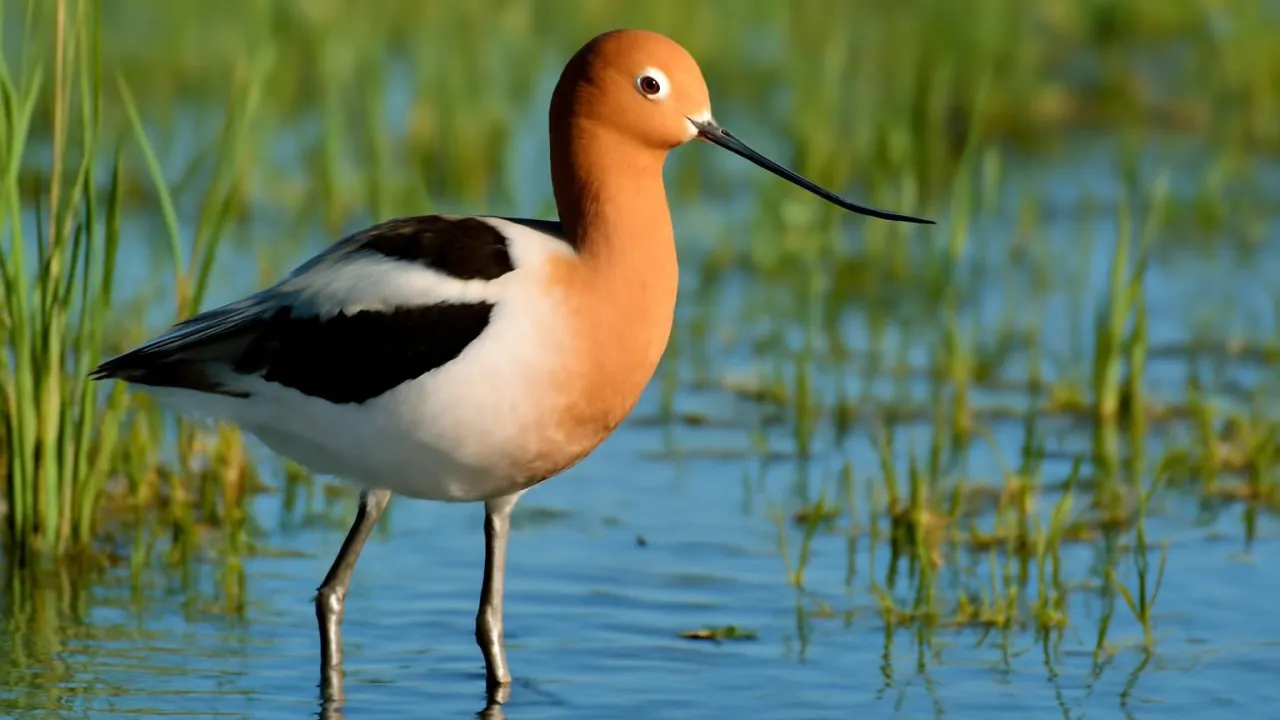
American Avocets use their curved bills like tiny rakes to catch food in water!
✨ Word Sparks (Grade 2 Glossary)
Tap 🔊 to hear
wade
To walk through water or mud
crustacean
Small water animals with shells
nesting
Making a home for eggs
🪝
Have you ever seen a bird with a bill that curves up like a smile?
1
Long Legs for Wading
The American Avocet has long, thin orange legs that help it walk in shallow water and mud. It uses its legs to through wetlands where it finds food. These legs keep the bird’s body dry while it searches for insects.
2
Unique Upturned Bill
This bird’s bill curves upward at the tip, which helps it sweep side to side in the water. It catches small insects and by moving its bill through the water’s surface. This special bill is perfect for finding food in wet places.
3
Wetland Home and Nesting
American Avocets live in shallow wetlands like ponds and lakes across North America. They build their nests on the ground near water, often in small groups. These wetlands provide plenty of food and safe places for their eggs.
1. Why are the American Avocet’s legs long and thin?
2. What does the American Avocet use its bill for?
🤯 Mind-Blowing Fact • Grade 3
American Avocets’ sweeping bill motion is a unique feeding adaptation among shorebirds!
✨ Word Sparks (Grade 3 Glossary)
Tap 🔊 to hear
adaptation
A body change that helps survival
camouflage
Colors that help hide animals
prey
Animals hunted for food
🪝
Did you know the American Avocet’s upturned bill helps it catch food in shallow water?
1
Wading in Wetlands
The American Avocet wades through shallow wetlands using its long, slender legs to stay above water. This helps it avoid predators while searching for food. Wetlands provide rich nutrients that support many small creatures.
2
Upturned Bill for Feeding
Its unique upturned bill sweeps side to side to catch aquatic insects and small crustaceans. This feeding method helps the bird capture hidden in mud or water. The curved shape is a special for its environment.
3
Camouflage and Protection
The bird’s brown and white feathers help it blend into wetland plants and mud, offering from predators. This natural coloring is an important survival trait. It also uses its sharp eyes to watch for danger.
4
Life Cycle and Nesting
American Avocets build shallow nests on open ground near water, often in colonies for safety. The eggs hatch after about three weeks, and the chicks quickly learn to wade and feed. This life cycle helps the species thrive in wetland habitats.
1. How does the American Avocet’s bill help it find food?
2. Why do American Avocets have brown and white feathers?
🤯 Mind-Blowing Fact • Grade 4
American Avocets’ sweeping bill motion helps them catch hidden prey, a rare skill among shorebirds.
✨ Word Sparks (Grade 4 Glossary)
Tap 🔊 to hear
ecosystem
A community of living things and places
migration
Moving to a new place seasonally
conservation
Protecting nature and animals
🪝
What makes the American Avocet’s upturned bill so perfect for wetland life?
1
Adaptations for Wetland Survival
The American Avocet’s long, slender legs allow it to wade through shallow waters without getting its body wet, which helps it avoid predators. Its upturned bill sweeps side to side, enabling it to efficiently catch small aquatic insects and crustaceans hiding in mud or water. These physical adaptations are essential for thriving in wetland .
2
Role in the Ecosystem
As a predator of aquatic insects and small crustaceans, the American Avocet helps control these populations, keeping the wetland balanced. It also serves as prey for larger animals like hawks and foxes, fitting into the food web. Its nesting colonies provide safety through numbers, reducing individual risk.
3
Geographic Range and Habitat
American Avocets breed across western and central North America, favoring freshwater wetlands, alkali flats, and shallow lakes. During winter, they migrate to coastal areas along the southern United States and Mexico. This wide range shows their ability to adapt to various wetland habitats.
4
Human Impact and Conservation
Wetland loss due to agriculture and development threatens American Avocet habitats, leading to population declines in some areas. efforts focus on protecting and restoring wetlands to support their breeding and feeding needs. Public awareness helps encourage wetland preservation for these unique birds.
1. How does the American Avocet help its wetland ecosystem?
2. Why is wetland conservation important for American Avocets?
🤯 Mind-Blowing Fact • Grade 5
American Avocets can wade in water up to 8 inches deep while sweeping their curved bills to catch tiny aquatic prey.
✨ Word Sparks (Grade 5 Glossary)
Tap 🔊 to hear
precocial
Chicks that can walk and feed soon after hatching
plumage
The bird’s feathers and colors
alkali flats
Flat wet areas with salty soil
🪝
How does the American Avocet’s unique bill shape and behavior support its survival in diverse wetlands?
1
Scientific Classification and Physical Traits
The American Avocet, Recurvirostra americana, belongs to the family Recurvirostridae, known for their distinctive upturned bills and long legs. Adults measure about 20 inches (51 cm) tall with a wingspan of 28 to 32 inches (71 to 81 cm). Their changes seasonally, displaying rusty orange on the head and neck during breeding and grayish-white in winter, aiding in camouflage.
2
Feeding Mechanics and Physiology
This species uses a specialized feeding technique where it sweeps its slender, upturned bill side to side through shallow water to capture aquatic invertebrates. The bill’s curvature allows efficient filtering of small prey like insect larvae and crustaceans from mud and water surfaces. Its long legs enable wading in water depths up to 8 inches (20 cm), maximizing feeding range.
3
Reproductive Behavior and Life Cycle
American Avocets nest in loose colonies on open ground near wetlands, often selecting that reduce predator access. Clutch sizes typically range from three to four eggs, incubated for about 23 to 25 days. Chicks are , leaving the nest shortly after hatching to feed alongside adults, which increases survival rates.
4
Geographic Distribution and Migration Patterns
Breeding primarily occurs in the western and central United States and southern Canada, with wintering grounds along the southern U.S. coasts and Mexico. Migration distances can exceed 1,000 miles (1,600 km), demonstrating strong navigational abilities. Habitat preferences include freshwater wetlands, salt flats, and estuaries.
5
Conservation Status and Human Influence
While currently listed as Least Concern, American Avocets face threats from wetland drainage and pollution caused by agriculture and urban development. Conservation programs focus on habitat restoration and protection, with some populations monitored for changes in breeding success. Public education about wetland importance supports ongoing preservation efforts.