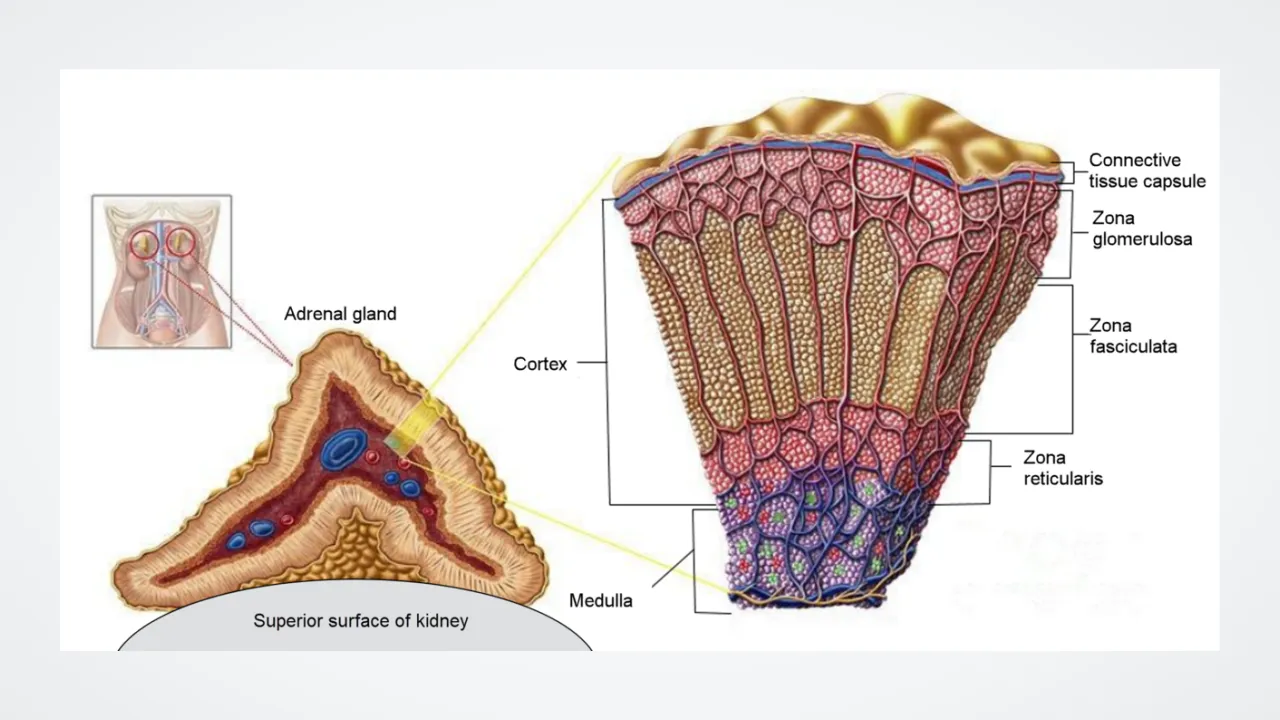
1. Where inside your body do your two adrenal glands sit?
2. What happens when adrenaline rushes through your blood before a big race?
🤯 Mind-Blowing Fact • Grade 2
Adrenaline temporarily pauses tummy rumbling and digestion so your muscles can borrow extra blood flow during big moments!
✨ Word Sparks (Grade 2 Glossary)
Tap 🔊 to hear
Epinephrine
Scientific medical name for adrenaline hormone
Pupil
Dark center opening of your eye
Kidney
Bean-shaped organ filtering water and blood waste
🪝
How can your body go from calm reading to catching a falling glass in less than a blink?
1
Two Glands in One
Sitting atop each like a folded golden cap, every adrenal gland actually hides two different workshops! An outer peel makes calm everyday hormones, while an inner core waits for exciting moments.
2
The Fight-or-Flight Boost
When your eyes spot a fast soccer ball heading toward your goal, your brain zaps a nerve signal straight to that inner adrenal core. Out bursts adrenaline—also called —into your bloodstream!
3
Superpower Teamwork
Adrenaline widens your eye to let in extra light, unlocks stored sugar from your liver for quick fuel, and sends extra blood to your arms and legs. Once the moment passes, everything settles peacefully again.
Outer adrenal hormone balancing daily energy levels
Fight-or-Flight
Rapid body response preparing for sudden action
🪝
Why does one tiny organ have an outer peel for slow daily chores and an inner core wired directly to your nerves?
1
Cortex Outside, Medulla Inside
Slice through a classroom model of an adrenal gland and it looks almost like a miniature peach! Its firm outer layer, the adrenal cortex, works steadily all day long. Tucked inside is a soft center called the , wired directly to rapid-fire nerves from your spinal cord.
2
Instant Action From the Medulla
Whenever you step onstage for a school play or swerve your bike around a puddle, your brain triggers the response. Nerve sparks hit the , releasing epinephrine and its partner norepinephrine. Within heartbeats, bronchial tubes relax for deeper breaths, liver glycogen turns into blood glucose, and muscles prime for motion.
3
Steady Helpers From the Cortex
Meanwhile, the outer cortex makes crucial daily hormones like and aldosterone. Cortisol helps manage energy and wakefulness each morning, while aldosterone tells your kidneys how much salt and water to save.
4
Cooling the Jets
Because epinephrine breaks down within minutes, your calm rest-and-digest nervous system smoothly brings your heartbeat back down once the excitement ends.
1. Which inner part of the adrenal gland is wired directly to nerves for instant adrenaline release?
2. What daily job does the hormone aldosterone from the outer adrenal cortex handle?
🤯 Mind-Blowing Fact • Grade 4
That funny 'butterflies in your stomach' feeling before a recital happens because adrenaline temporarily reroutes blood from your tummy toward your heart, brain, and muscles!
✨ Word Sparks (Grade 4 Glossary)
Tap 🔊 to hear
Chromaffin Cell
Nerve-like adrenal cell secreting epinephrine into blood
Aldosterone
Cortex hormone regulating kidney salt and water
Glycogen
Stored sugar fuel kept inside liver and muscles
🪝
How can the exact same adrenaline molecule widen blood vessels in your leg muscles while narrowing blood vessels in your skin?
1
Sympathetic Superhighway
Most endocrine glands wait for chemical instructions floating through blood, which takes tens of seconds. The adrenal medulla cheats the clock! Because its develop from the same embryonic tissue as nerve cells, sympathetic nerves from your spinal cord plug straight into them—launching eighty percent epinephrine and twenty percent norepinephrine almost instantaneously.
2
Alpha and Beta Receptor Switches
Once circulating, epinephrine acts like a master key fitting different locks called alpha and beta adrenergic receptors. Skin and digestive arterioles carry mostly alpha-1 receptors, which narrow vessels so less blood goes to non-urgent tasks—explaining why a sudden scare gives you 'butterflies' in your stomach! Simultaneously, skeletal-muscle vessels and lung bronchioles carry beta-2 receptors that widen passages for peak oxygen delivery.
3
Three Layers of the Adrenal Cortex
Surrounding that high-speed core, the outer adrenal cortex crafts steroid hormones from cholesterol across three microscopic zones. One regulates blood pressure via , the middle secretes cortisol along the hypothalamic-pituitary-adrenal axis to sustain blood glucose during long challenges, and the innermost layer produces mild growth androgens.
4
Lifesaving Medical Epinephrine
Because epinephrine opens narrowed lung airways within seconds while steadying blood pressure, doctors prescribe measured epinephrine auto-injectors as the fastest emergency rescue treatment for severe food or insect-sting allergic reactions.
1. How does epinephrine narrow blood vessels in your tummy while widening them in your leg muscles at the same time?
2. Why can the adrenal medulla release hormones much faster than most other glands?
🤯 Mind-Blowing Fact • Grade 5
In 1901, chemist Jokichi Takamine and Keizo Uenaka isolated pure crystals of adrenaline—making it the very first hormone in scientific history ever purified in a laboratory!
✨ Word Sparks (Grade 5 Glossary)
Tap 🔊 to hear
Catecholamine
Fast-acting hormone family including epinephrine and norepinephrine
Glycogenolysis
Splitting stored glycogen into ready blood glucose
Bronchodilation
Widening of lung airways for deeper breathing
🪝
How did chemist Jokichi Takamine crystallize the first pure human hormone in 1901—unlocking the secrets of our twin neuroendocrine powerhouses?
1
Two Embryological Organs Fused Into One
Perched retroperitoneally atop the superior poles of both kidneys—the right shaped like a pyramid and the left like a crescent—each four-gram suprarenal gland unites two evolutionary partners. Roughly eighty-five percent of the gland comprises the mesoderm-derived adrenal cortex, whereas the central adrenal medulla originates from neural crest cells, functioning essentially as a modified sympathetic ganglion that secretes into blood rather than across a tiny synaptic cleft.
2
Catecholamine Synthesis and Adrenergic Signaling
When the hypothalamic-sympathoadrenal system detects acute danger or athletic competition, preganglionic splanchnic fibers release acetylcholine onto medullary chromaffin cells. Stored granules discharge —synthesized sequentially from the amino acid tyrosine into L-DOPA, dopamine, norepinephrine, and epinephrine. Binding G-protein-coupled beta-1 receptors boosts heart rate and contractility, beta-2 activation triggers and hepatic , and alpha-1 signaling redirects splanchnic blood flow toward active skeletal muscle.
3
Three Cortical Zones and Steroidogenesis
Meanwhile, the adrenal cortex synthesizes lipid-soluble steroid hormones from cholesterol across three concentric histological layers: the outer zona glomerulosa secretes mineralocorticoids (aldosterone) to conserve renal sodium; the thick middle zona fasciculata responds to pituitary ACTH by releasing glucocorticoids (cortisol) that drive gluconeogenesis and temper excess inflammation; and the inner zona reticularis produces precursor androgens.
4
Parasympathetic Counterbalance and Allostasis
With a plasma half-life of roughly two minutes, circulating epinephrine is swiftly broken down by liver enzymes, allowing vagal parasympathetic signals to restore resting homeostasis. Cortisol follows a natural diurnal curve—peaking near sunrise to energize waking cells and ebbing at bedtime.
5
Pioneers of Endocrinology
Italian anatomist Bartolomeo Eustachi first mapped the adrenal glands in 1563, and British physician Thomas Addison revealed in 1855 that adrenal cortex hormones are essential for life. After George Oliver and Edward Schäfer demonstrated adrenal extracts' dramatic blood-pressure surge in 1894, Japanese chemist Jokichi Takamine and assistant Keizo Uenaka purified crystalline adrenaline in 1901—the very first hormone ever isolated in pure form—while American physiologist Walter Cannon later coined the famous phrase 'fight or flight.'