🧬 HUMAN BODY
🧬 Erythrocyte Surface Antigens • Genetics & Hematology
VA Science & Health SOL 1.1, 3.1, 4.2, 5.1 (Cells, Organs & Body Systems)
ABO Blood Types
Secret Sugar Name-Tags Riding Every Red Blood Cell
Grade 5 • Advanced • 281 words
🩺 Body System & LocationCirculatory System • Microscopic sugar-chain markers coating red blood cell membranes
🔬 Size / Cell Count4 main ABO groups (A, B, AB, O) • Combined with Rh (+/-) into 8 major blood types
⚙️ Core JobIdentifies native red blood cells so the immune system welcomes safe blood transfusions
⚡ Body SuperpowerTurns Type O-negative red cells into universal helpers without triggering immune alarms
🤯 Mind-Blowing Fact • Grade 1
Even though everyone's blood looks the same bright red, tiny invisible sugar tags divide humans into A, B, AB, and O teams!
✨ Word Sparks (Grade 1 Glossary)
Tap 🔊 to hear
Inherit
To get traits passed down from your parents
Marker
A tiny tag showing who a cell is
Donor
A kind person who shares healthy blood
🪝
Did you know your red blood cells wear invisible name tags?
1
Four Secret Teams
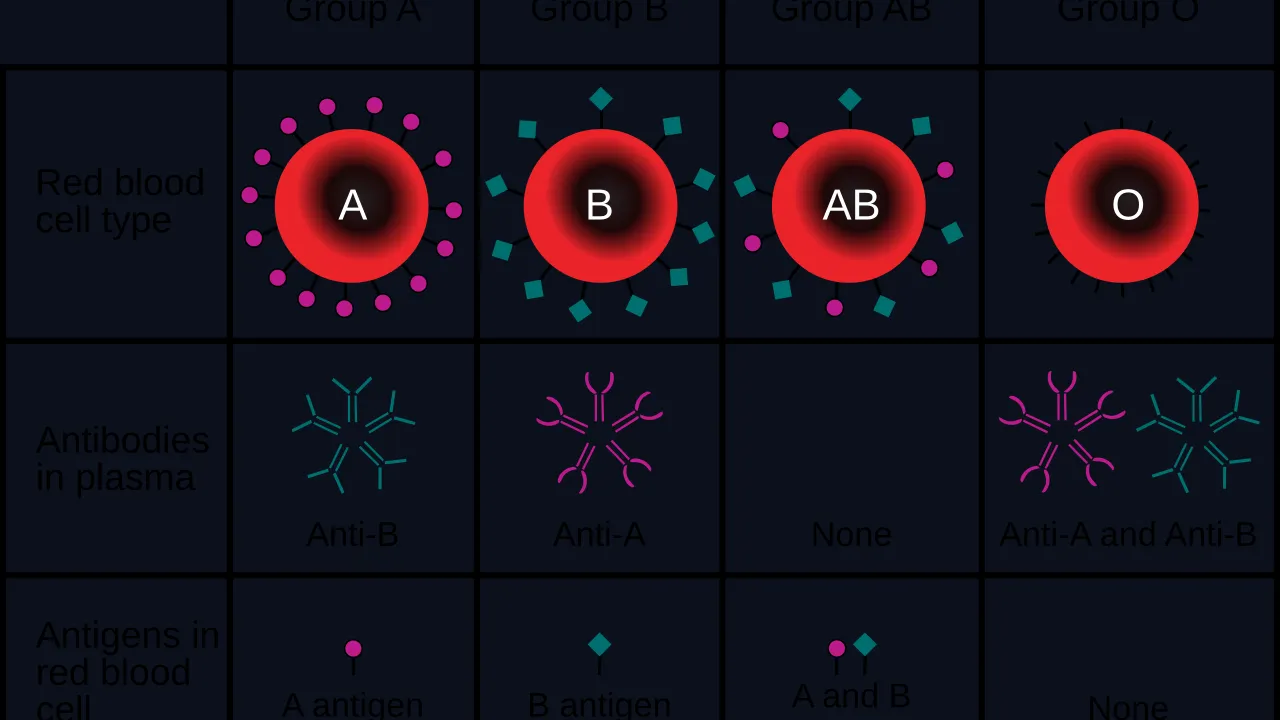
Look at two drops of blood, and they both look bright red! Yet zoom in super close, and red blood cells wear tiny name tags. These tags sort human blood into four teams: A, B, AB, and O.
2
Tags From Your Family
How do you get your blood team? You it from your parents, just like eye color or curly hair! Type A wears A tags, Type B wears B tags, and AB wears both.
3
Smooth Type O
Type O cells are smooth with zero A or B tags, making them extra friendly helpers at hospitals!
1. What are the four main ABO blood groups in humans?
2. Which blood group has smooth red blood cells with neither A nor B tags?
🤯 Mind-Blowing Fact • Grade 2
Type O-positive is the most common blood type in the world, shared by more than one out of every three people!
✨ Word Sparks (Grade 2 Glossary)
Tap 🔊 to hear
Transfusion
Giving healthy donated blood to help someone heal
Clump
To stick together in a tight little bunch
Rh factor
An extra protein tag making blood positive or negative
🪝
Why must doctors match blood letters carefully before sharing donated blood?
1
Microscopic Sugar Sprinkles
Imagine four kinds of red cupcakes! One has A sprinkles, one has B sprinkles, one has both A and B sprinkles, and the plain one has none at all. Your red blood cells work the very same way, wearing tiny sugar chains that give you blood type A, B, AB, or O.
2
Picky Immune Guards
Your white blood cells memorize your own sprinkle pattern completely. If someone with Type A blood received Type B cells, immune proteins in their plasma would spot the unfamiliar B tags and them up!
3
Plus or Minus Too
Cells also check for one extra protein tag called the . Having it adds a plus sign, like O-positive, while lacking it adds a minus sign, giving humans eight main blood types!
1. What are the A and B markers on red blood cells actually made of?
2. What gives a blood type its 'positive' or 'negative' sign?
🤯 Mind-Blowing Fact • Grade 3
Every single Type A red blood cell wears up to two million microscopic 'A' sugar tags across its outer coat!
✨ Word Sparks (Grade 3 Glossary)
Tap 🔊 to hear
Universal
Working safely for everyone across the whole group
Compatible
Able to mix together safely without any trouble
Gene
A DNA instruction passed from parents to kids
🪝
Why is Type O-negative called the 'universal donor' while AB-positive is the 'universal receiver'?
1
Solving a Centuries-Old Mystery
For hundreds of years, doctors wondered why sharing blood between two patients sometimes saved a life right away, yet other times caused dangerous clumping. In 1901, Austrian scientist Karl Landsteiner mixed tiny blood drops from himself and his lab coworkers on glass slides and cracked the puzzle: human blood comes in distinct groups!
2
Antigens on Cells, Antibodies in Plasma
Each red blood cell carries up to two million surface sugar tags, called antigens. Meanwhile, your liquid plasma carries matching guard proteins called antibodies against whichever tags you DO NOT have. Type A blood carries anti-B antibodies, while Type O plasma carries both anti-A and anti-B antibodies.
3
Universal Donors and Receivers
Because Type O-negative red blood cells wear zero A, B, or Rh antigens, nobody's antibodies attack them—making O-negative the red-cell donor for emergencies! Conversely, a person with AB-positive blood already recognizes A, B, and Rh tags as friendly, so they can safely receive red cells from any of the eight main types.
4
Passed Down in Genes
Your DNA holds two ABO copies—one from each parent—determining your lifelong blood type before you are even born.
1. Why can Type O-negative red blood cells be safely given to patients of any major blood type in an emergency?
2. Who discovered the ABO blood group system in 1901 by testing drops of blood on glass slides?
🤯 Mind-Blowing Fact • Grade 4
For liquid plasma donations, the universal rule flips completely upside down—rare Type AB is the universal plasma donor because its plasma holds zero anti-A or anti-B antibodies!
✨ Word Sparks (Grade 4 Glossary)
Tap 🔊 to hear
Allele
One specific version of an inherited DNA gene
Codominant
When two inherited gene versions show up equally
Agglutination
Clumping of cells when antibodies grab matching antigens
🪝
How can two parents—one with Type A blood and one with Type B blood—have four children with four completely different blood types?
1
Building Sugar Trees with Enzymes
Zoom down to the molecular scale on a red blood cell membrane, and you will find forest-like chains of sugars called oligosaccharides. Almost everyone starts with the same foundational sugar stalk, known as the H antigen. What happens next depends on a single gene on chromosome 9 that codes for a sugar-attaching enzyme!
2
Dominant, Recessive, and Codominant Genetics
The A version () of that gene builds an enzyme that snaps one specific sugar cap onto the H stalk, while the B allele builds an enzyme that snaps on a slightly different sugar cap. The O allele codes for an inactive enzyme that leaves the H stalk bare! Because A and B are over recessive O, inheriting an A from one parent and a B from the other expresses BOTH enzymes equally—producing Type AB blood. Meanwhile, if one parent carries hidden genotype AO and the other carries BO, their children could inherit AB, AO (Type A), BO (Type B), or OO (Type O)!
3
Why Plasma Compatibility Flips Backward
Here is a clever twist doctors use every day: while Type O is the universal donor for red blood cells, Type AB is the universal donor for liquid plasma! Because Type AB individuals recognize both A and B antigens as 'self,' their golden plasma contains neither anti-A nor anti-B antibodies.
4
Rapid Lab Cross-Matching
Before any hospital transfusion, technologists mix tiny drops of patient blood with lab antibody reagents—watching for (clumping) to confirm an exact, safe match in minutes.
1. Why are the A and B blood group alleles described as 'codominant'?
2. Why is Type AB the universal donor for liquid blood plasma?
🤯 Mind-Blowing Fact • Grade 5
Biotechnologists have discovered friendly gut-bacterial enzymes that act like molecular scissors, snipping A and B sugars off donated red blood cells to turn them into universal Type O blood!
✨ Word Sparks (Grade 5 Glossary)
Tap 🔊 to hear
Glycosyltransferase
An enzyme that attaches specific sugar molecules together
Immunoglobulin
A specialized Y-shaped or star-shaped antibody protein
Phenotype
The observable physical traits produced by your genes
🪝
Why did evolution preserve four competing ABO blood groups across humanity—and even in chimpanzees and gorillas—for millions of years?
1
Glycosyltransferase Chemistry on Chromosome 9
At the biochemical level, the ABO locus at chromosome 9q34 does not encode blood antigens directly; instead, it encodes enzymes that remodel glycolipids and glycoproteins protruding from erythrocyte membranes (and many epithelial tissues). Starting from a fucosylated precursor called the H antigen, the A-transferase attaches N-acetylgalactosamine, whereas the B-transferase—differing by just four critical amino acids—attaches D-galactose. A single-nucleotide frameshift deletion in the common O allele yields a truncated, nonfunctional enzyme, leaving unmodified H structures intact.
2
Natural IgM Antibodies and RhD Immunogenicity
During infancy, harmless gut bacteria wearing carbohydrate structures resembling A and B sugars stimulate the immune system to produce pentameric M (IgM) antibodies against whichever ABO antigens the infant's own cells lack. In contrast, the Rh blood group system—named after rhesus macaques studied by Karl Landsteiner and Alexander Wiener in 1940—centers on transmembrane proteins, especially the D antigen (RhD). Anti-RhD IgG antibodies typically form only after direct exposure to Rh-positive blood, which is why modern preventive Rh-immunoglobulin injections revolutionized newborn care.
3
Evolutionary Tug-of-War Against Pathogens
Why hasn't natural selection settled on a single blood type? Evolutionary geneticists point to balancing selection driven by infectious microbes! For instance, severe Plasmodium falciparum malaria parasites bind less tightly to Type O erythrocytes, making Type O dramatically higher in historically malarial regions, whereas certain cholera strains affect blood groups unequally—preserving diversity across populations.
4
Beyond ABO: Over Forty Blood Group Systems
Today, the International Society of Blood Transfusion recognizes more than forty distinct human blood group systems encompassing over 360 antigens, including the ultra-rare 'Bombay ' (hh), which lacks even the foundational H stalk!
5
Enzymatic Quest for Universal Blood
Biomedical engineers are currently testing benign gut-bacterial enzymes capable of snipping terminal A and B sugars cleanly off donated erythrocytes—potentially converting common blood units into universal Type O supplies for hospitals worldwide.