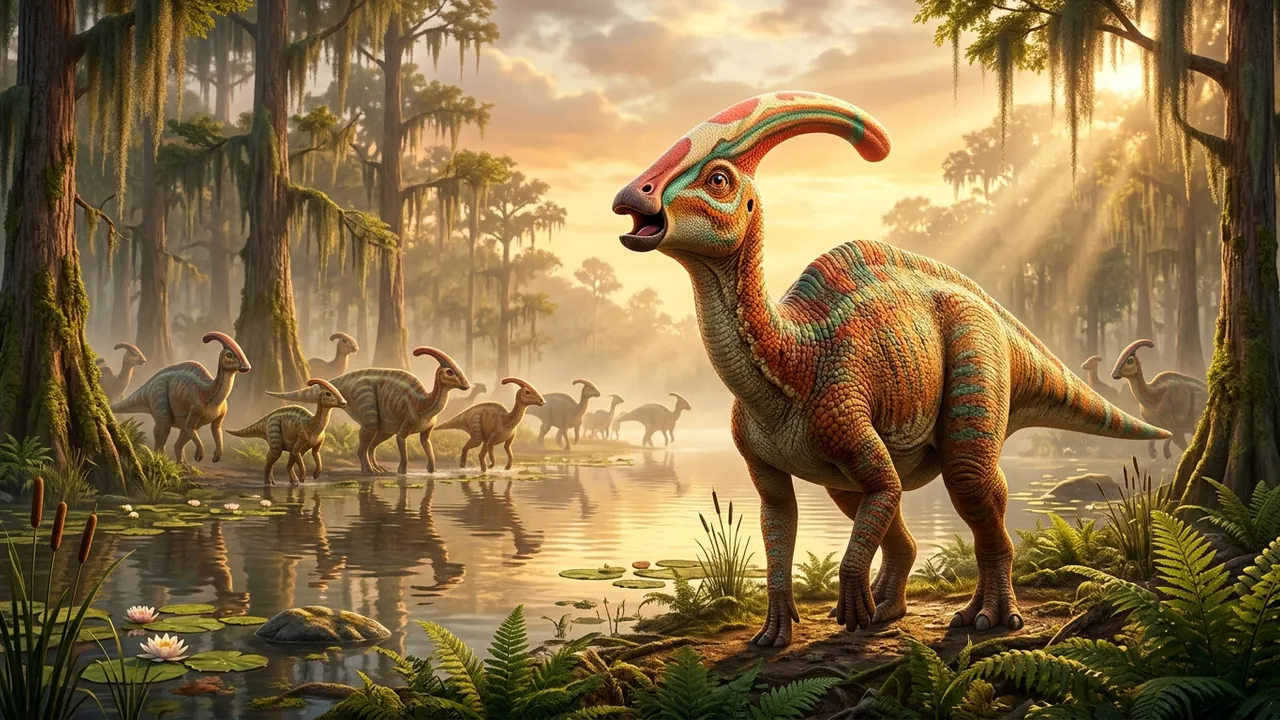
Meet the Legend: Crown of Lambeosaurines
Among all ornithischian dinosaurs of the Late Cretaceous, few achieved a cranial architecture as audacious as Parasaurolophus, the flagship genus of hollow-crested hadrosaurids. Mature adults measured nine point five to ten meters in total body length and weighed between two point five and four metric tons, combining comfortable quadrupedal foraging posture with powerful bipedal cursorial capability across open coastal floodplains.
Taxonomists currently recognize three valid species distributed across western North America: northern type species Parasaurolophus walkeri from Alberta, huge long-crested Parasaurolophus tubicen from New Mexico, and smaller, sharply decurved Parasaurolophus cyrtocristatus recovered from southern Utah and northern New Mexico. Each species differed subtly in crest curvature, internal airway complexity, and adult body proportions.
Whereas solid-crested saurolophine cousins such as Edmontosaurus or Saurolophus carried flat nasal arches devoid of internal airways, every lambeosaurine routed its primary nasal respiratory tract directly upward into an expanded bony cranial crest rising dramatically behind the orbits.
A landmark 2021 anatomical redescription demonstrated conclusively that hypertrophied premaxillary upper-snout bones—rather than nasal bones alone—constructed almost the entire external tubular wall of Parasaurolophus's sweeping projection, braced basally against an interlocking sutural platform on the frontal skull roof while stiffened dorsal tendons balanced its long tail horizontally.
Tracking cranial from tiny nestling to mature adult further reveals that these iconic hollow tubes functioned simultaneously as species-specific visual recognition banners beneath shady forest canopies and resonant low-frequency bioacoustic horns that united dispersed herds across vast wetlands. Soft skin flaps may also have stretched lightly between the lower crest edge and muscular neck.
Lost World Habitat: Campanian Basin Stratigraphy
Fossil occurrences of Parasaurolophus span a remarkable two-thousand-kilometer latitudinal corridor along the eastern coastal plain of Laramidia during the late Campanian stage of the Late Cretaceous. Field geologists correlate these fossiliferous horizons precisely across Alberta's Dinosaur Park Formation, southern Utah's Kaiparowits Formation, and New Mexico's Fruitland and Kirtland Formations.
High-precision argon-argon dating of microscopic volcanic sanidine crystals preserved inside interbedded bentonite ash layers constrains this Campanian tightly between seventy-six point five and seventy-three million years ago—roughly seven million years prior to Maastrichtian giants Tyrannosaurus rex and Triceratops.
During this warm greenhouse interval, shallow marine waters of the Western Interior Seaway flooded central North America continuously from the Arctic Ocean to the Gulf of Mexico, creating humid alluvial deltas threaded by meandering rivers, peat-accumulating bald-cypress swamps, and seasonally flooded oxbow bayous.
Regional basin stratigraphy documents intriguing ecological provincialism between northern and southern ecosystems: P. walkeri browsed cool-temperate taxodiaceous conifer and fern forests alongside Centrosaurus and Gorgosaurus in Alberta, whereas P. cyrtocristatus and P. tubicen inhabited warmer subtropical floodplains in Utah and New Mexico patrolled by southern tyrannosaurid Teratophoneus and giant crocodylian Deinosuchus.
Despite consistently representing a rarer community member than sympatric helmet-crested Corythosaurus or flat-headed Gryposaurus in bonebed censuses, this specialized thrived wherever dense riparian woodlands bordered deep, slow-moving river channels across western North America. Fossil leaf cuticles and wood growth rings from these beds indicate warm wet summers with virtually zero winter frost, sustaining abundant evergreen browse throughout all twelve months.
What's on the Prehistoric Menu?
Hadrosaurids achieved one of the highest herbivore abundances of the entire Mesozoic Era largely through a revolutionary feeding apparatus uniting multi-tooth grinding pavements with cranial . When Parasaurolophus closed its jaws, isognathous lower dentaries wedged upward between mobile upper maxillae, causing both upper cheek units to pivot slightly outward against streptostylic quadrate hinges and scrub tough plant fibers transversely across both sides simultaneously.
Each quadrant of the mouth housed thirty to forty interlocking vertical tooth families containing three to five stacked replacement crowns apiece, forming a continuous rough grinding block composed of six distinct dental tissues of varying mineral hardness and wear resistance.
Differential wear across peripheral enamel ridges, orthodentine, secondary dentine, mantle dentine, and supporting cementum maintained self-sharpening rasps capable of pulverizing fibrous conifer needles, ginkgo shoots, tough broadleaf angiosperms, and silica-laden horsetails far more thoroughly than sauropod or ankylosaur dentitions ever could.
Paleobotanical gut residues and permineralized coprolites recovered directly from Campanian reveal another surprising dietary behavior: hadrosaurs periodically consumed rotting conifer logs riddled with white-rot fungi and protein-rich detritus-feeding crustacean or insect larvae along damp forest floors!
This seasonal dietary flexibility supplied vital amino acids, calcium, and trace minerals for egg-laying females during reproductive nesting cycles, while efficient pleurokinesis extracted maximum caloric yield from coarse floodplain browse throughout every season of the year. Broad keratinous bills cropped vegetation cleanly from water level up to four meters overhead without damaging delicate inner tooth stacks during long daily foraging sessions.
Superpowers & Anatomy: Bioacoustics & Baby Joe
Non-destructive X-ray computed tomography has transformed Parasaurolophus from a century-old paleontological enigma into a textbook model organism for paleobioacoustics and developmental biology. Inside New Mexico's P. tubicen, paired respiratory tracts ascended dorsal premaxillary tubes nearly to the posterior crest apex, looped sharply downward through ventral return conduits, and branched into blind lateral diverticula totaling almost two point nine meters of continuous air-column length!
Acoustic boundary-element simulations conducted jointly by Sandia National Laboratories computer scientists and museum paleontologists demonstrated that exciting this closed-pipe column generated rich fundamental frequencies near thirty to forty-eight Hertz, accompanied by resonant brass-like harmonic overtones capable of carrying across several kilometers.
Endocranial CT casts of the inner ear independently corroborated this vocal communication hypothesis, revealing a markedly elongated lagena cochlear duct neurologically specialized to resolve low-frequency airborne vibrations through dense swamp vegetation while large optic lobes processed visual herd cues.
Equally transformative was the 2013 description of specimen RAM 14000—nicknamed Joe—an exquisitely articulated juvenile P. cyrtocristatus excavated from southern Utah's Kaiparowits Formation mudstones. Thin-section long-bone histology revealed rapid vascularized fibrolamellar bone deposition with zero annual lines of arrested growth, proving two-meter-long Joe died before reaching his very first birthday!
Across lambeosaurine , Joe's low, dome-like forehead boss began elongating backward into a hollow tube only during subadult maturation, shifting vocal resonance progressively deeper in pitch as growing individuals entered the adult breeding herd and established social bonds. Blood-rich mucosal linings inside those loops simultaneously aided cranial thermoregulation during warm subtropical afternoons.
Flight vs. Fight Arena! Acoustic Herd Defense
Comparing Late Cretaceous megaherbivores illustrates divergent evolutionary solutions to intense tyrannosaurid predation across western Laramidia's coastal floodplains. Whereas ankylosaurids and ceratopsians invested heavy metabolic calcium into dermal osteoderm shields or cranial horns for close-quarters defense, every committed fully to collective vigilance, herd cohesion, and rapid Team Flight.
In Alberta's Dinosaur Park ecosystems, slender-limbed tyrannosaurid Gorgosaurus libratus possessed elongated tibiae and compressed arctometatarsalian foot bones engineered for high-speed ambush chases through forest clearings, outpacing its stockier sympatric cousin Daspletosaurus across soft delta substrates and muddy riverbanks.
Unarmored Parasaurolophus countered this cursorial threat long before physical contact ever occurred: elevated lateral orbital sockets provided wide panoramic surveillance above marsh reeds, while booming thirty-Hertz crest alarms propagated with minimal acoustic attenuation through dense cypress swamps to alert dispersed herd subgroups several kilometers away in seconds.
Once warned, subadults and adults transitioned seamlessly from quadrupedal browsing into balanced bipedal sprints, powered by massive caudofemoralis longus tail-retractor muscles anchored along proximal caudal vertebrae while continuous high-efficiency feeding via sustained exceptional aerobic stamina over long escape distances.
Furthermore, predictable shifts in crest resonance across allowed mothers to distinguish higher-pitched juvenile distress calls instantly amid herd commotion, guiding vulnerable yearlings safely into deep fluvial channels where tall, tendon-latticed tails propelled swift aquatic retreats far beyond any terrestrial predator's reach. Coordinated group movement across wide sandbars also created dynamic visual confusion that disrupted single-target stalking tactics employed by solitary or pack-hunting tyrannosaurs patrolling coastal bayous from dawn until dusk.
Fossil Detective Secrets: Three Species in Stone
More than a century of fossil sleuthing across western North American was required to assemble a complete evolutionary portrait of Parasaurolophus. Field collector Levi Sternberg unearthed the articulated holotype skeleton along Alberta's Red Deer River in 1920, prompting Royal Ontario Museum paleontologist William Parks to erect Parasaurolophus walkeri two years later in honor of museum benefactor Sir Byron Edmund Walker.
In 1931, Swedish researcher Carl Wiman described New Mexico's massive, labyrinth-crested P. tubicen, followed in 1961 by John Ostrom's landmark description of shorter, strongly curved P. cyrtocristatus recovered from coal-bearing Fruitland beds in the San Juan Basin.
For decades, early twentieth-century museum murals depicted hadrosaurs as sluggish, tail-dragging swamp creatures breathing underwater through snorkel-tipped crests—until rigorous anatomical studies proved the crest lacked any apical opening, ossified vertebral tendons locked the tail horizontally, and padded hooves suited firm terrestrial floodplains.
Recent breakthroughs in 2021 led by paleontologists Terry Gates and Joe Peterson described a superbly preserved New Mexico skull of P. cyrtocristatus, uniting both southern species as closest sister taxa on the evolutionary tree while precise ash-bed dates mapped rapid species turnover across Campanian basins.
From rapid-growing, bump-headed yearlings preserved in Utah mudstones to six-foot trumpeting adults in Canadian river cliffs, this iconic endures in stone as paleontology's premier window into prehistoric bioacoustics, family care, and social herd communication across deep time. Every newly scanned fossil crest continues to refine how ancient Cretaceous wetlands sounded seventy-five million years ago across western North America.