Meet the Legend: Musical Hadrosaur
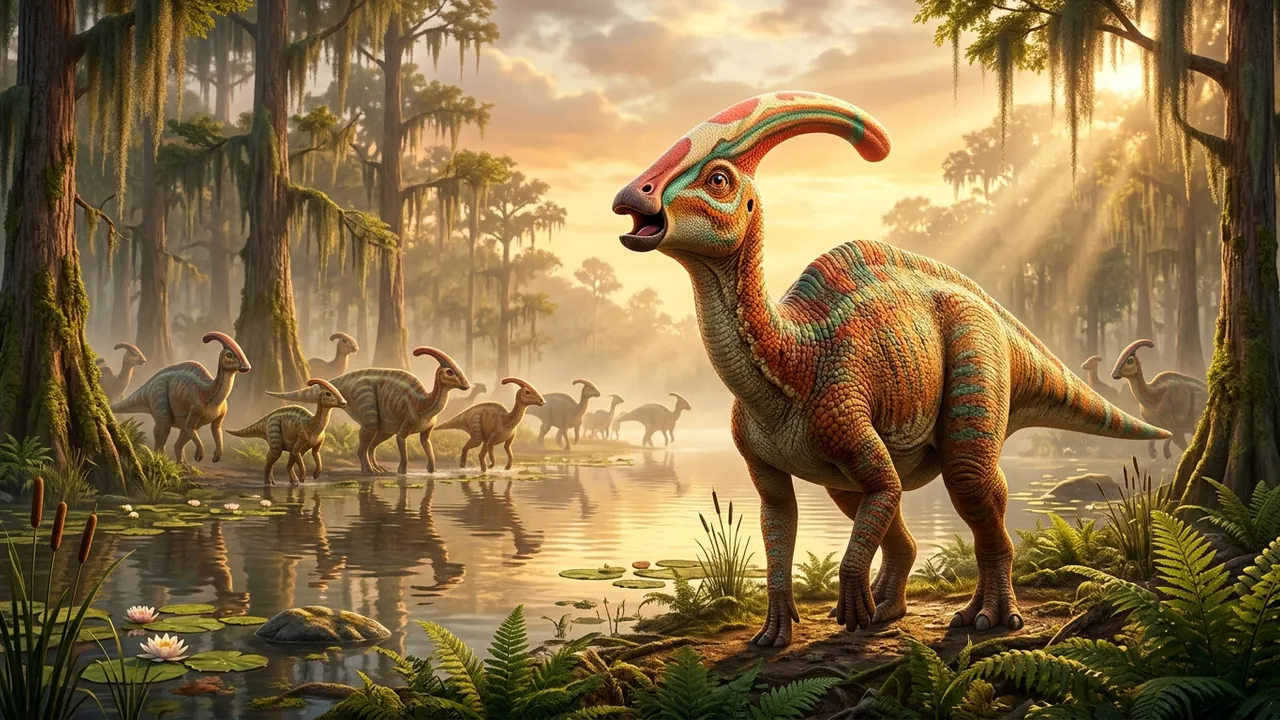
Few dinosaurs ever wore a silhouette as unforgettable as Parasaurolophus walkeri, one of the grandest members of the duck-billed family. Measuring more than thirty feet from broad beak to tail tip and weighing up to four tons, an adult stood as tall as an elephant whenever it reared upright on two muscular hind legs.
Its Greek name translates to near crested lizard, highlighting a spectacular structural rising from the top of its skull. Sweeping smoothly backward over its neck and shoulders curved a hollow bony tube up to six feet long!
Unlike horned or club-tailed neighbors built like heavy fortresses, this agile hadrosaur combined comfortable four-legged grazing with swift two-legged running across coastal plains. Paired with keen eyesight, acute low-pitched hearing, and expressive social calls, Parasaurolophus turned herd communication and teamwork into top prehistoric survival tools.
Lost World Habitat: Laramidia's Deltas
Seventy-six to seventy-three million years ago during the Late Cretaceous Period, Parasaurolophus ranged across lush coastal lowlands stretching from Alberta, Canada, southward through Utah and New Mexico. At that time, the warm Western Interior Seaway split North America into western Laramidia and eastern Appalachia.
While Virginia's Culpeper Basin on the eastern landmass preserves much older Early Mesozoic dinosaur footprints pressed into red quarry sandstone, Parasaurolophus flourished along western Laramidia's swampy river deltas millions of years later. Heavy seasonal rains fed meandering bayous, oxbow lakes, bald cypress groves, tall conifers, and early flowering magnolias.
Across this vibrant wetland , traveling herds shared muddy sandbars and fern glades with spiky-frilled Styracosaurus, club-tailed ankylosaurs, giant soft-shelled river turtles, and alligator-like hunters. Mild coastal breezes off the inland sea kept fresh green foliage sprouting steadily through every season of the year!
What's on the Prehistoric Menu?
Within the coastal swamp , green conifers, horsetails, and flowering shrubs captured solar energy as producers, while Parasaurolophus acted as an industrious primary consumer herbivore. Because it could drop onto four legs to graze knee-high ferns or rear upright to browse branches thirteen feet overhead, few woodland plants grew out of reach!
First, its wide, toothless duck bill edged in sharp keratin stripped tough pine needles, willow-like leaves, and fibrous marsh reeds cleanly from branches. Muscular cheeks kept sliced greenery tucked neatly inside its mouth while chewing.
Deep inside its jaws sat a masterpiece of feeding : tightly interlocked columns holding hundreds of small diamond-shaped teeth! Sliding past each other at an angle, those rough tooth pavements ground woody twigs and gritty needles into fine pulp that nourished every active in the herd.
Superpowers & Anatomy: Low-Pitch Resonance
Why did Parasaurolophus carry a six-foot bone tube above its shoulders? Rather than serving as a weapon, that hollow crest functioned as a biological wind instrument powered by acoustic ! Every breath inhaled through the nostrils traveled up twin pipes to the crest tip, looped around a U-turn, and flowed down into the lungs.
When the dinosaur exhaled forcefully, vibrating air waves bounced through nearly ten feet of coiled bone passages. Just like lengthening a slide trombone lowers its musical note, those long internal chambers produced deep, rumbling resonance across the valley!
High-pitched squeaks scatter quickly against dense tree trunks, whereas low-pitched waves roll smoothly over thick bushes and calm water for several miles. Paired with colorful skin patterns across the crest, this communication helped mothers, youngsters, and herd mates stay safely connected across foggy bayous.
Flight vs. Fight Arena! Herd Early Warning
Sharing the river-delta with thirty-foot tyrannosaur Gorgosaurus meant danger could burst from the cypress shadows at any moment. Unlike club-tailed tanks or three-horned defenders built to stand and clash head-on, Parasaurolophus wore thin pebbly skin with zero bony armor plates.
Instead, keen senses, social teamwork, and swift athleticism made this fleet-footed browser a true champion of Team Flight! While most herd members lowered their heads to feed on marsh ferns, alert sentinels stood tall scanning shady riverbanks with wide-set eyes and sensitive inner ears.
At the first snap of dry brush, a lookout blasted a booming alarm powered by crest that echoed instantly across the misty bayou! Alerted neighbors shifted their weight onto muscular hind legs, sprinting away in coordinated waves or plunging into deep river channels where heavy land predators struggled to follow.
Fossil Detective Secrets: Singing Skulls
Flooding rivers across ancient Alberta, Utah, and New Mexico washed thick blankets of sand, silt, and volcanic ash over dinosaur bones, preserving exquisite skeletons for modern science. Some fine-grained sandstone blocks even captured pebble-patterned skin impressions along the neck and flanks!
For decades after its 1922 naming, old textbooks mistakenly drew Parasaurolophus underwater using its crest like a diver's snorkel. Once fossil detectives proved the crest tip was completely solid bone, hospital CT scanners mapped the hidden airways inside without harming the stone skull.
Digital airflow models recreated the deep of an adult's call—and in 2009, high school student Kevin Terris spotted a tiny yearling skeleton eroding from Utah mudstone sediment! Nicknamed Joe, that remarkable youngster wore only a low forehead bump, proving Parasaurolophus crests grew longer—and deeper in voice—as babies grew up!