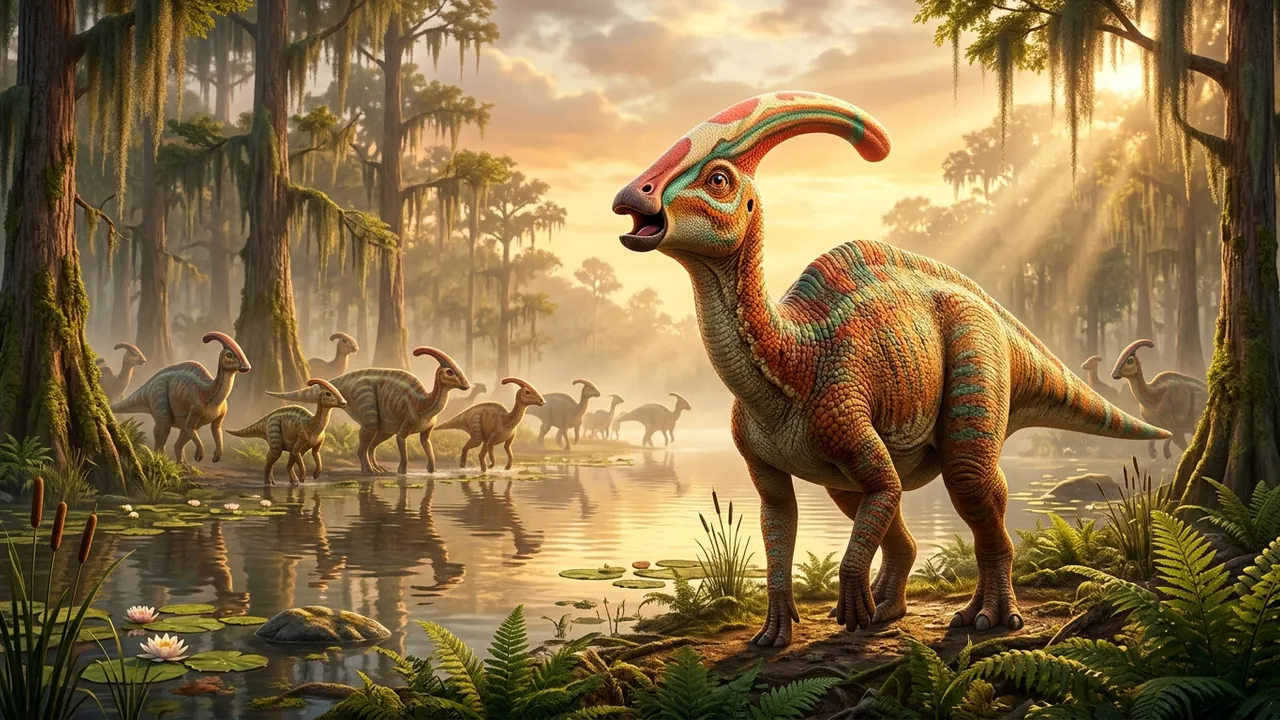
Meet the Legend: Brass-Horn Giant
Picture a dinosaur slightly longer than a yellow school bus wearing a curved six-foot trumpet on top of its head! That remarkable plant-eater was Parasaurolophus (PAIR-uh-sor-OL-uh-fus), whose Greek name means near crested lizard. Weighing as much as two family SUVs, it moved gracefully on four sturdy legs while grazing low ferns.
Whenever it wanted to reach high leaves or run fast, it tipped upward onto two powerful hind legs balanced by a long, muscular tail. Up front, a broad duck-shaped beak rimmed in hard sat beneath its sweeping hollow bone .
Lost World Habitat: Cypress Bayous
Seventy-six to seventy-three million years ago, Parasaurolophus lived across warm coastal plains from Alberta, Canada, all the way south to Utah and New Mexico. Winding rivers spilled into misty swamps shaded by towering bald cypress trees, redwood groves, and floating carpets of water lilies.
Noisy herds of Parasaurolophus shared these lush wetlands with spiky-frilled Styracosaurus, armored tanks, and giant river gars. Sticking close together beside open bayou water helped dozens of sharp eyes watch the treeline in case a hungry tried sneaking through the ferns!
What's on the Prehistoric Menu?
Feeding a three-ton dinosaur took hundreds of pounds of chewy plants every day! Standing on all fours, Parasaurolophus cropped soft marsh plants and horsetails along muddy banks. Rearing onto its hind legs let it pluck pine needles, ginkgo leaves, and tender twigs thirteen feet off the ground.
First, its wide duck bill wrapped in sharp stripped whole mouthfuls cleanly off branches. Next, tightly packed stacks of up to six hundred small diamond-shaped cheek teeth ground woody stems back and forth like coarse carpentry sandpaper!
Superpowers & Anatomy: Foghorn Tube
Slice open a model of Parasaurolophus's six-foot and you will find twin U-shaped air pipes looping from its nostrils to the back tip and all the way down to its throat! Uncoiled straight, that hidden airway stretched nearly ten feet—longer than an orchestral brass trombone.
When Parasaurolophus blew a big breath through those looping tubes, its hollow crest boomed a low, rumbling note like a ship's foghorn. Deep sounds traveled for miles through thick swamp trees without fading, warning distant herd mates long before any got close!
Flight vs. Fight Arena! Sound the Alarm
Fierce tyrannosaur cousin Gorgosaurus patrolled those same coastal forests on long, speedy legs! Unlike armored dinosaurs that swung tail clubs or sharp horns, sleek Parasaurolophus carried zero body armor. Its winning survival secret was teamwork and speed on Team Flight!
While friends munched needles, tall lookouts scanned the shadows with wide side-facing eyes. The instant a stepped near, a lookout tilted its skyward and blasted an ear-rumbling alarm! Immediately, the entire herd reared onto two muscular legs, sprinting twenty-five miles per hour or splashing across a deep channel.
Fossil Detective Secrets: Busted Snorkel!
After Canadian collectors unearthed the first Parasaurolophus skull in 1920, early books guessed its hollow worked like a submarine snorkel for breathing underwater! Careful inspection soon busted that myth: every confirmed the crest tip was solid bone with zero air hole on top.
In 1995, scientists scanned a New Mexico skull with hospital X-rays and used computers to play its haunting trombone call for the first time in seventy-five million years! Years later in Utah, another paleontologist team uncovered baby skeleton Joe—proving hatchlings started with tiny forehead bumps!