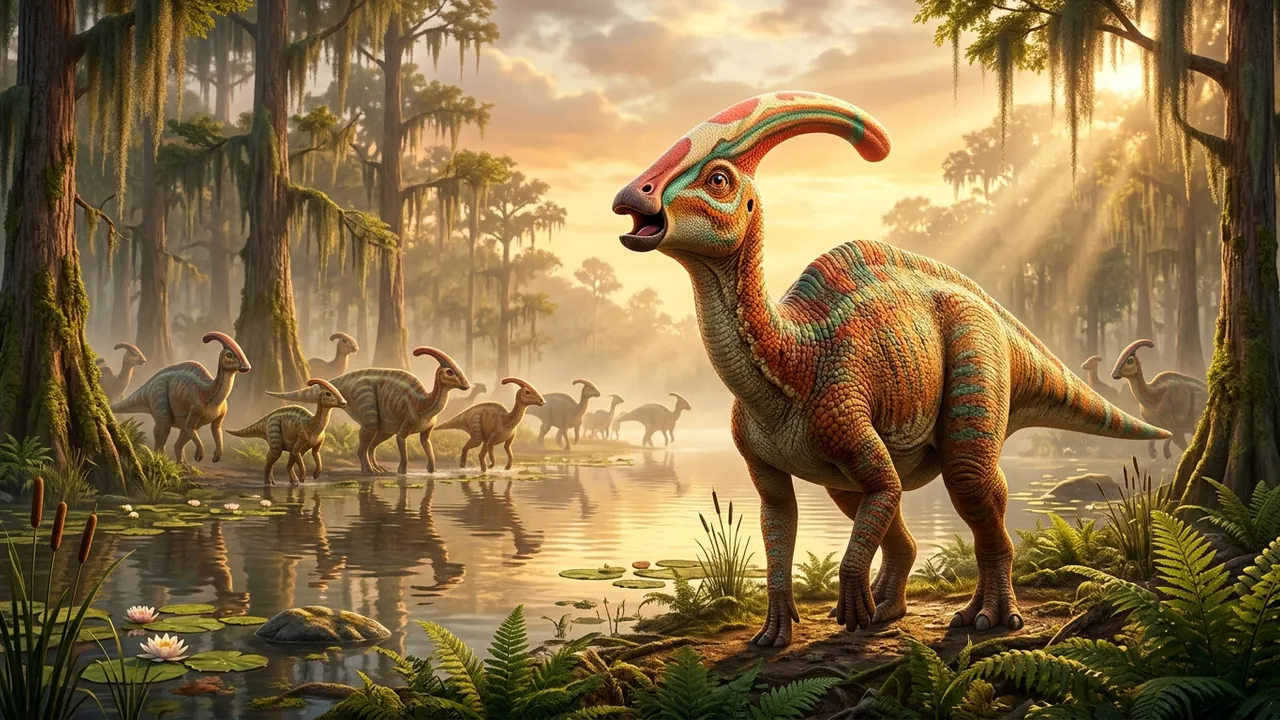
Meet the Legend: Acoustic Engineering
Stretching thirty-one to thirty-three feet from flattened duck bill to tail tip and weighing up to four tons, Parasaurolophus walkeri ranked among the most striking herbivores of the Late Cretaceous. Unlike rigidly quadrupedal armored tanks, its skeletal allowed seamless posture switching—grazing comfortably on four limbs before shifting its center of mass over pillar-strong hind legs for rapid bipedal sprints across open riverbanks.
Three weight-bearing middle digits on each slender forelimb wore blunt hoof-like pads suited for firm floodplain ground, while broad three-toed hind feet absorbed heavy running shock cleanly.
Rising from the tip of its snout swept an extraordinary tubular crest nearly six feet long, built not from solid horn cores, but from thin-walled premaxillary and nasal bones arched high behind the skull over the neck.
Inside that sweeping bony scabbard ran paired, hollow breathing passages that functioned as an acoustic resonator tuned to a remarkably deep vocal audible across dense wetlands.
Cross-braced ossified tendons latticed along tall vertebral spines stiffened its heavy tail horizontally, counterbalancing the elongated skull and muscular neck smoothly over the hips as Parasaurolophus turned bioacoustics into a frontline evolutionary superpower.
Lost World Habitat: Coastal Delta Food Webs
Between seventy-six and seventy-three million years ago, Parasaurolophus inhabited lush subtropical river deltas and coastal swamps bordering the Western Interior Seaway from Alberta south to Utah and New Mexico. Braided river channels wound through dense canopies of bald cypress, dawn redwood, araucaria conifers, tree ferns, and flowering broadleaf trees.
Within this high-productivity wetland food web, duck-billed herds served as dominant primary consumer engines at the base of the vertebrate pyramid. By converting vast quantities of tough needles, leaves, and marsh vegetation into multi-ton herd biomass, hadrosaurs sustained diverse terrestrial and aquatic food chains.
Dense swamp foliage and hanging Spanish-moss-like epiphytes limited line-of-sight visibility to just a few dozen yards across misty bayous, creating an urgent ecological challenge for large social groups grazing apart through shadowy woods.
Parasaurolophus solved that visibility barrier through acoustic physics: broadcasting low- calls dipping close to elephant-like kept scattered foraging subgroups coordinated across several miles of flooded timber without requiring constant visual contact.
Alongside horned centrosaurines, club-tailed ankylosaurs, soft-shelled trionychid turtles, giant bowfin fish, and crocodilian hunters, these trumpeting herds shaped every sunlit riverbank clearing and damp woodland trail.
What's on the Prehistoric Menu?
Fueling an active three-to-four-ton dinosaur required processing hundreds of pounds of woody twigs, conifer needles, and silica-rich horsetails every single day. Up front, a broad flared beak rimmed in fluted keratin stripped whole leafy shoots cleanly at heights ranging from ground level up to thirteen feet overhead.
Behind the toothless beak sat one of prehistory's most sophisticated chewing machines—a hadrosaur packing three hundred to six hundred diamond-shaped teeth simultaneously! Each jaw quarter held dozens of vertical columns stacking up to five replacement teeth deep, though only the active surface row contacted food at once.
Even more impressive was its jaw : unlike mammals that swing lower jaws sideways to grind grass, Parasaurolophus possessed mobile upper cheek hinges. As the lower jaw pressed upward, both upper maxillae flexed slightly outward, dragging upper and lower tooth pavements across each other like dual industrial power sanders!
Because each tooth combined hard enamel, medium dentine, and supportive cementum that wore down at different rates, chewing automatically maintained rough, self-sharpening ridges.
Pulverizing stubborn plant cells before swallowing maximized digestive energy extraction inside its long gut, powering its primary consumer role across all four seasons.
Superpowers & Anatomy: 30-Hertz Trombone
Peering inside a Parasaurolophus skull with X-ray tomography reveals an astonishingly intricate wind pathway. Inhaled air entered paired nostrils, climbed parallel dorsal tubes all the way to the crest's rear tip, folded around a sharp hairpin bend, descended ventral tubes into side chambers, and finally entered the windpipe—nearly ten feet of continuous bone tubing!
Acoustic physics explains why natural selection favored such an elongated loop. In any open or closed pipe, lengthening the vibrating air column lowers its resonant , producing a much longer sound wavelength that resists fading over distance.
Whereas high-frequency bird chirps bounce off tree trunks and fade within yards, deep waves vibrating between 30 and 48 Hertz—right at the edge of human hearing and elephant —bend cleanly around swamp cypress trunks and carry across several miles of misty marshland!
Casts of Parasaurolophus's inner ear confirm a matching sensory upgrade: an elongated cochlear hearing duct exquisitely sensitive to those exact low-pitched vibrations, paired with large optic lobes for spotting colorful crest displays.
Simultaneously, blood-rich nasal membranes lining that long pathway helped cool warm arterial blood flowing near the brain during vigorous midday foraging.
Flight vs. Fight Arena! Coordinated Evasion
Coastal floodplains of Alberta and Montana were patrolled by fleet-footed tyrannosaurid Gorgosaurus—a two-ton apex hunter armed with serrated banana-shaped teeth and long shin bones built for twenty-five-mile-per-hour pursuits. Unlike armored ankylosaurs or horned ceratopsians, Parasaurolophus carried zero defensive spikes or heavy bone shields.
Instead, every aspect of its anatomy and herd behavior optimized Team Flight ! Large side-mounted eyes provided wide panoramic vision while tall sentinel posture elevated lookouts high above dense marsh reeds and riverside shrubs.
The split second a stalking tyrannosaur betrayed its ambush, a sentinel blasted a booming low- alarm wave across the delta. Every herd member heard the directional rumble instantly, eliminating the surprise advantage predators relied upon to bridge levels during an attack!
Dropping slender forelimbs clear of the mud, adults accelerated rapidly on muscular bipedal hind legs powered by giant tail-retractor muscles, reaching estimated speeds matching or outlasting heavy-headed pursuers across soft floodplain terrain.
Where deep river channels bordered feeding grounds, herds also plunged directly into swift currents, sculling powerfully with tall, laterally flattened tails to leave land-bound hunters stranded harmlessly along the muddy riverbank.
Fossil Detective Secrets: Digital Soundscapes
Since paleontologist William Parks named Parasaurolophus walkeri from a magnificent Alberta skeleton in 1922, scientists debated dozens of wild hypotheses for its hollow crest—ranging from underwater breathing snorkels and air-storage tanks to foliage-pushing prows and specialized leaf-smelling chambers.
Anatomical inspection steadily ruled out aquatic gadgets once researchers verified the crest tip was completely sealed solid bone and its padded feet belonged to a terrestrial browser whose chewed tough land conifers and shrubs.
In 1995, computer scientists at Sandia National Laboratories teamed up with New Mexico paleontologists to perform high-resolution hospital CT scans on a Parasaurolophus tubicen skull containing extraordinarily complex internal air chambers.
By modeling digital airflow through those exact three-dimensional passages, their computer simulation generated a rich, resonant 30-Hertz trombone blast—recovering the authentic voice of an extinct dinosaur for the first time in history without needing fossilized soft vocal cords!
Then in 2013, researchers unveiled specimen RAM 14000—a nearly complete one-year-old juvenile nicknamed Joe excavated in southern Utah—proving hatchlings began life with short nasal domes whose vocal dropped steadily deeper as their crests elongated into adulthood alongside expanding lung capacity.