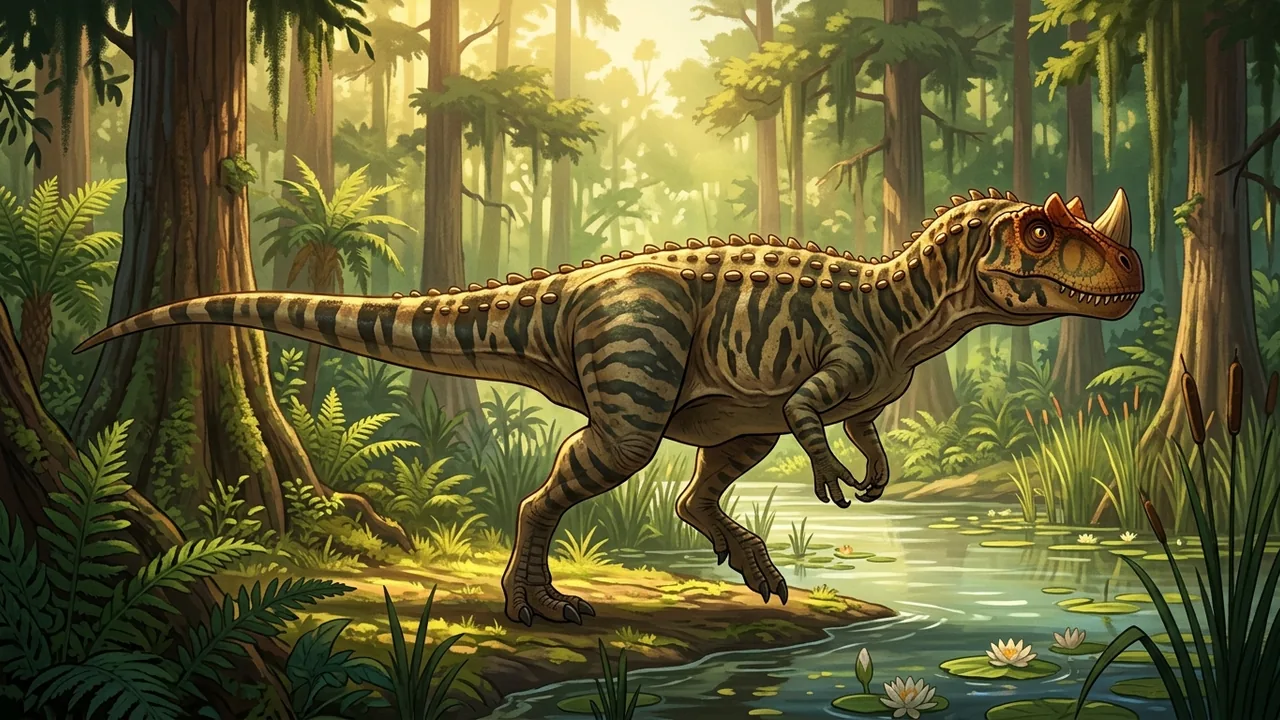
Meet the Legend: Namesake of Ceratosauria
Within Late Jurassic predator guilds dominated numerically by tetanurans, Ceratosaurus nasicornis stood apart as a striking evolutionary mosaic. Measuring 5.5 to 7 meters (18 to 23 feet) in length and weighing 500 to 900 kilograms, this lithe carnivore lent its name to an entire major branch of theropod evolution: Ceratosauria.
Phylogenetic demonstrates that Ceratosaurus shared a closer common ancestor with Cretaceous Gondwanan abelisaurids—such as bull-horned Carnotaurus—than with its own Morrison neighbor Allosaurus! That deep divergence explains its distinctive combination of ancestral and derived traits.
Unlike three-fingered tetanurans, Ceratosaurus retained four metacarpals and digits on shortened, muscular forelimbs, alongside co-ossified pelvic bones and fused tarsometatarsal ankle elements.
Atop its fused nasals rose a laterally compressed bony horn core complemented by paired triangular preorbital ridges on the lacrimals, while a median longitudinal row of keeled bony ossicles traced its axial spine from neck to tail.
Armed with proportionally hypertrophied maxillary blades sheathed in extra-oral labial tissue, Ceratosaurus combined flamboyant cranial ornamentation with specialized wetland predatory mechanics.
Rather than competing head-on with bulkier savanna hunters, this horned ceratosaur perfected a sinuous, low-slung body plan tailored for navigating forested Late Jurassic waterways across two continents.
Every skeletal detail—from its broad, low femur attachments and pneumatic cervical vertebrae to its deeply keeled tail chevrons—marked an ancient theropod lineage thriving for millions of years through amphibious ecological specialization, rapid shoreline acceleration, and visual species signaling rather than sheer terrestrial gigantism. Even among diverse Mesozoic carnivores, no other known Jurassic predator paired dermal midline armor with such unmistakable cranial crests.
Lost World Habitat: Morrison & Lourinhã Strata
Reconstructing the geographic range of Ceratosaurus requires correlating the of two famous Upper Jurassic units: North America's Morrison Formation (spanning Colorado, Utah, and Wyoming) and Europe's Lourinhã Formation along the Atlantic cliffs of central-west Portugal.
Argon-argon (40Ar/39Ar) and uranium-lead radiometric dating of volcanic bentonite ash beds constrain Ceratosaurus-bearing horizons in the Brushy Basin and Salt Wash members to the Kimmeridgian and early Tithonian stages, roughly 153 to 148 million years ago.
During the preceding Triassic and Early Jurassic—recorded across eastern North America in rift basins such as Virginia's Culpeper Basin—crustal extension split Pangaea apart to birth the central Atlantic Ocean. By Kimmeridgian time, however, episodic sea-level drops still exposed island-stepping corridors linking eastern Laurasia (Iberia) with North America, permitting trans-Atlantic dispersal of ceratosaurids, allosaurids, and stegosaurs.
Sedimentary facies across both formations depict seasonally semi-arid floodplains crossed by meandering anastomosing rivers, oxbow billabongs, and lush riparian gallery forests of conifers, ginkgoes, cycads, and tree ferns.
Within these shaded fluvial channels thrived giant dipnoan lungfish (Ceratodus), amiiform fishes, pleurosternid turtles (Glyptops), and semi-aquatic goniopholidid crocodylomorphs—forming the exact wetland microhabitat where Ceratosaurus concentrated its hunting activity.
Taphonomic censuses confirm that Ceratosaurus remains occur disproportionately in fluvial channel sandstones and overbank swamp mudstones rather than dry distal floodplain bonebeds.
Seasonal monsoons periodically swelled these wooded river corridors into sprawling emerald marshes, replenishing freshwater fish nurseries, recharging groundwater-fed lagoons, and sheltering semi-aquatic hunters from scorching upland droughts that baked neighboring open fern savannas. Fossilized root casts and carbonate paleosol nodules confirm just how sharply moisture levels shifted between shady river channels and sunlit interfluvial plains.
What's on the Prehistoric Menu?
How could three multi-hundred-kilogram theropod lineages—Ceratosaurus, Allosaurus, and Torvosaurus—inhabit the same Morrison river basins for millions of years without competitive exclusion? Paleobiologists resolved this ecological paradox by examining craniodental mechanics and stable isotope geochemistry—classic signatures of trophic .
Relative to skull length, Ceratosaurus evolved exceptionally elongated maxillary crowns—flattened, recurved saber blades reaching up to 9.5 centimeters in large individuals, finely serrated along their posterior carinae and extending nearly to the ventral border of the dentary when occluded.
Driven by deep adductor mandibulae musculature and strong ventroflexor neck attachments, these narrow piercing blades excelled at impaling slick, armoured scales of meter-long Ceratodus lungfish, snapping limbs of freshwater turtles, and dispatching semi-aquatic crocodylomorphs.
Independent verification arrived when geochemists analyzed carbon and oxygen stable isotope ratios preserved inside fossil tooth enamel across sympatric Morrison theropods.
Whereas Allosaurus enamel yielded terrestrial isotopic values matching open-plain sauropods and stegosaurs, Ceratosaurus enamel consistently clustered alongside aquatic vertebrates inhabiting shaded river channels!
Complementing piscivory and reptile predation with opportunistic ambushes on forest-browsing ornithopods such as Dryosaurus altus and juvenile Camptosaurus, Ceratosaurus secured a dependable year-round energy supply sheltered from open-prairie competition.
Even during prolonged dry intervals when upland fern prairies withered under intense subtropical sun, perennial groundwater-fed river pools concentrated lungfish, turtles, crocodylomorphs, and thirsty forest ornithopods right inside the submerged ambush reach of waiting Ceratosaurus along overhanging mudbanks. Microscopic wear striations along shed Ceratosaurus crowns further corroborate frequent puncturing contact against tough dermal scutes and heavy ganoid-like fish scales.
Superpowers, Senses & Anatomy
Axial anatomy underscores just how thoroughly Ceratosaurus adapted to riparian waterways. In derived tetanuran theropods such as Allosaurus, elongated prezygapophyseal processes locked the distal tail into a stiffened dynamic stabilizer for terrestrial sprinting—a clade-defining trait reflected in the very name Tetanurae ('stiff tails').
Ceratosaurus retained and amplified a radically different caudal configuration: its tail vertebrae lacked interlocking stiffening rods, while extraordinarily tall dorsal neural spines and deep, paddle-tipped ventral chevrons (haemal arches) created a tall, laterally compressed sculling organ.
Quantitative morphometric comparisons by Robert Bakker and Gary Bir demonstrated that this deep, flexible axial column functioned much like the tail of a modern caiman or Nile crocodile, generating sinuous lateral undulation to propel the predator stealthily across deep channels!
Along the dorsal midline, vascularized bony scutes anchored within thick dermis stiffened the dorsal skin envelope during swimming strokes while offering modest protection along its spine.
High-resolution CT scans of the braincase and nasal horn core further revealed extensive pneumatic sinuses, large olfactory bulbs, and a laterally thin (under two centimeters wide) rugose nasal crest incapable of withstanding predatory stabbing impacts.
Sheathed in vivid keratin alongside its paired lacrimal brow horns, the nasal blade served exclusively for intraspecific visual signaling through dappled gallery-forest light.
Together, supple axial undulation, pneumatic cranial lightening, fused hind-foot leverage, and keen olfaction allowed Ceratosaurus to transition seamlessly between silent, nearly submerged river glides and explosive shoreline lunges against unsuspecting wetland vertebrates. Inner-ear semicircular canal geometry even indicates crisp gaze stabilization while tracking darting prey beneath rippling water surfaces.
Flight vs. Fight Arena!
Inside the crowded Morrison predator guild, survival hinged on behavioral flexibility and fine-grained whenever 700-kilogram Ceratosaurus encountered two-ton Allosaurus fragilis or four-ton Torvosaurus tanneri along shrinking dry-season billabongs.
On open, sun-baked fern prairies, cursorial Allosaurus held decisive advantages in stride length, body mass, and three-fingered grappling reach—making direct terrestrial brawls over giant sauropod carcasses a losing proposition for lighter Ceratosaurus.
Inside dense conifer-and-tree-fern gallery woods or steep-banked oxbow lagoons, however, biomechanical trade-offs flipped in favor of the horned river stalker!
When challenged near the water's edge, Ceratosaurus could deploy ritualized visual deterrence first—angling its keratin-sheathed nasal blade and lacrimal crests sideways while flashing hypertrophied fangs.
Should a mature Allosaurus press an aggressive charge, Ceratosaurus pivoted sharply around dense riverside trunks using its supple dorsal column or slipped straight into deep channel currents, sculling effortlessly away with crocodilian tail strokes where stiff-tailed tetanurans lost footing.
Against its own riverside quarry, meanwhile, Ceratosaurus struck as an uncompromising Team Apex Hunter—exploding out of turbid shallows to seize basking crocodylomorphs or cornering agile Dryosaurus against steep mudbanks before they could bolt onto open plains.
This dual mastery of tactical evasion around multi-ton megatheropods and decisive ambush predation along shaded waterways exemplifies how evolutionary trade-offs between terrestrial speed and amphibious agility stabilize complex prehistoric food webs across millions of years. Rather than crowning a single universal champion, Late Jurassic ecosystems rewarded predators engineered precisely for distinct microhabitats along every winding river bend and shaded floodplain slough.
Fossil Detective Secrets
The paleontological history of Ceratosaurus began in 1883–1884 at Felch Quarry 1 in Garden Park near Cañon City, Colorado, where farmer Marshall Parker Felch extracted an articulated skeleton from hard fluvial sandstone for Yale paleontologist Othniel Charles Marsh.
Naming the holotype (USNM 4735) Ceratosaurus nasicornis in 1884, Marsh spotlighted features never before documented together in a theropod: a prominent midline nasal horn core, fused pelvic elements, co-ossified metatarsals, and median dorsal ossicles.
When the specimen moved to the Smithsonian Institution, early twentieth-century preparators embedded its crushed bones inside a bas-relief wall plaque in an upright, tail-dragging posture—inadvertently inserting six extra plaster dorsal vertebrae that made its trunk look artificially elongated for nearly a century!
Between the 1990s and 2010s, new subadult and adult discoveries from Utah's Fruita and Cleveland-Lloyd quarries—coupled with trans-Atlantic specimens from Portugal's Lourinhã Formation—prompted Smithsonian conservators to dismantle the historic wall plaque, micro-CT scan the original skull, and construct an accurate, horizontal free-standing mount.
Juvenile cranial material proved the adult nasal blade formed via ontogenetic fusion of paired left and right nasals along the midline.
Integrating , , caudal myology, and enamel isotope chemistry, modern science revealed Ceratosaurus as the premier semi-aquatic ambush specialist of the Late Jurassic Period.
Every visitor standing before the restored horizontal mount in Washington today sees firsthand how modern micro-CT imaging, museum conservation, and geochemical testing can rescue nineteenth-century dinosaur icons from decades of plaster distortion. New Portuguese and western North American finds continue refining how this horned swimmer bridged two continents.