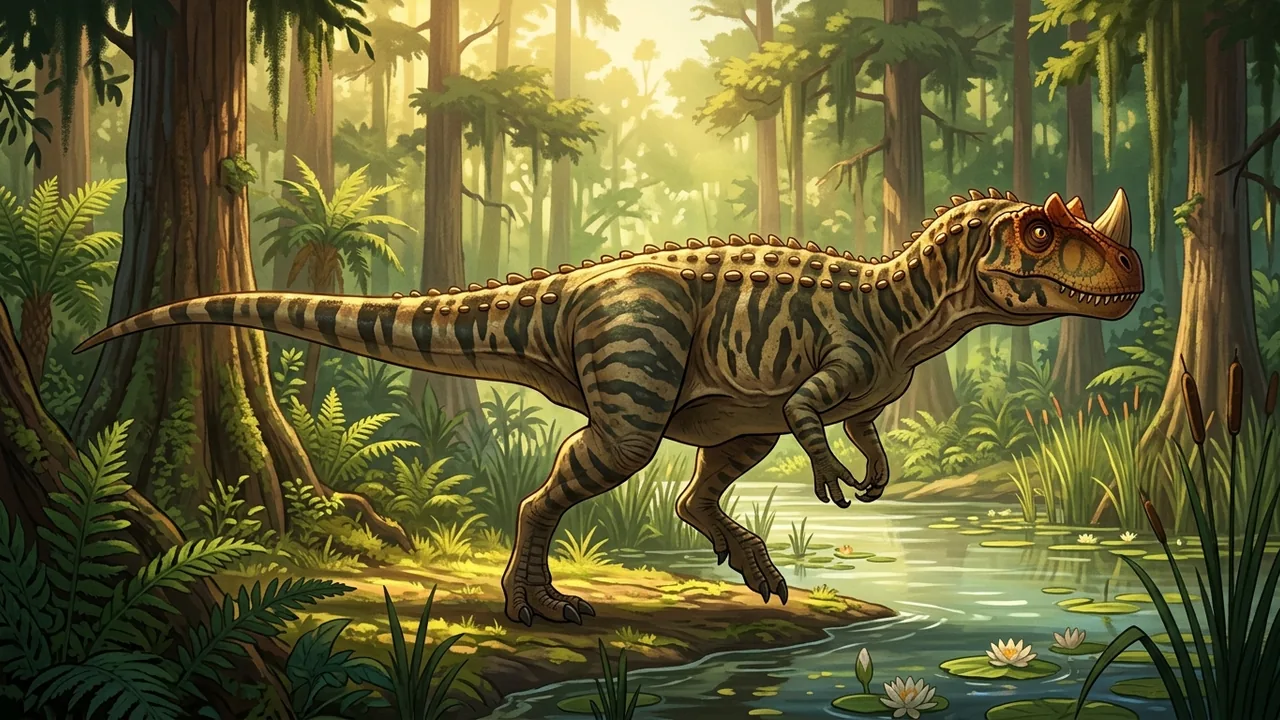
Meet the Legend: Saber-Toothed Horned Ceratosaur
Late Jurassic floodplains hosted a dazzling cast of multi-ton giants, yet few predators looked more dramatic emerging from riverside mist than Ceratosaurus nasicornis. Measuring eighteen to twenty-three feet long and weighing between 1,100 and 2,000 pounds, this muscular carnivore combined primitive skeletal traits with specialized wetland weaponry.
Rising from the midline of its fused nasal bones stood a narrow, rounded horn core flanked by two triangular lacrimal ridges just ahead of its eyes. Along the center of its neck, back, and tail ran a single row of keeled bony scutes—making Ceratosaurus the only large Jurassic predator known to wear dorsal dermal armor!
Equally distinctive were its short, stout forelimbs bearing four digits instead of the three-fingered hands seen in advanced tetanurans like Allosaurus.
Far from an outdated relic, however, skeletal reveals a supple, low-slung ambush specialist engineered for tangled river corridors across North America and Europe.
With extra-long maxillary fangs sheathed neatly behind lip scales and a deep, undulating fin-tail, Ceratosaurus thrived wherever Late Jurassic rivers carved shady galleries through sun-baked plains and seasonal wetlands teeming with freshwater prey.
Lost World Habitat: Riparian Webs of the Morrison
Around 150 million years ago, the Morrison Basin stretched from New Mexico to Montana as a mosaic of semi-arid fern savannas intersected by meandering rivers, oxbow lakes, and seasonal marshes. Across the narrow young Atlantic seaway, Portugal's Lourinhã coastal plains mirrored that exact climate and plant community.
Sunlight fueled dense riparian forests of ginkgoes, araucarian conifers, cycads, tree ferns, and horsetails along permanent waterways, anchoring a productive aquatic-terrestrial web.
Beneath murky river surfaces swam yard-long Ceratodus lungfish, gar-like ray-finned fishes, Glyptops freshwater turtles, and armored Goniopholis crocodylomorphs. Along shaded banks browsed fleet-footed Dryosaurus and thumb-spiked Camptosaurus.
While larger predators patrolled dry open savannas after multi-ton sauropods, Ceratosaurus occupied the top riparian trophic tier inside dense gallery woods, moving effortlessly from gravel bars into calm backwater sloughs.
By linking underwater fish energy with terrestrial forest herbivores through clean , this horned hunter stabilized Late Jurassic river ecosystems during both monsoon floods and scorching dry-season droughts when shrinking lagoons concentrated aquatic prey into crystal-clear hunting channels bordered by shady tree ferns and towering conifers across two continents. Warm groundwater springs kept these winding river refuges green even during dry months.
What's on the Prehistoric Menu?
A glance at the skull of Ceratosaurus reveals a jaw built for decisive, deep-slashing strikes. Although its skull measured roughly two feet long, its upper maxillary teeth grew into flattened, serrated blades nearly four inches tall—proportionally longer relative to skull size than the fangs of Allosaurus or Tyrannosaurus!
Jaw explains why such elongated blades suited a riverside specialist. Driven by deep adductor jaw muscles and powerful downward-pulling neck flexors, those narrow saber teeth sliced cleanly through tough lungfish scales, leathery turtle limbs, and slippery crocodylomorph hides without skidding off wet skin.
How do paleontologists confirm that aquatic menu millions of years later? Geochemists tested stable carbon and oxygen ratios locked inside fossilized Ceratosaurus tooth enamel from Colorado and Utah.
Time after time, Ceratosaurus teeth matched the chemical water-dwelling signatures of freshwater fish and aquatic reptiles far more closely than dry-land sauropods!
Supplementing those river catches with ambushes on thirsty Dryosaurus and juvenile Camptosaurus along forest trails, Ceratosaurus turned every shaded watering hole into a reliable year-round dining hall across middle and upper levels of the Morrison floodplain.
Superpowers, Senses & Anatomy
While tetanuran predators like Allosaurus stiffened the rear half of their tails with overlapping bony prongs for open-ground sprinting, Ceratosaurus evolved the opposite design. Its tail vertebrae lacked rigid stiffening rods; instead, unusually tall neural spines rose above each vertebra while elongated, blade-shaped chevron bones hung below.
In biomechanical studies conducted by Robert Bakker and Gary Bir, this tall, laterally flattened caudal profile closely resembled the sculling tail of modern crocodilians. Firing flexible side-to-side muscle waves down its spine and tail, Ceratosaurus propelled itself smoothly through deep channels while keeping its nostrils and elevated brow ridges just above the surface!
Meanwhile, CT scans of its braincase and nasal horn clarified how its head ornaments functioned. Because the nasal horn core measured less than an inch thick laterally and contained vascular grooves for a bright keratinous sheath, rules out violent horn-stabbing against struggling prey.
Instead, vivid horn colors and paired brow crests served for close-range species recognition and ritualized head-bobbing displays across dappled forest light, while large olfactory bulbs tracked faint scent plumes drifting down winding creeks and marshy lagoons.
Flight vs. Fight Arena!
Few prehistoric ecosystems packed more rival predators together than the Late Jurassic Morrison Formation, where Ceratosaurus shared floodplains with thirty-foot Allosaurus fragilis, massive Torvosaurus, and giant Saurophaganax! How did a one-ton hunter avoid getting crowded out by two-to-four-ton neighbors?
Evolution answered with textbook . Out on treeless fern prairies, longer-legged Allosaurus dominated sauropod and stegosaur hunts; inside tangled riverine woods and deep oxbow channels, compact, supple-bodied Ceratosaurus held the home-court advantage.
When a wandering Allosaurus approaches a drought-shrunk lagoon to contest a catch, Ceratosaurus weighs physics carefully. Turning sideways to flash its tall keratin nose horn, crimson brow crests, and gaping four-inch fangs signals fierce readiness without immediate contact.
If a much heavier Allosaurus charges anyway, gives Ceratosaurus an instant escape route: pivoting sharply through dense streamside brush or plunging straight into deep river currents where stiffer-tailed prairie giants lose traction.
By trading open-plain brawls for amphibious agility and specialized wetland prey, Ceratosaurus endured for over five million years across both North American and European river valleys without ever surrendering its productive watery niche to larger dry-land rivals.
Fossil Detective Secrets
Paleontologists first met Ceratosaurus in 1883–1884 when quarryman Marshall Parker Felch excavated a nearly complete articulated skeleton from hard channel sandstone at Garden Park, Colorado. Describing the find in 1884, Othniel Charles Marsh marveled at its nasal horn, fused pelvic and foot bones, four-fingered hands, and row of dorsal osteoderms.
For over a century, museum visitors saw that famous Smithsonian holotype mounted flat inside a plaster wall plaque in an outdated, upright kangaroo stance. In the twenty-first century, conservators carefully freed the original bones for CT scanning and remounted a dynamic horizontal cast reflecting modern !
Fresh discoveries from Utah, Wyoming, and coastal cliffs near Lourinhã, Portugal, expanded the detective story even further. Juvenile skulls revealed how two separate nasal crests grew upward and fused along the midline into a single adult horn.
Meanwhile, stable tooth sampling and fin-muscle modeling solved the old riddle of why Morrison rocks held so many rival carnivores—proving through that blade-horned Ceratosaurus ruled shady rivers right beside open-prairie sauropod herds across millions of years of Late Jurassic history while leaving unmistakable footprints and shed teeth inside ancient stream sandstones.