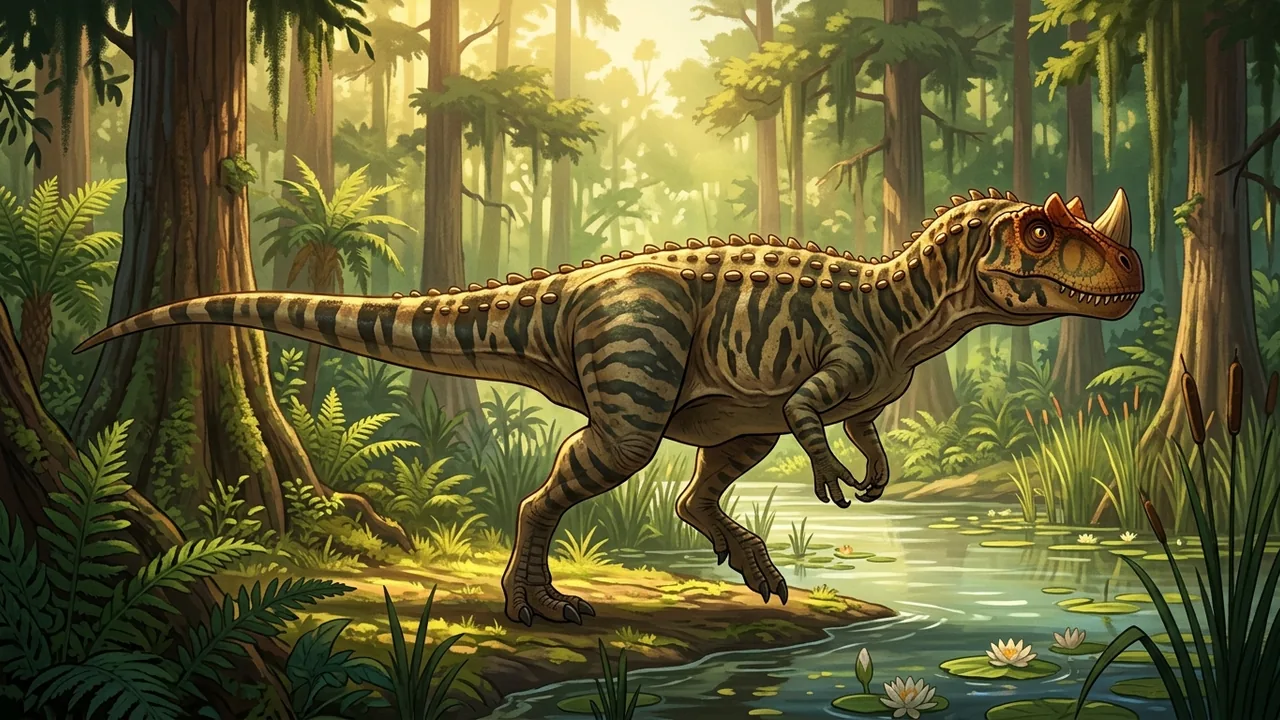
Meet the Legend: Blade Horn & Saber Teeth
Step up to a Late Jurassic riverbank and watch ripples spread across the water! Out steps Ceratosaurus, a sleek two-legged hunter stretching twenty feet long—about the length of a family minivan—and weighing as much as a polar bear.
Right on top of its snout stood a rounded blade of bone wrapped in bright , flanked by two smaller ridges ahead of its eyes! Even cooler, a single line of pebble-like armor ran down the center of its neck, back, and tail, giving this striped stalker a crocodile-style look.
Lost World Habitat: Wooded Jurassic Rivers
Around 150 million years ago, vast seasonal rivers wound across western North America and ancient Portugal. Sunny fern prairies stretched far inland, while thick gallery woods of conifers, tree ferns, and horsetails shaded the muddy channels.
Ceratosaurus claimed those tangled river corridors as its favorite home. Tangled roots and tall reeds hid its striped body from view, while cool oxbow lagoons teemed with turtles, armored crocodiles, and three-foot lungfish waiting just beneath the lily-like water plants every warm afternoon.
What's on the Prehistoric Menu?
Open the jaws of Ceratosaurus and you will spot a surprise: its upper teeth looked like curved kitchen knives nearly as long as your palm! Compared with its skull size, those saber-like fangs were even longer than the teeth of Allosaurus.
Those long slicing blades were ideal for gripping slippery meals such as giant lungfish, hard-shelled river turtles, and small freshwater crocodiles. Along wooded trails, Ceratosaurus also ambushed deer-sized Dryosaurus and horse-sized Camptosaurus when thirsty plant-eaters bent down to drink.
Superpowers, Senses & Anatomy
Most large meat-eating dinosaurs had stiff tails built strictly for balancing on dry land. Ceratosaurus built a different superpower! Tall spines above and below its tail bones made its tail deep, flat-sided, and flexible—just like the swimming tail of a modern alligator.
Swishing its muscular tail smoothly from side to side, Ceratosaurus glided across deep river bends with ease. Meanwhile, its row of bony bumps stiffened the skin along its spine, and its colorful nose horn signaled strength to other Ceratosaurus across misty creeks.
Flight vs. Fight Arena!
Sharing the Late Jurassic meant crossing paths with Allosaurus, a rival predator that grew ten feet longer and twice as heavy! In a head-on tug-of-war on open prairie grass, lighter Ceratosaurus would face tough odds.
Instead of constant combat, nature solved the puzzle through a clever riverside ! Low-slung Ceratosaurus twisted nimbly through dense riverbank trees and swam deep channels where heavier Allosaurus rarely followed. By dividing wooded waterways from open plains, both apex hunters thrived for millions of years.
Fossil Detective Secrets
In 1883, Colorado rancher Marshall Felch chipped an extraordinary horned skull and skeleton out of hard sandstone at Garden Park. One year later, paleontologist Othniel Charles Marsh named it Ceratosaurus nasicornis, marveling at its nose horn and tiny back stones!
More than a century later, paleontologists digging coastal cliffs in Portugal unearthed Ceratosaurus teeth and bones matching American fossils almost bone for bone! Those twin discoveries proved that Jurassic land bridges once connected North America and Europe before the Atlantic Ocean widened.