Meet the Legend: Horned Prowler of the Creeks
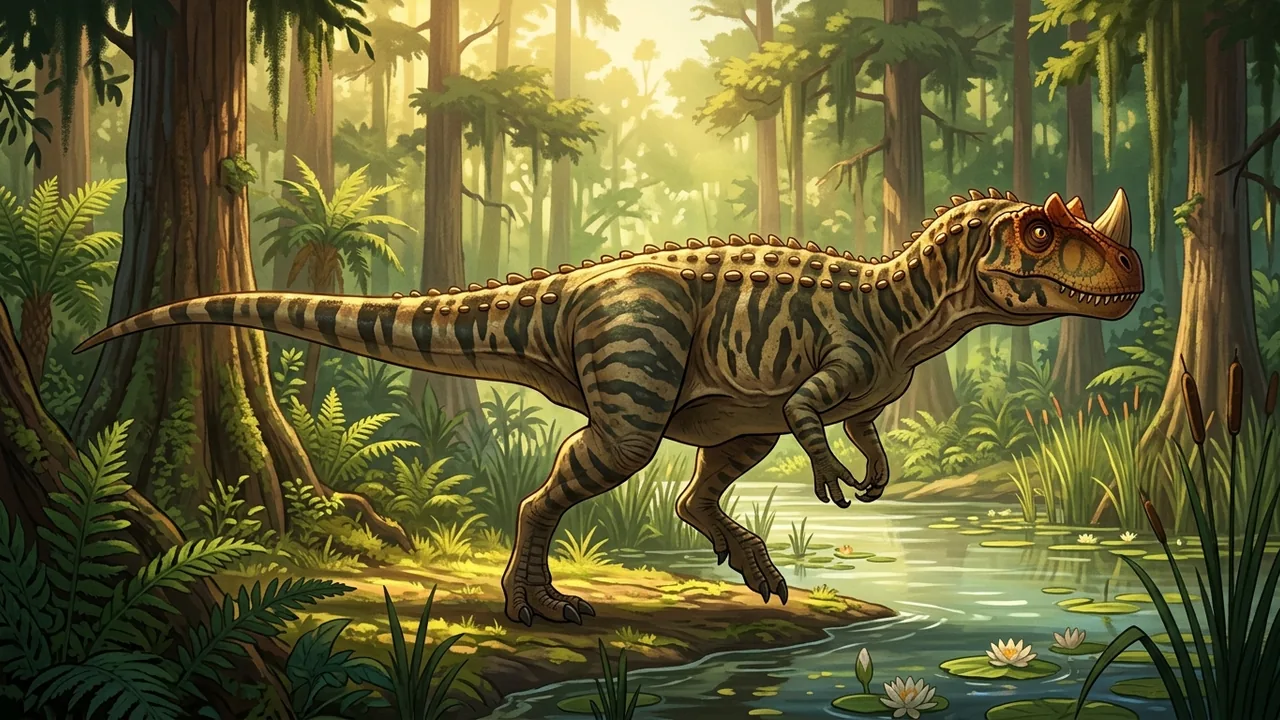
Among all the giant hunters of the Late Jurassic Period, Ceratosaurus nasicornis wore one of nature's boldest crowns! Stretching eighteen to twenty-three feet long and weighing up to a ton, this muscular carried a prominent blade-shaped horn on its nose plus two smaller bony ridges right in front of its eyes.
Even more surprising for a fast-moving predator, a neat midline row of small bony plates ran down the center of its neck, back, and tail. Short, powerful forearms ended in four clawed fingers held palms-inward against its chest.
While bigger Late Jurassic neighbors patrolled sunny open prairies, low-slung Ceratosaurus evolved specialized traits for prowling shady river bends and marshy oxbow lakes.
From its saber-like upper fangs to its deep, crocodile-style tail, every inch of this striped stalker fit life along ancient waterways.
Lost World Habitat: Rivers Across Young Oceans
Between 153 and 148 million years ago, seasonal rivers crisscrossed a vast western lowland preserved today as North America's Morrison Formation. Fern savannas covered higher ground, while dense gallery forests of ginkgoes, cycads, tree ferns, and conifers hugged winding waterways.
Interestingly, paleontologists also uncover Ceratosaurus bones across the ocean in Portugal! Earlier in the Mesozoic Era, giant rift valleys—preserved right in Virginia's Culpeper and Taylorsville rock basins—marked where North America first began splitting away from Europe and Africa.
By the Late Jurassic, that young Atlantic seaway off Virginia's ancient coast was still narrow enough that temporary land bridges linked North America and Portugal during low sea levels.
Across both continents, lush freshwater marshes gave Ceratosaurus cool shade, murky ambush pools, and bustling aquatic life year-round whenever warm rains refilled the river channels.
What's on the Prehistoric Menu?
Inside the Late Jurassic riverine , sunlit horsetails, aquatic plants, and riverside ferns supported snails, crayfish, giant Ceratodus lungfish, freshwater turtles, and swift plant-eating dinosaurs like Dryosaurus. Ceratosaurus hunted right where land and water met!
Its skull featured an unforgettable feeding : extraordinarily long, flat-sided upper blade teeth that reached nearly four inches in length. Proportional to skull length, those saber-like fangs towered taller than the teeth of almost any other Jurassic carnivore!
Deep slicing blades excelled at puncturing slippery lungfish, gripping armored marsh crocodiles, and ambushing medium-sized herbivores crouching at forest waterholes.
Flexible lower-jaw joints and strong neck muscles allowed Ceratosaurus to haul heavy aquatic catches onto muddy sandbars before bigger prairie scavengers noticed a splash along the misty creek bank, keeping its riverbank territory well supplied through wet seasons and summer dry spells alike.
Superpowers, Senses & Anatomy
Take a close look at the tail bones of Ceratosaurus and you will spot a swimmer's secret ! Unlike stiff-tailed runners, Ceratosaurus grew tall bony spines above its tail vertebrae and matching blade-like chevrons underneath, creating a deep, flexible paddle much like a modern crocodile's tail.
Undulating its supple spine and tail from side to side, Ceratosaurus glided silently across deep lagoons to surprise basking turtles or drinking ornithopods. Along its back, small keeled scutes reinforced tough scaly hide without weighing it down in water.
What about that famous nasal horn? Because the bony core was thin from side to side, slamming it into prey would have cracked the bone!
Instead, a vivid keratin sheath turned the nose horn and twin brow ridges into unmistakable visual badges for recognizing mates and warning rival Ceratosaurus.
Flight vs. Fight Arena!
How did one-ton Ceratosaurus survive in neighborhoods patrolled by two-ton Allosaurus and Torvosaurus? Ecologists point to a brilliant survival strategy called ! Rather than clashing over giant sauropods out on open fern prairies, Ceratosaurus specialized in wooded marshes and deep river channels.
When a larger Allosaurus wanders down to a riverbank sandbar, Ceratosaurus faces a sharp Flight versus Fight choice. Against a solo young rival, flashing its bright nose horn and baring four-inch blade fangs warns the intruder away.
If a full-grown Allosaurus presses forward, however, agile Ceratosaurus pivots smoothly between tangled cypress-like trunks or slips straight into deep river currents where stiffer-tailed prairie hunters hesitate to follow.
By dividing habitats and prey menus cleanly, niche partitioning allowed multiple giant species to share Jurassic landscapes for millions of years.
Fossil Detective Secrets
Fossil detective work on Ceratosaurus began in 1883 when Colorado farmer Marshall Felch excavated an articulated skeleton encased in tough sandstone near Cañon City. Yale paleontologist Othniel Charles Marsh named it Ceratosaurus nasicornis in 1884, astonished by its fused ankle bones, midline armor, and nasal horn.
Because Marsh mounted that first skeleton flattened inside a sandstone slab, early drawings mistakenly posed it upright like a tail-dragging kangaroo. Modern skeletal mounts corrected its posture into a sleek, horizontal river stalker!
Even more exciting, chemical analysis of tooth enamel in the twenty-first century revealed aquatic oxygen signatures matching turtles and crocodiles from the same Morrison beds.
Combined with skeletons from Utah and Portugal, stone clues proved beyond doubt how a horned swimmer carved out its own watery territory during the Late Jurassic Period.