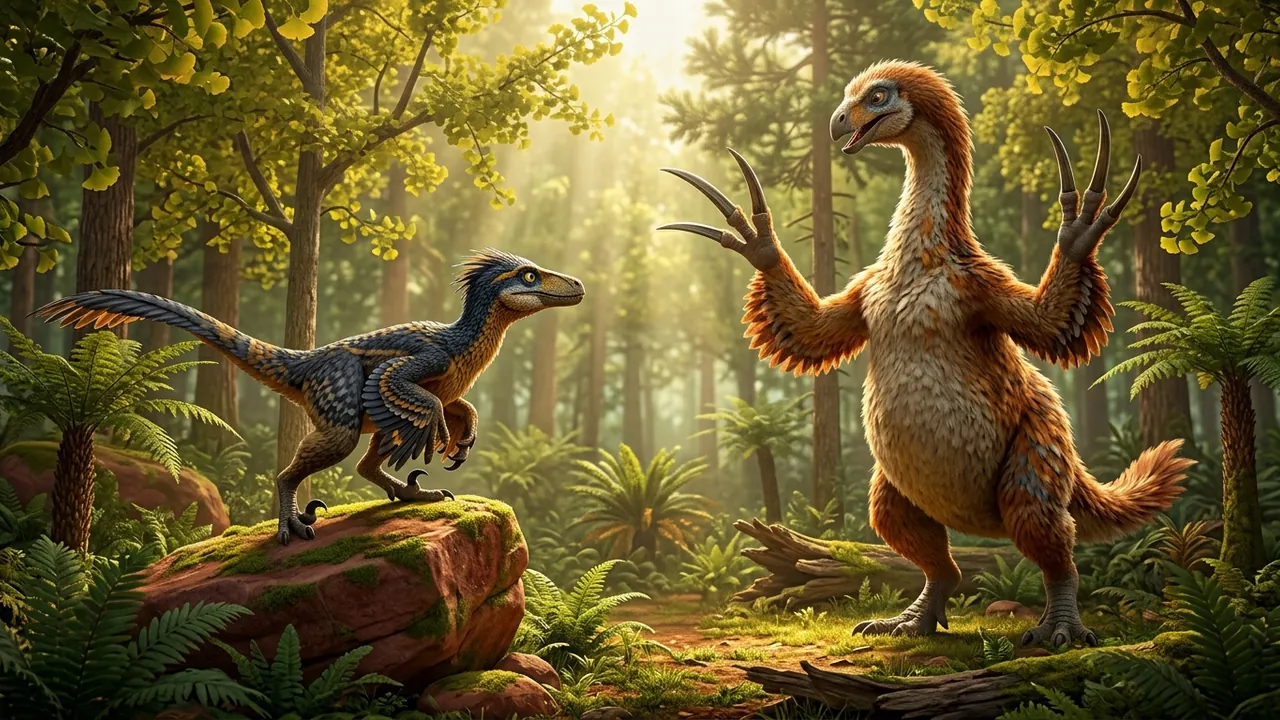
Meet the Legend: Maniraptoran What-If Lab
Rigorous paleontology always distinguishes true sympatric ecological rivals from cross-era biomechanical comparisons. Whereas Books 31 through 35 examined coeval neighbors from identical rock horizons, our World 10 finale presents an explicit Paleo-Biomechanics What-If Simulation!
Separated by roughly sixty-five million years and the North Pacific, Barremian dromaeosaurid Utahraptor ostrommaysi (~135–130 MYA) from Utah's and Maastrichtian therizinosaurid Therizinosaurus cheloniformis (~70 MYA) from Mongolia's never shared a living ecosystem.
Yet comparing them side by side illuminates one of evolutionary biology's grandest radiation stories: both giants belonged to the feathered clade closely allied to birds!
From a shared coelurosaurian ancestor with semilunate wrist bones and pennaceous plumage, one lineage produced a five-hundred-kilogram hypercarnivore armed with twenty-four-centimeter pedal sickle talons, while its cousin evolved into a five-metric-ton herbivore wielding one-meter manual scythes! Because fifty-five to sixty-five million years of Cretaceous geologic time separated Early Cretaceous Utah from Late Cretaceous Asia, no living Utahraptor ever glimpsed a towering Therizinosaurus—which is precisely why paleontologists frame their meeting as a comparative engineering test. By examining how inherited bird-like wrists, hollow skeletal pneumaticity, and warm feathered integument scaled up along opposite ecological pathways, scientists uncover the physical rules governing Earth's most extreme foot hooks and hand blades.
Even their outer keratin sheaths obeyed contrasting structural engineering: compact dromaeosaurid toe talons maximized curvature and cross-sectional thickness to concentrate gripping force at a single sharp point, whereas elongated therizinosaurid manual blades traded puncturing stiffness for sweeping two-meter reach across lush Late Cretaceous canopies!
Lost World Habitat: Utah & Nemegt Basins
Stratigraphic reconstruction explains the selective pressures that sculpted each mega-claw specialist in its native basin! Within the Early Cretaceous Yellow Cat Member of eastern Utah's , caliche-bearing mudstones and lacustrine limestones record semi-arid seasonal floodplains bordered by conifer gallery woods.
There, robust Utahraptor shared waterholes with heavily spiked polacanthid ankylosaur Gastonia, thumb-spiked iguanodontians like Hippodraco, and brachiosaurid and titanosauriform sauropods such as Cedarosaurus.
Sixty-five million years later across southern Mongolia's Maastrichtian , meandering channel sandstones and wet floodplain mudstones supported lush araucarian, taxodiaceous conifer, and ginkgo forests.
Sharing those humid Nemegt woodlands with cursorial Gallimimus, armored Tarchia, and duck-billed Saurolophus was Asia's six-ton apex tyrannosaurid, Tarbosaurus bataar! Facing real predation pressure from forty-foot Tarbosaurus explains why Therizinosaurus paired high-browsing reach with intimidating five-ton defensive bulk. Radiometric zircon dates and biostratigraphic correlations confirm a fifty-five-to-sixty-five-million-year gap between Utah's Barremian Yellow Cat floodplain beds and Mongolia's Maastrichtian river channels—a span nearly as long as the entire Cenozoic Era separating T. rex from us today! Contrasting semi-arid Cedar Mountain scrublands against monsoon-watered Nemegt gallery forests inside our Paleo-Biomechanics What-If Simulation shows how vastly different Cretaceous ecosystems shaped specialized claw levers across continents.
While seasonal droughts in Early Cretaceous Utah concentrated ornithopod and sauropod herds around shallow carbonate springs where ambush hunters thrived, Late Cretaceous Mongolia's braided Nemegt river plains supported multi-story deciduous canopies that rewarded towering body height, hindgut plant fermentation, and broad forelimb deterrence against giant tyrannosaurids across central Asia's richest Late Cretaceous floodplain ecosystem.
What's on the Prehistoric Menu?
Tracing feeding evolution reveals a textbook example of ! Utahraptor amplified ancestral theropod hypercarnivory—combining a surprisingly deep, robust skull and serrated ziphodont dentition with stocky, muscular hind limbs built to ambush and pin half-ton Early Cretaceous ornithopods.
Therizinosaurus marched in the exact opposite trophic direction, mirroring extinct giant ground sloths (Megatherium) and chalicotheres! Basal Early Cretaceous therizinosaurians like Falcarius in Utah still retained mixed omnivorous traits before later Asian descendants committed fully to high-fiber herbivory.
To accommodate an immense hindgut fermentation chamber, Therizinosaurus evolved an opisthopubic pelvis—rotating its pubis posteriorly parallel to the ischium—alongside a broad four-toed plantigrade foot stance, elongated S-curved neck, keratinous cropping rhamphotheca, and small foliate cheek teeth!
Reaching upward with 2.4-meter forelimbs, its curved manual scythes hooked leafy ginkgo and conifer boughs effortlessly down to oral level. Across North America and Asia, fossil trackways and transitional skeletons—from omnivorous Barremian Falcarius utahensis right inside Utah's to intermediate Alxasaurus and gigantic Maastrichtian Therizinosaurus—trace every anatomical step of that dietary revolution! While half-ton Utahraptor relied on high-protein meat to fuel explosive ambush bursts, five-ton Therizinosaurus harvested abundant riverside canopy foliage all day long without spending energy chasing swift prey.
Just as extinct South American ground sloths evolved massive forelimb claws, broad pelvises, and upright sitting postures to harvest Miocene tree boughs millions of years later, Therizinosaurus independently arrived at the exact same biomechanical solution inside dinosaurian anatomy—proving ecological opportunity repeatedly guides evolution toward matching mechanical designs across completely separate branches of the vertebrate tree.
Superpowers, Senses & Anatomy
Computational biomechanics allows researchers to test fossil claw performance mathematically without risking museum holotypes! Utahraptor possessed unusually stout, robust tibiae and tarsometatarsi compared with gracile cousins like Velociraptor—trading top cursorial velocity for massive muscular torque driving deep-based, strongly curved pedal-II sickle unguals.
How did Therizinosaurus's meter-long manual claws perform under load? In 2014, paleobiologist Stephan Lautenschlager applied three-dimensional across diverse therizinosaurian manual unguals under simulated scratching, piercing, and hook-pulling forces.
Stress maps proved extreme elongation in Therizinosaurus dramatically elevated von Mises bending stress near the narrow distal blade—meaning forceful stabbing against bone risked structural fracture!
Conversely, smooth adduction pulling distributed tensile stress safely along the dorsal curvature during foliage harvesting, while sweeping six meter-long keratin-sheathed blades horizontally created an intimidating visual and slashing deterrent against approaching theropods. Follow-up 2023 biomechanical modeling by Zichuan Qin and colleagues further confirmed that giant manual unguals in Therizinosaurus had grown beyond pure mechanical digging efficiency, functioning primarily for canopy branch raking, intraspecific display, and broad defensive deterrence! Meanwhile, both lineages retained rich coats of filamentous or pennaceous plumage—streamlined and wing-stabilized on grappling Utahraptor, shaggy and insulating on pot-bellied Therizinosaurus—proving feathers partnered seamlessly with dinosaur mega-claws.
When Utahraptor leaped onto struggling quarry, stiffened caudal rods and broad forearm pennaceous feathers acted like aerodynamic stabilizers while deep flexor tendons locked its curved second-toe talons shut, contrasting sharply with Therizinosaurus's slow, high-leverage shoulder adduction strokes built for steady botanical harvesting and wide-arc intimidation across humid Nemegt gallery woodlands.
Flight vs. Fight Arena!
Stepping into our Paleo-Biomechanics What-If Simulation, mass scaling governs the tactical outcome! At roughly five hundred kilograms, athletic Utahraptor holds overwhelming superiority in sprint acceleration, leaping agility, and binocular targeting—lethal against unarmored prey near its own body mass.
Against a healthy five-metric-ton adult Therizinosaurus rearing nearly five meters tall, however, a solitary Utahraptor confronts a ten-to-one mass deficit! Even though Therizinosaurus's narrow scythes avoided bone-piercing stabs, powerful pectoral muscles swinging 2.4-meter arms delivered sweeping kinetic blows capable of fracturing a half-ton dromaeosaurid's ribs before it ever reached the herbivore's throat—handing Team Fight the solo simulation crown!
Across real Mesozoic floodplains, sauropod titans went even further—flipping bold predators from Fight straight into Flight! While 1997 models suggested diplodocid whip tails broke the 340-meter-per-second sound barrier, 2022 multibody finite-element simulations by Simone Conti and colleagues showed soft-tissue limits capped tail tips near thirty-three meters per second (~73 mph)—still delivering stinging defensive lashes that sent theropods retreating! Viewed through evolutionary game theory, both giant claws and sauropod whip tails solved the exact same Flight-versus-Fight equation without requiring lethal combat: whenever a defender raised the injury cost of an attack high enough—whether through five tons of rearing bulk or a cracking diplodocid tail tip—natural selection rewarded smart predators that broke off the chase and survived to hunt safer quarry tomorrow.
Even if multiple Utahraptor individuals coordinated a pack rush inside our hypothetical simulation, scaling five metric tons of feathered muscle guarded by sweeping 2.4-meter forelimbs carried daunting injury odds—illustrating why giant body size paired with long-reach deterrence remained one of prehistory's surest shields.
Fossil Detective Secrets
Both mega-claw icons entered science through unforgettable detective twists! When a joint Soviet-Mongolian expedition recovered giant flattened unguals from the in 1948, paleontologist Evgeny Maleev named Therizinosaurus cheloniformis in 1954 under the impression they were giant turtle limb elements!
Only after associated forelimbs, pelves, and feathered basal relatives like Beipiaosaurus emerged across Asia did cladistics unmask Earth's weirdest herbivorous .
Meanwhile in Utah's , paleontologist James Kirkland described Utahraptor ostrommaysi in 1993 and subsequently spearheaded the extraction of a nine-ton quicksand-trap sandstone megablock preserving an adult alongside multiple juveniles and hatchlings—offering rare clues into dromaeosaurid social aggregation!
From healed Triceratops horns and punctured Allosaurus vertebrae to Kem Kem isotopes and finite-element claw simulations, World 10's Flight vs. Fight Arena proves every fossil bone is an engineering blueprint waiting to be decoded. Inside Utah laboratories today, preparators working with fine air-scribes on the nine-ton Stikes Quarry Cedar Mountain megablock continue uncovering articulated Utahraptor skulls, pedal sickle cores, and juvenile bones trapped in ancient quicksand over one hundred thirty million years ago! Paired with 3D of Nemegt Formation scythe claws half a world away, these discoveries show how modern paleontology unites fieldwork, physics, and imagination.
Whether reconstructing lost Egyptian spinosaurs from archival photos, mapping oxygen isotopes in Moroccan river teeth, or stress-testing Mongolian claws inside supercomputers, twenty-first-century paleontologists prove that dinosaur science is more vibrant than ever—turning ancient stone mysteries into living biomechanical adventures across every geologic age of the Mesozoic Era!