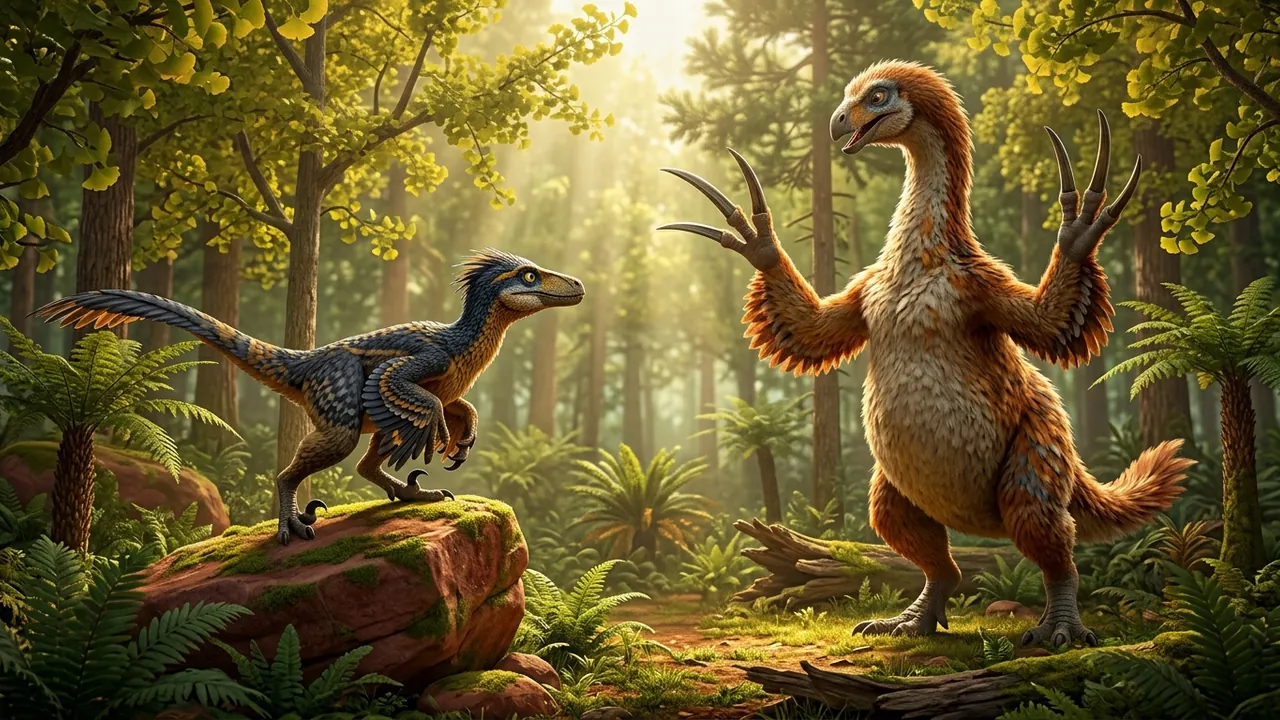
Meet the Legend: Mega-Claw Simulation!
Welcome to a special Paleo-Biomechanics What-If ! These two feathered giants never met in real life! Utahraptor (YOO-tah-rap-tor) was a polar-bear-sized super-raptor from Utah. Therizinosaurus (thair-ih-ZEE-noh-SOR-us) means lizard from Mongolia! Both wore real , and both grew record-breaking claws! Let's see how foot hooks compare with giant hand blades!
Lost World Habitat: Two Faraway Homes
Why could these two never meet? Time and oceans stood between them! Utahraptor prowled pine woods in Utah one hundred thirty-five million years ago. Sixty-five million years later, Therizinosaurus strolled lush ginkgo forests in Mongolia. Science lets us test both habitats in one cool !
What's on the Prehistoric Menu?
Giant claws do not always mean meat eater! Twenty-foot Utahraptor was a fierce hunter that chased plant-eating neighbors. Towering thirty-three-foot Therizinosaurus had a big round belly and ate only leaves, fruit, and soft shoots! Its long hands hooked tall tree branches right down to its beak.
Superpowers, Senses & Anatomy
Compare foot claws against hand claws! Half-ton Utahraptor balanced on swift legs and held a curved nine-inch claw on each second toe. Five-ton Therizinosaurus stood tall as a giraffe and waved three yard-long claws on each hand! Fluffy made it look doubly huge.
Flight vs. Fight Arena!
Who wins our ? Five-ton Therizinosaurus outweighs one-ton-or-less Utahraptor ten to one! Rearing up and sweeping wide arms keeps a lone raptor back. Even bigger long-necked sauropods snapped long tails like thunder—flipping bold hunters from Fight straight into speedy Flight!
Fossil Detective Secrets
Fossil detectives use computer models to test how claws really worked! Strong, thick toe bones let Utahraptor grip big prey tightly. Long, narrow claws on Therizinosaurus worked best for pulling branches and swatting away hungry tyrannosaurs. Together, their fossils show claws can hunt, harvest, or defend!