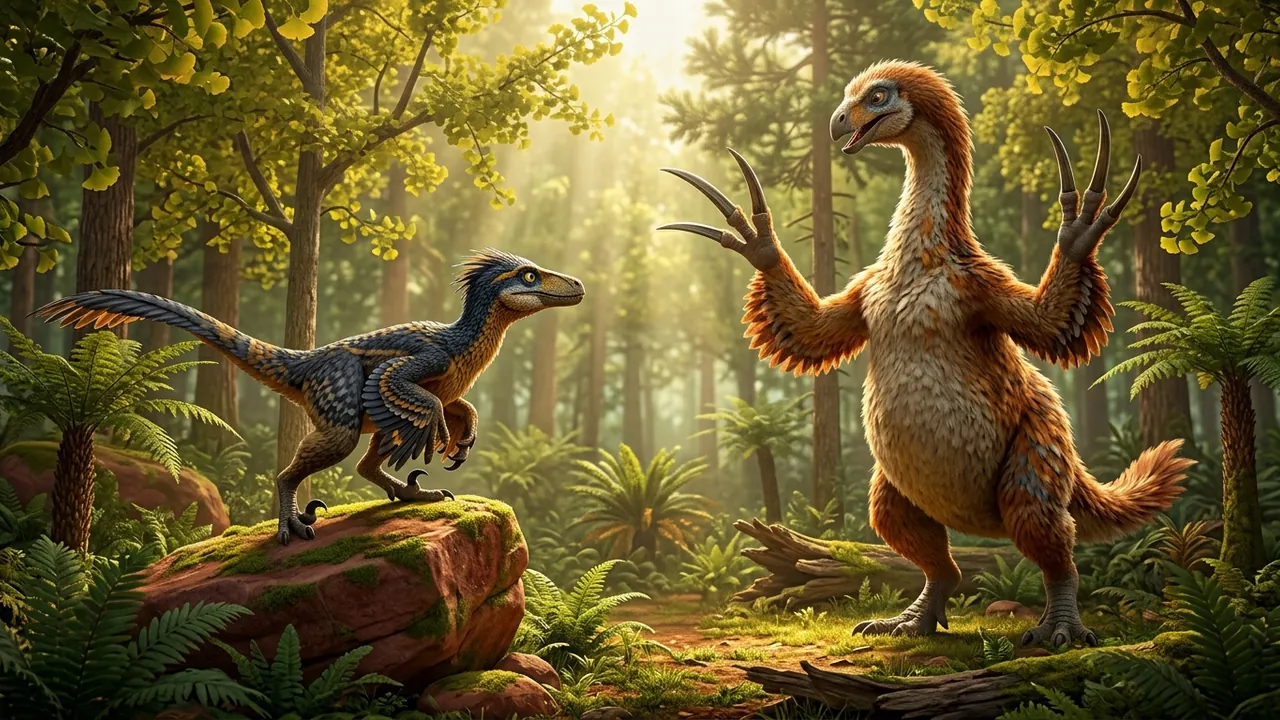
Meet the Legend: Paleo-Biomechanics Simulation
Throughout Shelf 6, we have tested real prehistoric rivals preserved side by side in identical rock layers. For our closing finale, step inside an explicit Paleo-Biomechanics What-If ! Separated by roughly sixty-five million years and the wide Pacific Ocean, Early Cretaceous Utahraptor ostrommaysi (135–130 MYA, Utah) and Late Cretaceous Therizinosaurus cheloniformis (70 MYA, Mongolia) never met in nature.
Why bring them together inside a comparative physics lab? Because both dinosaurs evolved on the feathered coelurosaurian branch of the theropod family tree—wearing warm coats of bird-like plumage and folding winged wrists—yet pushed skeletal claw engineering to opposite extremes!
Twenty-foot Utahraptor packed roughly one thousand pounds of muscle—as heavy as an adult polar bear—behind raised, deeply curved nine-inch second-toe talons built for pinning heavy quarry.
Across our test arena towers thirty-three-foot, five-ton Therizinosaurus, standing taller than a giraffe while waving three-foot keratin-sheathed hand claws longer than samurai swords! Comparing grappling foot hooks against canopy-reaching hand scythes reveals how natural selection reshapes inherited dinosaur anatomy into radically different survival tools. While dromaeosaurs concentrated piercing leverage into compact hind-foot weapons, therizinosaurs stretched manual finger bones to unprecedented lengths—giving students a living engineering lesson in biological trade-offs.
Lost World Habitat: Cedar Mountain & Nemegt
Examining each dinosaur's true home ecosystem explains why their claws diverged so dramatically across the Cretaceous Period! During the Early Cretaceous in eastern Utah's Cedar Mountain environments, semi-arid seasonal floodplains, braided streams, and conifer woodlands supported medium iguanodonts like Hippodraco, spiky ankylosaur Gastonia, and towering sauropod herds—giving muscular ambush predator Utahraptor abundant half-ton quarry.
Sixty-five million years later across Late Cretaceous Mongolia's lush Nemegt river basin, monsoon-fed channels, marshy oxbow lakes, and tall gallery forests of ginkgoes, araucarian conifers, and horsetails nourished diverse herbivores while forty-foot tyrannosaur Tarbosaurus ruled as top predator.
In that predator-packed Mongolian woodland, giant feathered plant-eating browsers needed two mechanical advantages simultaneously: long overhead reach to pull high canopy foliage within beak range, and intimidating defensive reach to keep hungry Tarbosaurus safely back!
By contrasting Utah's open brushy floodplains with Mongolia's towering riverside forests inside one physics , paleontologists show how local food webs, forest height, and neighboring predators sculpt every curve of a dinosaur's skeleton. Where dry Utah clearings rewarded explosive muscular grappling near ground level, Mongolia's dense humid woodlands rewarded five-ton size, warm insulating plumage, and overhead leaf-harvesting hooks.
What's on the Prehistoric Menu?
Nothing surprises young paleontologists more than discovering that Earth's longest claws belonged to a peaceful herbivore! Utahraptor retained classic hypercarnivore equipment: a deep, broad skull lined with serrated ziphodont teeth, winged forelimbs for balance, and powerful grasping hands built to subdue half-ton ornithopods across open clearings.
Therizinosaurus represents a dramatic evolutionary diet switch! Descending from small, feathered omnivorous coelurosaurs, every later traded slicing meat-eater teeth for a smooth, toothless keratinous front beak paired with dozens of tiny leaf-shaped cheek teeth.
To digest hundreds of pounds of fibrous ginkgo leaves, cycad fronds, shoots, and riverside fruits each day, Therizinosaurus rotated its pubic hip bone backward like ornithischian plant eaters—opening room inside its torso for a colossal hindgut fermentation vat!
Sitting upright on wide four-toed feet like a giant shaggy ground sloth, it reached upward with eight-foot muscular arms and curved three-foot claws formed over elongated finger cores, hooking leafy canopy boughs effortlessly down to its cropping beak without wasting energy climbing or running. Because plant leaves yield far fewer calories per pound than meat, that peaceful sit-and-reach browsing style saved vital daily energy across Mongolia's riverside forests.
Superpowers, Senses & Anatomy
Three-dimensional engineering scans of each dinosaur's claw bone—called an —reveal stark differences in mechanical strength! Utahraptor's second-toe ungual featured a deep, thick base and tight hook curvature wrapped in tough outer keratin, resisting intense while pinning struggling prey beneath a thousand pounds of feathered muscle.
Unlike slender desert sprinters such as Velociraptor, Utahraptor grew thick, stocky shin and ankle bones built like a heavyweight wrestler's legs, trading top marathon speed for explosive ambush torque and feathered wing-assisted balance!
By contrast, paleobiologist Stephan Lautenschlager's computer finite-element stress tests modeled forty-plus theropod claws and proved Therizinosaurus's meter-long manual unguals were narrow from side to side and experienced dangerously high bending stress if jabbed straight into solid bone or rocky soil!
Instead, pulling smoothly downward along the inner curve distributed tension safely while harvesting leafy branches—and sweeping two eight-foot feathered arms sideways flashed six gleaming three-foot keratin blades that discouraged even giant tyrannosaurs from testing their luck. Meanwhile, both coelurosaurs wore dense coats of bird-like feathers—sleek arm-wing vanes aiding Utahraptor's tight turns, and thick shaggy filaments insulating five-ton Therizinosaurus through cool forest nights while amplifying its towering silhouette.
Flight vs. Fight Arena!
Run our Paleo-Biomechanics What-If ! In a solo encounter, half-ton Utahraptor holds clear edges in sprint burst, leaping agility, feathered tail steering, and forward binocular targeting—making it formidable against unarmored herbivores near its own weight.
Against a healthy five-ton adult Therizinosaurus, however, a lone Utahraptor faces a ten-to-one mass deficit! Standing sixteen feet tall on stable four-toed feet, fluffing its dense coat of feathers to double its visual bulk, and sweeping muscular eight-foot arms tipped with yard-long scythes, Therizinosaurus commands a wide defensive perimeter. Even though high prevented bone-piercing stabs, one heavy forelimb slap backed by five tons of body mass could knock a thousand-pound raptor off its feet—handing Team Fight the clear solo verdict!
What flipped bold predators from Team Fight straight into Team Flight across real dinosaur floodplains? Towering sauropods armed with a specialized !
Modern physics simulations show diplodocid sauropods accelerated slender tail tips past seventy miles per hour (over thirty meters per second)—unleashing thunderous cracks and stinging defensive lashes that sent raptors and carnosaurs retreating immediately! Rather than risking a shattered jaw against a lashing sauropod tail or a rearing five-ton , smart Mesozoic hunters trusted survival math and sprinted away to hunt safer targets.
Fossil Detective Secrets
Both stars of our mega-claw puzzled fossil detectives when their bones first surfaced! When expedition teams in Mongolia's Nemegt Basin unearthed giant flattened manual cores in 1948, anatomists thought they belonged to a colossal sea turtle's rib cage or swimming flippers—naming the mystery animal Therizinosaurus cheloniformis ('turtle-formed scythe lizard') in 1954!
Decades later, complete skeletons of smaller feathered cousins in China such as Beipiaosaurus and Alxasaurus revealed shaggy filamentous plumage, wide pot bellies, four-toed feet, and unmistakable hips!
Meanwhile in eastern Utah, state paleontologist James Kirkland described Utahraptor in 1993—honoring Deinonychus pioneer John Ostrom—and later engineered the heroic recovery of a nine-ton quicksand sandstone megablock preserving an adult, teenagers, and tiny hatchlings trapped together!
Whether pinning prey in Early Cretaceous Utah, raking ginkgo boughs in Late Cretaceous Mongolia, or cracking sauropod caudal whips to send hunters fleeing, modern fossil biomechanics proves every prehistoric claw and tail balanced physics, energy, and survival. Today, high-resolution X-ray CT scanners and 3D computer stress simulations let museum researchers test those fossil claws digitally without leaving a single scratch on priceless prehistoric bone, uniting desert fieldwork with modern engineering!