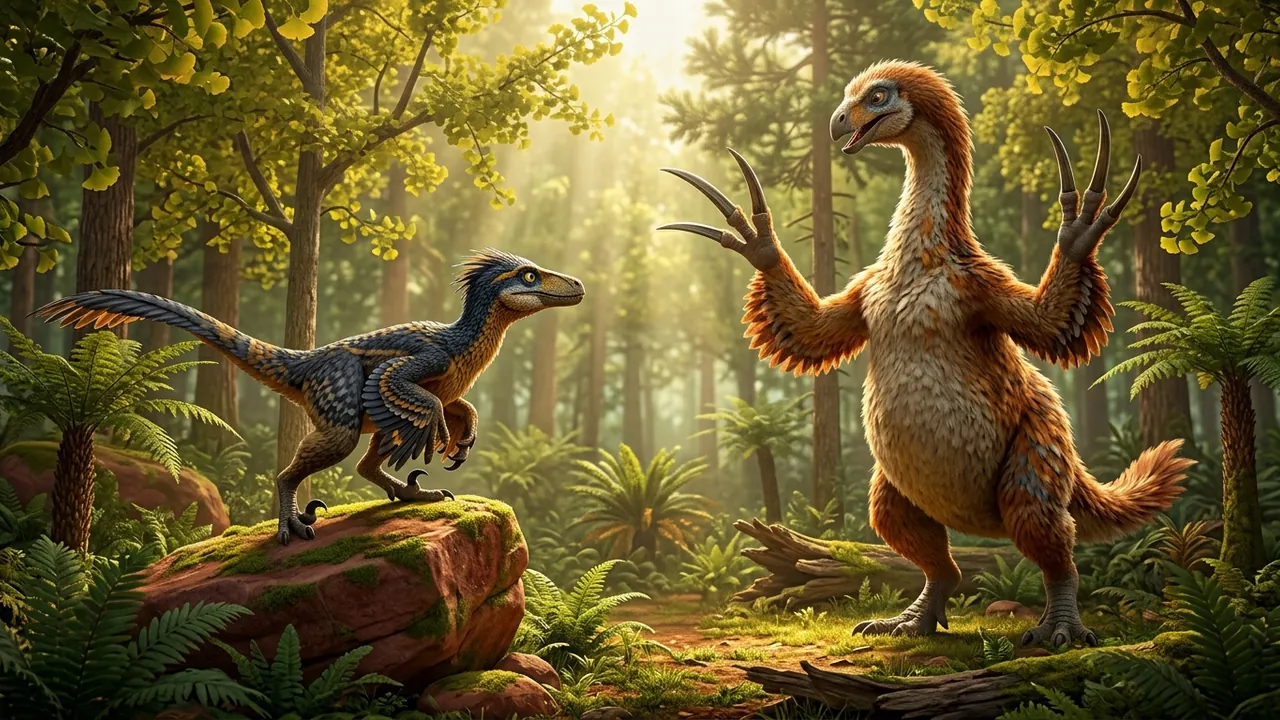
Meet the Legend: What-If Claw Arena!
Every earlier book on this shelf matched real neighbors from the exact same rock layers. For our grand finale, welcome to a special Paleo-Biomechanics What-If ! Scientists love comparing Earth's fiercest foot claws against Earth's longest hand claws—even though sixty-five million years separated them!
In one corner stands twenty-foot Utahraptor, a half-ton feathered hunter built as heavy as a giant polar bear! Towering in the other corner stands thirty-three-foot Therizinosaurus, a five-ton fluffy-feathered giant as heavy as an elephant! Both wore coats of bird-like feathers, and each carried gleaming or hook claws longer than any living predator's talons today.
Lost World Habitat: Utah & Mongolia
Let's check the real calendar and map for both champions! One hundred thirty-five million years ago during the Early Cretaceous, Utahraptor prowled cedar woodlands and red river floodplains in Utah alongside spiky armored Gastonia and young herds.
Fast-forward sixty-five million years to Late Cretaceous Mongolia! Seventy million years ago, Therizinosaurus strolled wet riverside ginkgo forests shared with giant tyrannosaur Tarbosaurus. Bringing them together in a science shows how two eras solved survival differently! Even across distant continents and changing climates, feathered dinosaurs kept inventing bold new claw shapes for hunting and defense.
What's on the Prehistoric Menu?
Look past those scary-looking claws and you will find a big surprise! Muscular Utahraptor was a true meat eater that ambushed medium plant-eating dinosaurs across Utah's open clearings, using thick jaws and hooked talons to hold dinner fast.
Towering Therizinosaurus, on the other hand, was a gentle vegetarian! Sitting back on wide hips with a huge pot belly, it reached overhead with three-foot curved claws to hook leafy ginkgo branches right down to its small, plant-snipping beak. When hungry meat eaters crept too close, those same yard-long claws doubled as a giant warning !
Superpowers, Senses & Anatomy
Not all claws are built for the same job! Each second toe on Utahraptor carried a thick, curved bone core wrapped in tough —forming a nine-inch sickle talon strong enough to support a thousand pounds of leaping hunter without snapping.
Therizinosaurus grew bony finger cores over two feet long that reached past three feet once wrapped in keratin! Those narrow, flat-sided blades were too delicate for tackling prey, yet swept wide like three-foot rakes to gather leaves and act as a bold visual ! Thick arm muscles and broad four-toed feet let Therizinosaurus balance steadily while waving those giant horn-covered blades.
Flight vs. Fight Arena!
Who takes the crown in our Paleo-Biomechanics What-If ? Agile Utahraptor wins easily on speed and footwork, yet five-ton Therizinosaurus weighs ten times as much! Rearing fifteen feet tall, fluffing its feathers, and sweeping six three-foot claws keeps a solo half-ton raptor safely out of reach.
Even apex hunters knew when to switch from Fight to Flight! In Utah and Jurassic plains alike, giant long-necked titans cracked long tapered whip tails faster than highway cars—creating thunderous snaps that sent smart raptors and carnosaurs bolting!
Fossil Detective Secrets
How do fossil detectives test claws without guessing? Scientists scan fossil bones with X-rays and run computer stress tests! In 2014, biomechanics studies tested dozens of theropod claws and proved Therizinosaurus's long blades excelled at hooking branches and sweeping sideways rather than digging or piercing thick hide.
Meanwhile, Utah paleontologists led by James Kirkland studied a massive sandstone block packed with baby, teenage, and adult Utahraptor skeletons! Together, these discoveries celebrate how prehistoric claws evolved into nature's ultimate multi-tools. By pairing real claw physics with 3D bone scans, our turns fossil clues into clear science!