Meet the Legend: Paleo What-If Arena
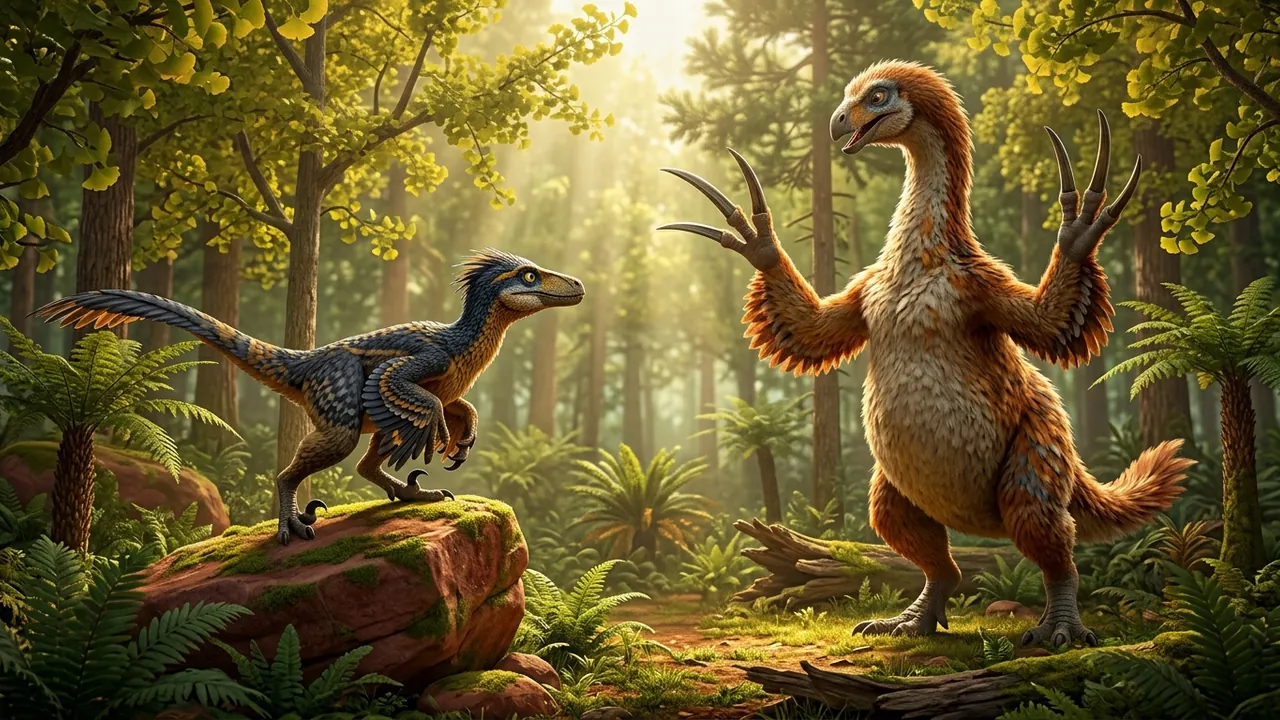
Books 31 through 35 on this shelf paired real prehistoric neighbors preserved inside the exact same rock formations. For our final arena event, welcome to an official Paleo- What-If ! Separated by roughly sixty-five million years and the wide Pacific Ocean, Utahraptor ostrommaysi and Therizinosaurus cheloniformis never crossed paths in real life.
Why test them side by side? Because together they represent the two most extraordinary claw designs ever evolved on land! Twenty-foot, thousand-pound Utahraptor was the heavyweight champion of feathered raptors, built as sturdy as a polar bear and armed with curved nine-inch foot talons.
Across our simulation clearing towers thirty-three-foot, five-ton Therizinosaurus, crowned with shaggy plumage and three-foot scythe claws on its hands—the longest claws in Earth's history! Using biomechanics, scientists compare how evolution engineered foot hooks for hunting and hand scythes for peaceful foraging and defense.
Lost World Habitat: Across Time & Continents
Checking geologic rock layers shows why time travel would be required for this meeting! Roughly 135 to 130 million years ago during the Early Cretaceous Period, Utahraptor patrolled semi-arid conifer woodlands and seasonal river floodplains in Utah's Cedar Mountain rocks alongside spiky ankylosaur Gastonia, iguanodont herds, and giant long-necked dinosaurs.
During that exact Early Cretaceous window on North America's East Coast, meandering rivers across Virginia's Potomac beds buried giant conifer trunks, lush ferns, early flowering plants, and dinosaur footprints! Comparing Utah and Virginia sediments helps geologists map how warm Cretaceous habitats stretched from coast to coast.
Meanwhile, Therizinosaurus lived tens of millions of years later—seventy million years ago—in Late Cretaceous Mongolia's humid Nemegt river forests. Surrounded by towering ginkgo trees, horsetails, and shallow streams, Therizinosaurus needed its giant defensive claws in our 's real-world counterpart against a forty-foot neighbor: Tyrannosaurus rex's Asian cousin, Tarbosaurus!
What's on the Prehistoric Menu?
Comparing their menus reveals how natural selection reshaped related feathered theropod ancestors for opposite jobs in the food chain! Built as muscular as a grizzly or polar bear, Utahraptor was an apex hunter that ambushed medium-sized iguanodont plant eaters across brushy floodplains, using serrated teeth and gripping toe claws to hold active quarry.
Towering Therizinosaurus took a remarkable evolutionary detour! Over millions of years, its dietary shifted completely from hunting meat to peaceful herbivory: its neck lengthened to reach high canopy leaves, its front jaws grew a smooth horny beak ahead of tiny leaf-shaped cheek teeth, and its pelvis widened to support a massive plant-fermenting belly.
Instead of chasing prey across open ground, five-ton Therizinosaurus sat or stood tall beside riverside trees, hooking golden ginkgo boughs, cycad fronds, and soft conifer shoots smoothly down to its mouth with three-foot curved hand claws like giant garden rakes!
Superpowers, Senses & Anatomy
Scientists use —the physics of bones, muscles, and levers—to test why foot talons and hand scythes worked so differently! Utahraptor was not a fragile sprinter; it had thick, muscle-packed hind legs and a stiffened feathered tail built for grappling balance. Each second toe held a deep, curved bone core wrapped in tough up to nine or ten inches long, engineered to grip and pin heavy prey without snapping!
Therizinosaurus grew three slender, gently curved claws on each eight-foot feathered arm—measuring more than three feet long once covered in outer keratin sheaths! Computer engineering models prove those narrow, flat-sided blades would crack if slammed straight into thick bone.
Instead, broad shoulder and chest muscles swung those three-foot scythes downward to pull leafy branches cleanly and swept them wide like gleaming swords whenever hungry predators stepped too close!
Flight vs. Fight Arena!
Step into our Paleo- What-If arena! Half-ton Utahraptor holds clear advantages in quickness, leaping agility, and sharp forward eyesight. Against an unarmored target near its own thousand-pound weight, Utahraptor is an athletic powerhouse.
Yet adult Therizinosaurus weighs five full tons—ten times heavier than a solo Utahraptor—and rears over sixteen feet high! Braced firmly on wide four-toed feet, puffing its dense coat of feathers to look even bigger, and sweeping muscular arms tipped with six yard-long scythes, Therizinosaurus creates a wide defensive safety zone no lone raptor can safely cross, earning Team Fight the solo win!
Even bold hunters learned when Fight flipped to Flight! Across Utah floodplains and Jurassic prairies alike, giant long-necked adults swung slender tapered whip tails past seventy miles per hour—producing loud thunderous cracks and stinging strikes that sent smart predators bolting away!
Fossil Detective Secrets
Both mega-claw champions surprised paleontologists when their fossils first emerged from ancient rock! When Soviet and Mongolian researchers excavated giant flattened claws in the Gobi Desert in 1948, they initially thought they had uncovered the ribs or flippers of a colossal sea turtle—giving Therizinosaurus its species name cheloniformis, meaning turtle-formed!
Only decades later did arm, hip, and feathered fossils from Asian cousins prove it was a towering, plant-eating theropod dinosaur! Meanwhile in eastern Utah, paleontologist James Kirkland named Utahraptor in 1993 and later led the careful rescue of a nine-ton quicksand sandstone block preserving adults, teenagers, and tiny babies trapped together.
Paired with modern computer tests on dinosaur claws and whip tails, World 10's final showdown proves fossil detectives never stop uncovering amazing survival secrets locked inside prehistoric stone! Even sixty-five million years apart, their fossils teach us how giant claws conquered two lost worlds.