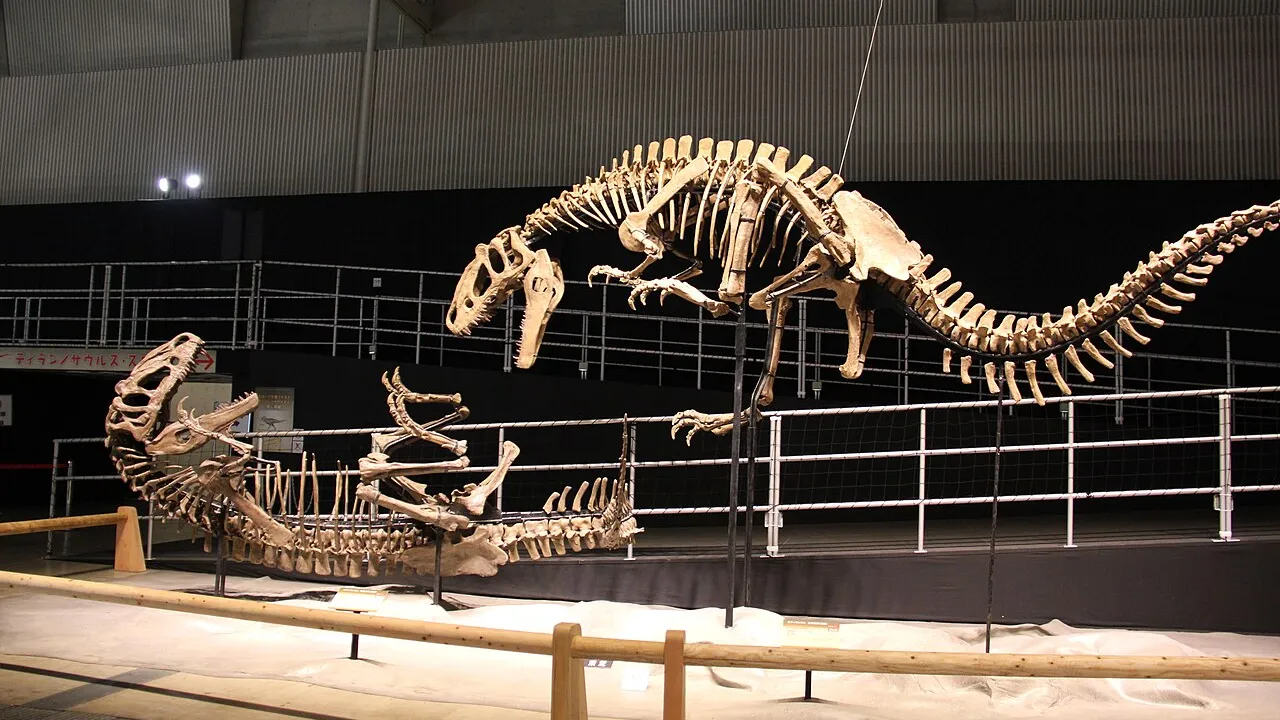
🦴 PREHISTORIC
🦴 Yutyrannus huali • Tyrannosauroidea
VA Science SOL 2.5, 3.4, 3.5, 5.8 (Fossils, Adaptations & Earth History)
Yutyrannus
Giant Shaggy-Feathered Tyrant of Cool Forests
Grade 5 • Advanced • 286 words
🌋 Geologic Period & RegionEarly Cretaceous (125 MYA) • Liaoning Province, China
📏 Size & Weight29.5 ft (9 m) long • 3,100 lbs (1.4 tons)
🦴 Diet & FossilsApex Carnivore • Yixian Formation
⚡ Survival SuperpowerThick eight-inch fuzzy coat on a 1.4-ton tyrannosaur
🤯 Mind-Blowing Fact • Grade 1
Weighing over 3,000 pounds, Yutyrannus is the biggest dinosaur ever proven by fossils to have feathers!
✨ Word Sparks (Grade 1 Glossary)
Tap 🔊 to hear
frost
Tiny ice crystals formed in cold air
tyrant
A mighty ruler with great power
coat
A thick outer layer of fur or feathers
🪝
Why did this bus-sized cousin of T. rex wear a warm, fuzzy coat?
1
A Giant Fuzzy Hunter
Crunch, crunch! Cold sparkles on pine needles in ancient China. Out of the trees steps Yutyrannus! Soft, fuzzy feathers covered its huge body like a warm winter .
2
Beautiful Feathered Tyrant
Its name mixes Chinese and Latin words to mean beautiful feathered . Feathers grew up to eight inches long on its neck and tail!
3
Three Claws on Each Hand
Unlike two-fingered T. rex, Yutyrannus had three sharp claws on each hand and hunted in groups.
1. Why did giant Yutyrannus need a thick coat of fuzzy feathers?
2. What does the full name Yutyrannus huali mean?
🤯 Mind-Blowing Fact • Grade 2
Yutyrannus weighed forty times more than Beipiaosaurus, the previous record-holder for the heaviest feathered dinosaur!
✨ Word Sparks (Grade 2 Glossary)
Tap 🔊 to hear
down
Soft, fluffy feathers that trap warm air
habitat
The natural home where an animal lives
wispy
Thin, light, and feathery like soft strands
🪝
Could a thirty-foot dinosaur weighing more than a car really be covered in fluffy feathers?
1
Surprise in Volcanic Rock
Imagine brushing gray rock off a thirty-foot tyrannosaur skeleton and seeing long, feathers preserved right beside the bones! Before 2012, scientists knew tiny dinosaurs wore feathers, yet most thought big dinosaurs stayed scaly because large bodies hold heat easily. Yutyrannus proved giant predators could be fluffy too!
2
Built for Chilly Woods
One hundred twenty-five million years ago, northeastern China was much cooler than most dinosaur , averaging about fifty degrees Fahrenheit with snowy winters. Shaggy eight-inch feathers trapped body heat like a chick's .
3
Wrinkled Nose Crest and Pack Clues
A bumpy crest ran along its snout, and three skeletons found together with sauropod bones hint that Yutyrannus hunted in packs!
1. How much heavier was Yutyrannus than any feathered dinosaur found before 2012?
2. How many clawed fingers did Yutyrannus have on each hand?
🤯 Mind-Blowing Fact • Grade 3
Fossilized Yutyrannus tail feathers angled backward at 30 degrees, forming a sleek shaggy plume over seven inches thick!
✨ Word Sparks (Grade 3 Glossary)
Tap 🔊 to hear
protofeather
An early, simple hair-like feather used for warmth
insulation
Material that keeps body heat from escaping
plumage
All the feathers covering an animal's body
🪝
How did ancient volcanic ash preserve delicate feathers on a 3,000-pound dinosaur?
1
Chilly Mornings in the Jehol
Cold mist drifts past ginkgo trees and active volcanoes in Early Cretaceous Liaoning, China, 125 million years ago. Striding through the conifer forest come three Yutyrannus huali—an adult nearly thirty feet long followed by two sleeker youngsters. Draped across their necks, backs, and tails are thousands of hair-like !
2
Preserved by Fine Volcanic Ash
Normally, soft feathers rot away long before bone turns to stone. In China's Yixian Formation, fine-grained lake mud and sudden volcanic ash blankets sealed three Yutyrannus skeletons away from oxygen and bacteria, capturing fifteen-to-twenty-centimeter feather filaments around the hips, feet, and tail.
3
Insulation, Not Flight
Because these simple filaments lacked interlocking hooks, Yutyrannus certainly could not fly. Instead, its shaggy acted as thermal during cool ten-degree-Celsius years.
4
Early Cousin of T. rex
Sporting a wavy midline nasal crest and three-fingered hands, this early tyrannosauroid likely teamed up in packs to ambush medium-sized sauropods like Dongbeititan.
1. What geological event in China's Yixian Formation preserved Yutyrannus's delicate feathers?
2. Why couldn't Yutyrannus fly despite having eight-inch feathers?
🤯 Mind-Blowing Fact • Grade 4
Chemical oxygen-isotope thermometers inside Yixian fossils proved Yutyrannus lived during a cool spell roughly 8°C (14°F) colder than typical dinosaur eras!
✨ Word Sparks (Grade 4 Glossary)
Tap 🔊 to hear
isotope
Atom variety whose ratios reveal ancient temperatures in fossils
integument
Natural outer body covering such as skin, scales, or feathers
temperate
Having mild summers and cool, crisp winters
🪝
Why was 1.4-ton Yutyrannus covered in shaggy feathers while later eight-ton T. rex had scaly patches?
1
Breaking the Giant Feather Barrier
Picture the cool, volcanic lake basins of northeastern China 125 million years ago during the Aptian stage. When paleontologist Xing Xu and colleagues unveiled three exquisite skeletons from Liaoning's Yixian Formation in 2012, they named the nine-meter, 1,400-kilogram predator Yutyrannus huali—combining Mandarin 'yu' (feather) and 'huali' (beautiful) with Latin 'tyrannus.' Overnight, Yutyrannus overturned the assumption that multi-ton dinosaurs shed all feathers due to overheating.
2
Paleoclimate Clues in Dinosaur Teeth
Oxygen locked inside Yixian fossil teeth revealed why Yutyrannus wore a winter coat. While Late Cretaceous Montana where Tyrannosaurus rex lived enjoyed warm subtropical temperatures, Early Cretaceous Liaoning averaged roughly ten degrees Celsius (50°F)—similar to cool forests today. Combined with a leaner 1.4-ton body mass than eight-ton T. rex, filamentous up to twenty centimeters long prevented precious metabolic heat loss.
3
Crested Proceratosaurid Design
Unlike late tyrannosaurids with tiny two-fingered arms, Yutyrannus belonged to the earlier proceratosaurid branch, retaining powerful three-fingered forelimbs and a corrugated, air-filled midline crest along its snout for visual display.
4
Evidence for Pack Predation
Because an adult and two subadults were buried together alongside remains of the sauropod Dongbeititan, researchers proposed that cooperative hunting allowed Yutyrannus to tackle giant herbivores.
1. How did oxygen isotopes in Yixian Formation fossils explain Yutyrannus's shaggy coat?
2. Which anatomical features identify Yutyrannus as an earlier proceratosaurid cousin rather than a late tyrannosaurid?
🤯 Mind-Blowing Fact • Grade 5
Because later tyrannosaurids like T. rex evolved in much hotter climates and weighed five times more than Yutyrannus, scientists now realize tyrannosaurs could evolutionarily dial feather coverage up or down like elephants versus woolly mammoths!
✨ Word Sparks (Grade 5 Glossary)
Tap 🔊 to hear
paleothermometry
Measuring ancient Earth temperatures using chemical clues in fossils
lacustrine
Formed at the calm bottom of an ancient lake
endotherm
Warm-blooded animal generating its own internal body heat
🪝
How does Yutyrannus huali illuminate thermoregulatory scaling and plumage evolution across Tyrannosauroidea?
1
Monumental Discovery in the Jehol Biota
In April 2012, paleontologist Xing Xu and an international team stunned evolutionary biology by describing three nearly complete tyrannosauroid skeletons from Barremian–Aptian beds (~125 MYA) of the Yixian Formation near Batu Yingzi in Liaoning, China. Named Yutyrannus huali ('beautiful feathered tyrant'), the holotype adult measured approximately nine meters long and weighed an estimated 1,414 kilograms—making it forty times heavier than Beipiaosaurus and the largest animal ever confirmed with direct fossilized plumage.
2
Filamentous Plumage Preservation
Fine-grained volcaniclastic slabs preserved dense patches of simple, unbranched filamentous protofeathers across multiple body regions across all three specimens: twenty-centimeter filaments sweeping backward from the tail, fifteen-centimeter strands along the neck, and sixteen-centimeter filaments flanking the humerus and foot. This widespread distribution demonstrated extensive body coverage rather than isolated display tufts.
3
Thermoregulatory Scaling vs. Paleoclimate
Biophysical heat-transfer principles dictate that giant possess low surface-area-to-volume ratios, explaining why warm-greenhouse giants like eight-ton Tyrannosaurus rex preserve localized scaly skin impressions to dissipate excess metabolic heat. However, oxygen-isotope from Yixian Formation biogenic apatite indicates cool mean annual air temperatures near ten degrees Celsius (~50°F) punctuated by frosty winters. At 1.4 metric tons in an elevated volcanic highland, Yutyrannus benefited substantially from a dense filamentous coat while potentially adjusting plumage seasonally.
4
Proceratosaurid Osteology and Display
Phylogenetically nested within Proceratosauridae alongside Guanlong and Proceratosaurus rather than derived Late Cretaceous Tyrannosauridae, Yutyrannus combined robust, functional tridactyl (three-fingered) forelimbs, blade-like ziphodont teeth, and non-arctometatarsalian feet with a heavily rugose, sinus-lightened naso-premaxillary midline crest that rose prominently along its snout for intraspecific visual signaling and courtship.
5
Taphonomic Evidence of Gregariousness
The simultaneous preservation of one nine-meter adult alongside two smaller subadults (~596 kg and ~493 kg) in direct association with remains of a large sauropod such as Dongbeititan provides compelling taphonomic evidence that Yutyrannus lived and hunted in multi-generational social groups across Early Cretaceous conifer forests.