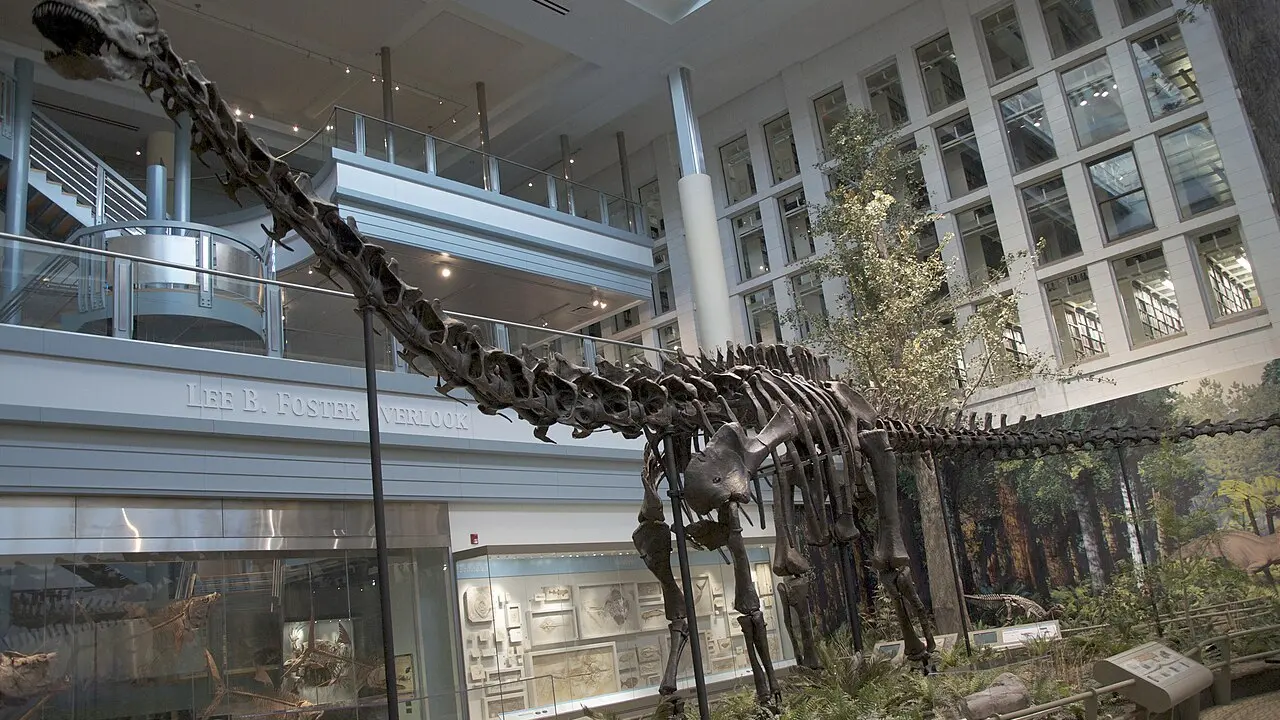
1. Where did all the pencil-like teeth grow inside a Diplodocus mouth?
2. How long was a grown-up Diplodocus compared to school buses?
🤯 Mind-Blowing Fact • Grade 2
Replica casts of a famous Wyoming skeleton nicknamed 'Dippy' were gifted to museums in eight countries, making Diplodocus the first dinosaur millions of kids ever saw!
✨ Word Sparks (Grade 2 Glossary)
Tap 🔊 to hear
Horizontal
Stretching flat and level from side to side
Taper
Gradually grow thinner toward the far tip
Replica
Exact museum copy molded from real fossil bones
🪝
Could a dinosaur really crack the tip of its tail louder than thunder?
1
Living Suspension Bridge
Imagine a dinosaur nearly ninety feet long, yet much lighter and sleeker than chunky Brachiosaurus! One hundred fifty million years ago, Diplodocus wandered green floodplains in Wyoming and Colorado. Shorter front legs kept its neck and tail stretching straight out horizontally.
2
Why 'Double Beam'?
Underneath its long tail sat special two-pronged bones shaped like tiny skids that protected blood vessels whenever its tail brushed the ground. Those twin-ended bones inspired its name, Diplodocus—meaning double beam!
3
Crack of the Whip
Tapering down to bones thinner than your thumb at the tip, its forty-five-foot tail could flick fast enough to make a booming crack that scared off Allosaurus!
1. What inspired the name Diplodocus, meaning 'double beam'?
2. How did Diplodocus hold its long neck most of the time?
🤯 Mind-Blowing Fact • Grade 3
Diplodocus wore down its pencil-thin front teeth on gritty plants so quickly that it grew a brand-new tooth in every socket about once a month!
✨ Word Sparks (Grade 3 Glossary)
Tap 🔊 to hear
Chevron
Small bone underneath a tail protecting blood vessels
Tripod
Stable three-point stand formed by legs and tail
Philanthropist
Person who donates money to support public learning
🪝
How did one Wyoming discovery turn 'Dippy' the Diplodocus into an international superstar?
1
Andrew Carnegie's Giant Discovery
In 1899, paleontologists funded by Andrew Carnegie excavated a breathtakingly complete sauropod skeleton at Sheep Creek, Wyoming. Named Diplodocus carnegii in 1901, 'Dippy' amazed the public! Kings and presidents asked for copies, so Carnegie sent plaster casts to London, Paris, Berlin, Madrid, Vienna, and beyond.
2
Vacuum-Cleaner Grazing Strategy
While tall-shouldered Brachiosaurus browsed forty-foot treetops, Diplodocus specialized in sweeping its twenty-six-foot neck in wide sideways arcs across low fern prairies and mid-height bushes—clearing huge swaths of greenery while conserving energy!
3
Replacing Teeth Every Single Month
Stripping gritty horsetails wore down its slender peg teeth fast. Microscopic growth lines inside fossil jaws show Diplodocus grew up to five backup teeth behind each active tooth, replacing worn teeth every thirty-five days!
4
Rearing Up on Hind Legs
Because its center of mass sat right near its heavy hips, Diplodocus could occasionally rear back onto its hind legs and sturdy tail to reach higher branches.
1. Why did Diplodocus replace its front peg teeth roughly every thirty-five days?
2. What allowed Diplodocus to rear up onto its hind legs when reaching taller branches?
🤯 Mind-Blowing Fact • Grade 4
Fossilized skin impressions discovered in Wyoming showed Diplodocus wore a dramatic row of triangular iguana-like keratin spines running down its back and tail!
✨ Word Sparks (Grade 4 Glossary)
Tap 🔊 to hear
Sonic Boom
Thunderous crack made when an object passes sound speed
Tactile
Communicating or sensing through gentle physical touch
Diplodocid
Family of slender, whip-tailed, peg-toothed sauropods
🪝
What did fossilized Diplodocus skin impressions reveal running right down the middle of its back and tail?
1
Surprise Spines Along the Spine
For more than a century, museum artists painted Diplodocus with plain, smooth elephant skin. Then in the 1990s, geologist Stephen Czerkas discovered exquisite fossilized skin impressions from in Wyoming's Howe Quarry! Running along the midline of the tail and back stood a neat row of pointed, triangular keratinous spines up to seven inches tall—giving this gentle giant an unmistakable dragon-like crest.
2
Testing the Supersonic Tail Hypothesis
In 1997, computer scientist Nathan Myhrvold and paleontologist Philip Currie modeled the eighty-vertebra tail as a bullwhip, proposing its paper-thin tip broke the sound barrier with a 200-decibel ! In 2022, updated soft-tissue stress models by Simone Conti showed skin and ligaments would tear above seventy miles per hour—still fast enough for stinging defensive cracks and herd communication without breaking its own tail.
3
Thumb Spikes and Columnar Feet
While its outer front toes lacked claws and rested in a cushioned horseshoe column, each inner thumb bore one stout, curved claw used to steady tree trunks or scoop nest trenches in warm riverbank sand.
4
Super-Sized Relative: Diplodocus hallorum
Giant vertebrae found in New Mexico—originally nicknamed Seismosaurus ('earth-shaking lizard')—were later reclassified as an oversized species, Diplodocus hallorum, exceeding one hundred feet in length!
1. What did 1990s fossil skin discoveries change about how paleontologists reconstruct Diplodocus?
2. What happened to the giant New Mexico sauropod originally named 'Seismosaurus'?
🤯 Mind-Blowing Fact • Grade 5
Despite stretching eighty-eight feet from snout to tail tip, hollow air-filled vertebrae kept an adult Diplodocus weighing only around fourteen tons—about the same as two large elephants!
✨ Word Sparks (Grade 5 Glossary)
Tap 🔊 to hear
Cantilevered
Supported from a central tower extending outward horizontally
Pleurocoels
Deep air-filled hollows carved into the sides of vertebrae
Precocial
Able to walk and feed independently soon after hatching
🪝
How did suspension-bridge biomechanics allow an eighty-eight-foot Diplodocus to weigh less than three elephants?
1
Suspension-Bridge Axial Mechanics
Described initially by Othniel Charles Marsh in 1878 (`Diplodocus longus`) and popularized globally through John Bell Hatcher's 1901 monograph on `Diplodocus carnegii`, this quintessential diplodocid achieved twenty-seven meters (88 feet) in length while weighing only twelve to sixteen metric tons—less than a third of Brachiosaurus! Tall, notched neural spines over the hips anchored a thick elastic nuchal ligament that suspended the fifteen-vertebra neck forward and the eighty-vertebra tail rearward like steel cables on a bridge.
2
Extreme Vertebral Pneumaticity
Each meter-long cervical and dorsal vertebra featured deep lateral cavities () and honeycomb internal struts invaded by cervical air sacs, trimming skeletal weight by more than half without sacrificing torsional strength.
3
Cranial Branch-Stripping Biomechanics
Finite-element skull simulations by David Button and Emily Rayfield compared three feeding modes—bark biting, branch stripping, and precision nipping. Diplodocus skulls excelled specifically at branch stripping: clamping slender cylindrical front teeth over fern fronds or conifer twigs and pulling its head backward to rake foliage cleanly into its mouth.
4
Precocial Hatchlings and Rapid Juvenile Growth
Small narrow-snouted juvenile skulls found in Montana show young diplodocids possessed slightly broader jaws to browse varied forest-floor plants in safety among dense trees before joining open-floodplain adult herds, multiplying their hatchling weight thousands of times in under two decades.
5
Multiscale Dermal Mosaic
High-resolution laser scans of diplodocid skin from Wyoming's Mother's Day Quarry reveal non-overlapping hexagonal pebble scales varying subtly in size across flanks, joints, and cushioned footpads to combine tough abrasion resistance with smooth, flexible stride motion across seasonal Late Jurassic savannas and riverbanks.