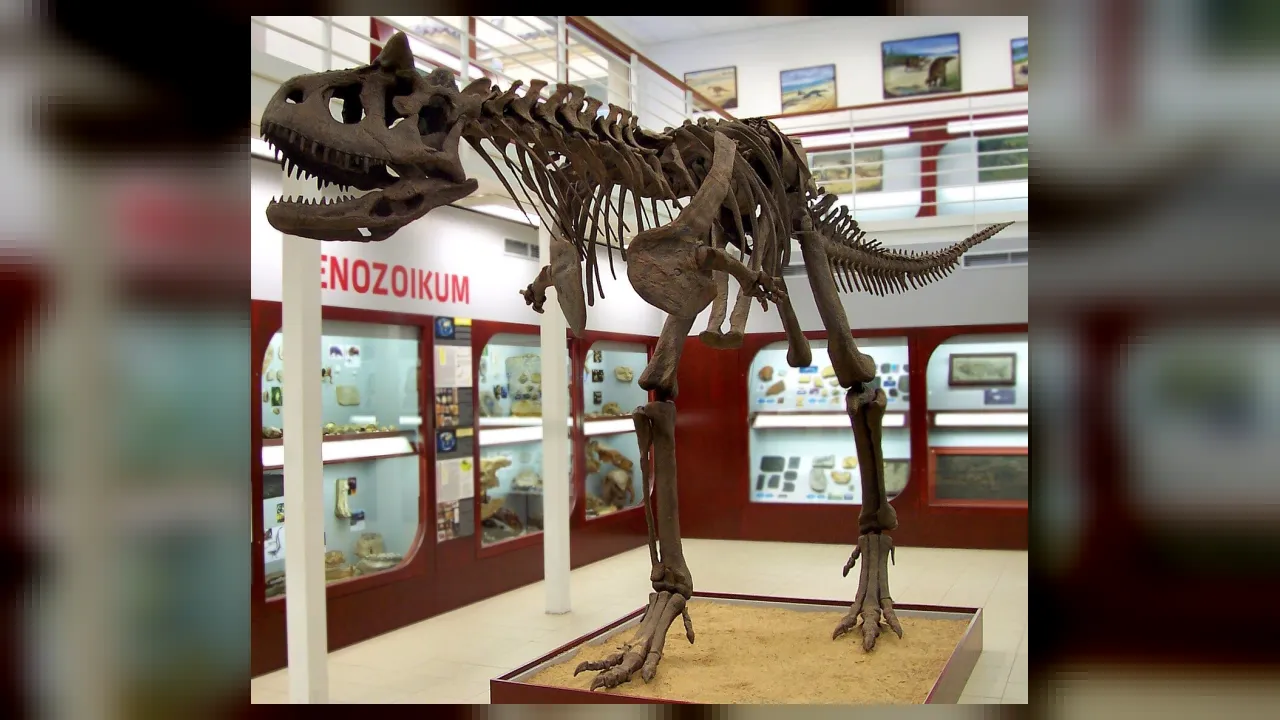
1. Why did scientists name Carnotaurus the 'meat-eating bull'?
2. How did the arms of Carnotaurus compare to Tyrannosaurus Rex arms?
🤯 Mind-Blowing Fact • Grade 2
Only one skeleton of Carnotaurus has ever been discovered, yet it was so complete that even large patches of its bumpy skin were preserved!
✨ Word Sparks (Grade 2 Glossary)
Tap 🔊 to hear
Patagonia
Windy southern region of Argentina rich in fossils
Estuary
Coastal water where rivers meet the salty sea
Impression
Pattern pressed into mud that hardens into rock
🪝
How do we know what Carnotaurus skin felt like without finding feathers?
1
Cheetah of the Southern Continents
Imagine a twenty-six-foot predator sprinting faster than an Olympic runner! Seventy million years ago, Carnotaurus hunted across river plains and estuaries in , Argentina. Long, slender hind legs made it one of the fastest large meat-eaters ever.
2
Preserved in a Rock Blanket
In 1984, rancher Angel Sastre helped paleontologist José Bonaparte uncover an almost complete skeleton curled cleanly in hard stone. Amazingly, large sheets of fossilized skin still covered its right side! Tiny pebble scales surrounded larger rows of bumpy cones—with zero feathers anywhere.
3
Short Boxy Snout
Unlike long-snouted hunters, Carnotaurus had a remarkably deep, short skull shaped almost like a bulldog's.
1. How many skeletons of Carnotaurus have paleontologists found so far?
2. What covered the body of Carnotaurus according to its fossil skin?
🤯 Mind-Blowing Fact • Grade 3
Upward-tilted bone flanges on its tail anchored leg-pulling muscles bigger relative to body size than in any other meat-eating dinosaur!
✨ Word Sparks (Grade 3 Glossary)
Tap 🔊 to hear
Abelisaur
Short-snouted, tiny-armed carnivore family of southern continents
Vestigial
Shrunken body part no longer used for grabbing
Flanges
Projecting bone ridges where powerful muscles attach
🪝
How did giant tail muscles turn Carnotaurus into a thirty-five-mile-per-hour sprinter?
1
Southern Hemisphere Specialist
While tyrannosaurs ruled northern continents during the Late Cretaceous, a completely different family called ruled South America, Africa, Madagascar, and India. Carnotaurus sastrei stood out as the sleekest, most specialized member of that southern clan!
2
Supercharged Tail Engine
In 2011, paleontologist Scott Persons examined bizarre wing-like ribs sticking up at V-angles along the sides of Carnotaurus tail vertebrae. Those upward anchored gigantic caudofemoralis muscles—the exact muscles that pull a dinosaur's thigh bone backward during every stride! Powered by that oversized tail engine, Carnotaurus rocketed forward in straight-line sprints up to thirty-five miles per hour.
3
Stiff Tail, Wide Turning Circle
Locking those tail ribs together stiffened the tail, meaning Carnotaurus blazed straight ahead like a dragster rather than making sharp zig-zag turns.
4
Vestigial Forelimbs
Its forearm bones measured only a quarter the length of its upper arm, lacking flexible elbow joints completely!
1. What trade-off came with the stiff, muscle-packed tail of Carnotaurus?
2. Which continents were home to the abelisaur dinosaur family?
🤯 Mind-Blowing Fact • Grade 4
Even though Carnotaurus could not bend its tiny elbows at all, ball-and-socket shoulders let it twirl its little arms around—possibly during courtship dances!
✨ Word Sparks (Grade 4 Glossary)
Tap 🔊 to hear
Concretion
Mineral-cemented rock nodule protecting delicate buried fossils
Articulated
Fossil bones preserved still connected at natural joints
Courtship
Visual displays or dances animals use to attract mates
🪝
Why did Carnotaurus have immovable elbows yet flexible ball-and-socket shoulders?
1
Excavation in La Colonia Formation
Encased inside a rock-hard hematite in Argentina's Chubut Province, the 1984 holotype of Carnotaurus sastrei preserved nearly every bone in life position. Measuring eight meters (26 feet) long and weighing roughly 1.7 tons, it inhabited warm coastal estuaries populated by long-necked saltasaurid titanosaurs, turtles, plesiosaurs, and early mammals.
2
The Mystery of Twirling Tiny Arms
At first glance, the four-fingered arms of Carnotaurus look completely useless: the radius and ulna measured barely four inches long, wrist bones never even hardened from cartilage, and the elbow joint was locked frozen! Yet its shoulder socket was surprisingly large and spherical, allowing muscular shoulders to wave or flick the stubby arms during colorful displays.
3
Hatchet-Quick Bites vs. Small Prey
Biomechanical skull tests show Carnotaurus possessed a relatively slender lower jaw with a flexible mid-jaw joint and fast-closing muscles. Rather than wrestling twenty-ton sauropods, it likely delivered rapid, snapping bites to capture nimble ornithopods and smaller reptiles.
4
Horns for Head-Shoving or Display?
Thickened frontal bones formed six-inch horn cores above forward-tilted eyes; in life, keratin sheaths extended those horns even farther for rival shoving matches, species recognition, or bold visual signaling across open Patagonian plains.
1. What unusual combination did anatomists find in the forelimbs of Carnotaurus?
2. What does the slender, fast-snapping jaw structure of Carnotaurus suggest about its preferred prey?
🤯 Mind-Blowing Fact • Grade 5
A 2021 study of the original Carnotaurus skin fossils revealed that its big cone-shaped bumps weren't arranged in neat stripes at all—they scattered in random polka-dot patterns across fine pebble scales!
✨ Word Sparks (Grade 5 Glossary)
Tap 🔊 to hear
Cursorial
Anatomically specialized for fast running across open ground
Integument
External body covering such as skin, scales, or feathers
Gondwana
Ancient southern supercontinent uniting South America and Africa
🪝
What did the 2021 microscopic reanalysis of Carnotaurus skin reveal about theropod heat control and camouflage?
1
Gondwanan Divergence of Abelisauridae
When supercontinent Pangaea fractured into northern Laurasia and southern during the Jurassic and Cretaceous Periods, isolated southern landmasses evolved distinct theropod lineages. Described by José Bonaparte in 1985 from Maastrichtian deposits of Argentina's La Colonia Formation, Carnotaurus sastrei represents the extreme pinnacle of Abelisauridae—combining a deep, foreshortened sixty-centimeter cranium with gracile, elongated tibiae and metatarsals.
2
Caudal Myology and Cursorial Locomotion
Volumetric muscle reconstructions published in 2011 demonstrated that elevated, crescentic caudal ribs (transverse processes) expanded attachment space for the M. caudofemoralis longus—accounting for up to fifteen percent of total body mass! Generating immense femoral retraction torque while interlocking hyposphene-hypantrum joints rigidified the spine, Carnotaurus achieved peak speeds estimated between forty-eight and fifty-six kilometers per hour.
3
2021 Integumentary Reanalysis
In 2021, paleontologists Christophe Hendrickx and Phil Bell re-examined the fossilized skin spanning the neck, shoulder, thorax, and tail of Carnotaurus. Contrary to older assumptions that conical feature scales lined neatly in rows, five-centimeter domed studs scattered randomly across a fine mosaic of non-overlapping polygonal basement scales—without a single filamentous protofeather.
4
Thermoregulation Without Feathers
Wrinkled folds and tiny interstitial granules around larger studs likely aided convective heat dissipation in warm coastal habitats where thick insulating plumage would have caused dangerous overheating during high-speed chases across sunlit estuaries.
5
Kinetic Jaw Mechanics and Binocular Overlap
Forward-angled postorbital bones granted partial stereoscopic depth perception ahead of the short snout, while flexible intramandibular joints absorbed mechanical shock as rapid, neck-assisted bites seized agile prey across Late Cretaceous Patagonia—proving southern theropods achieved evolutionary excellence along a completely unique anatomical path.