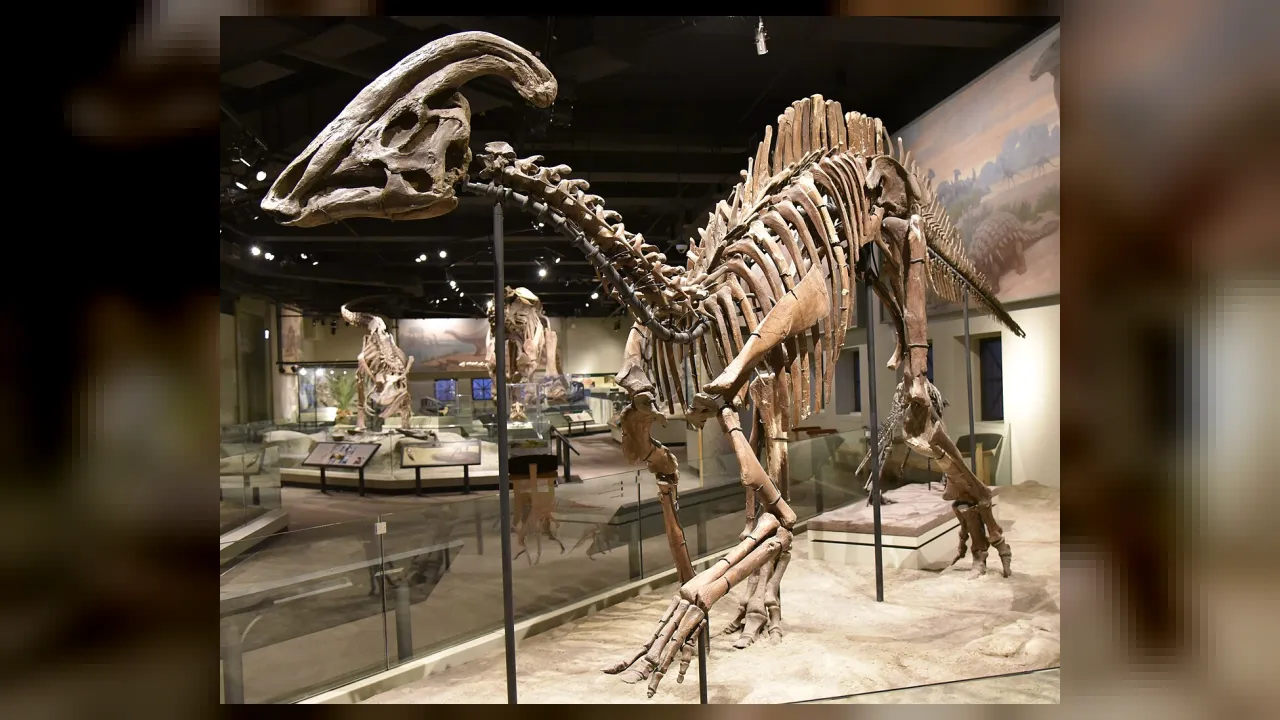
⚡ Survival SuperpowerSix-foot hollow head crest containing looping trombone-like tubes for booming calls
🤯 Mind-Blowing Fact • Grade 1
Scientists blew air through a 3D computer model of a Parasaurolophus crest so we can hear its deep foghorn call after seventy-five million years!
✨ Word Sparks (Grade 1 Glossary)
Tap 🔊 to hear
Crest
Long curved bony tube atop a dinosaur's head
Hollow
Having open air space inside instead of solid
Echo
Sound bouncing far across hills and valleys
🪝
What dinosaur wore a giant musical horn curved backward off its head?
1
Hooooonk Through the Trees!
Boooooom, hooooonk! A deep, musical sound across the misty river valley. High above the ferns rises a long curved head ! Meet the singing plant-eater, Parasaurolophus.
2
Built-In Trumpet
Its long bony was inside like a brass trumpet! Every breath traveled up through the tube and back down, booming deep calls to friends.
3
Walking Two Ways
While nibbling berries and leaves, it walked gently on four legs. When running fast, it stood up on two strong back legs!
1. What was hidden inside the long head crest of Parasaurolophus?
2. How did Parasaurolophus move when it wanted to run quickly?
🤯 Mind-Blowing Fact • Grade 2
Even though people once guessed the crest was an underwater snorkel, the back tip is completely sealed shut with solid bone!
✨ Word Sparks (Grade 2 Glossary)
Tap 🔊 to hear
Hadrosaur
Plant-eating dinosaur family known for wide duck-like bills
Resonate
Vibrate air inside a chamber to make deep sound
Snorkel
Open breathing tube used while swimming near surface
🪝
Why did scientists once think Parasaurolophus used its head tube as a breathing snorkel underwater?
1
Musician of the Ancient Forest
Imagine walking through a swampy redwood forest in Alberta or New Mexico seventy-five million years ago and hearing a bass horn rumble through the trees! Out steps Parasaurolophus, a thirty-foot duck-billed dinosaur wearing a curved bony tube up to six feet long.
2
No Hole at the Tip!
Long ago, people guessed the dinosaur swam underwater and poked its crest out like a diver's . Closer inspection solved the puzzle: there is no breathing hole at the back tip of the crest! Instead, air entered its nostrils, looped all the way up and down inside the closed tube, and resonated like a trombone.
3
Living in Safe Herds
Low, booming calls traveled for miles through thick woods, warning herd mates whenever tyrannosaurs lurked nearby.
1. How do scientists know Parasaurolophus did NOT use its head crest as an underwater snorkel?
2. Why were deep, low-pitched calls so useful in thick ancient forests?
🤯 Mind-Blowing Fact • Grade 3
A baby Parasaurolophus skeleton nicknamed 'Joe' discovered in Utah showed that youngsters started out with stubby little forehead bumps that stretched into giant tubes as they grew!
✨ Word Sparks (Grade 3 Glossary)
Tap 🔊 to hear
CT Scanner
X-ray machine taking 3D pictures inside solid fossils
Frequency
How high or low a musical sound vibrates
Conifers
Evergreen trees bearing cones and tough needles
🪝
How did scientists recreate the real voice of Parasaurolophus using hospital CT scanners and supercomputers?
1
Bringing a 75-Million-Year-Old Voice Back to Life
In 1995, paleontologists in New Mexico unearthed an intact skull of Parasaurolophus tubicen and placed it inside a medical . Without cracking the priceless fossil, X-rays mapped complex looping airways nearly nine feet long folded inside the four-and-a-half-foot crest! Computer scientists simulated airflow through those chambers, producing haunting, foghorn-like notes.
2
Grinding Tough Conifers
Like other duck-billed hadrosaurs, Parasaurolophus owned one of the most advanced chewing systems ever evolved. Behind its toothless duck bill sat hundreds of tightly packed cheek teeth that ground pine needles, twigs, and leaves into a fine paste!
3
Growing Into Its Crest
Cute fossilized youngsters nicknamed 'Joe' found in Utah show babies hatched with just a tiny bump over the nose, growing their long trombone crests only as teenagers.
4
Deep Swimmer Tail
Tall spines along its tail vertebrae formed a deep, muscular tail helpful both for fast running and paddling across wide rivers.
1. How did scientists map the air tubes inside the New Mexico Parasaurolophus skull without breaking it?
2. What did the juvenile skeleton nicknamed 'Joe' teach paleontologists?
🤯 Mind-Blowing Fact • Grade 4
Inner-ear fossils of Parasaurolophus were specially tuned to hear the exact super-low thirty-hertz bass notes produced by its own six-foot trombone crest!
✨ Word Sparks (Grade 4 Glossary)
Tap 🔊 to hear
Lambeosaurine
Subfamily of duck-billed dinosaurs bearing hollow head crests
Cochlea
Inner-ear tube that turns sound vibrations into signals
Hertz
Unit measuring how many sound waves pass each second
🪝
Why did three different species of Parasaurolophus wear slightly different crests across western North America?
1
Three Species, Three Signatures
Between seventy-six and seventy-three million years ago, three distinct species of Parasaurolophus inhabited rivers bordering the Western Interior Seaway. Named in 1922 from Alberta, Canada, Parasaurolophus walkeri sported a long, gently curving tube; New Mexico's Parasaurolophus tubicen evolved an even more intricate internal labyrinth; and Parasaurolophus cyrtocristatus owned a shorter, tightly hooked crest!
2
Acoustic Tuning Between Crest and Ear
Paleontologist David Weishampel compared the resonant sound frequencies of hollow crests—roughly thirty to sixty , like the lowest notes on a piano—against CT scans of their fossilized inner ears. Remarkably, the fluid-filled cochlear ducts inside Parasaurolophus ears were elongated specifically to hear those exact ultra-low bass rumbles!
3
Six-Material Grinding Teeth
Microscopic tooth studies reveal hadrosaurs outperformed horses and bison! Each tooth combined six tissues of differing hardness so wear carved rough diamond-shaped grinding basins capable of pulverizing woody horsetails and conifers.
4
Padded Hoof-Like Mitten Hands
Mummified hadrosaur fossils show their three weight-bearing front fingers were wrapped together inside a fleshy, hoof-tipped 'mitten'—not webbed duck paddles as early books once guessed! Supported by sturdy hind hooves and a muscular counterbalancing tail, herds traveled efficiently along forested river plains while keeping watch and ear tuned for distant herd calls.
1. What matching link did paleontologists discover between the crest and inner ear of Parasaurolophus?
2. What did mummified duck-billed dinosaur fossils prove about their front hands?
🤯 Mind-Blowing Fact • Grade 5
Bone growth rings inside the six-foot-long juvenile Parasaurolophus fossil 'Joe' revealed that the youngster grew to over six feet long in less than a single year!
✨ Word Sparks (Grade 5 Glossary)
Tap 🔊 to hear
Premaxilla
Front upper jaw bone stretched backward into the crest
Infrasound
Ultra-deep sound waves almost below human hearing
Allometry
One body part growing faster than overall body size
🪝
How did hollow premaxillary skull bones stretch six feet backward over the shoulders of Parasaurolophus?
1
Cranial Remodeling of the Premaxilla and Nasal Bones
When University of Toronto paleontologist William Parks described Parasaurolophus walkeri ('near crested lizard') from Alberta's Dinosaur Park Formation in 1922, anatomists marveled at how its six-foot cranial tube formed. Rather than sprouting a brand-new horn bone, evolutionary development stretched the premaxillary and nasal bones—the exact bones framing the tip of a reptile's snout—upward between the eyes and far behind the occiput! A 2021 skull discovery in New Mexico finally confirmed the identical bone seam arrangement in Parasaurolophus cyrtocristatus.
2
Bioacoustics and Infrasonic Herd Signaling
Measuring nine-and-a-half meters (31 feet) and roughly three metric tons, adult Parasaurolophus possessed paired U-bend respiratory tracts totaling nearly 2.9 meters in acoustic path length. Digital fluid-dynamics models by Carl Diegert and Thomas Williamson produced fundamental frequencies down to thirty hertz—bordering —ideal for long-range contact calls across dense Late Cretaceous taxodiaceous cypress swamps without revealing exact location to tyrannosaurid ambushers like Daspletosaurus or Teratophoneus.
3
Ontogenetic Allometry of 'Baby Joe'
Histological bone-ring counts on the six-foot-long juvenile skeleton 'Joe' (RAM 14000) from Utah's Kaiparowits Formation revealed the youngster died before its first birthday! Already one-quarter adult length, its rapid isometric limb growth paired with delayed positive of the crest shows acoustic pitch dropped steadily as individuals matured.
4
Nuchal Ligament Attachment Debate
Tall neural spines over the sixth and seventh dorsal vertebrae bear a distinctive notch; some anatomists propose an elastic neck ligament linked the crest tip to the shoulders, while skin impressions from related hadrosaurs show a fleshy frill of triangular scales framing the neck.
5
Complex Dental Pavement
Up to three hundred teeth per jaw quadrant locked into self-maintaining grinding pavements, empowering lambeosaurine herds to process tough gymnosperm needles and early woody angiosperms.