1. Where did Yangchuanosaurus live millions of years ago?
2. How long was the tail of Yangchuanosaurus compared to its body?
🤯 Mind-Blowing Fact • Grade 2
The largest species, Yangchuanosaurus magnus, had a massive skull more than three and a half feet long!
✨ Word Sparks (Grade 2 Glossary)
Tap 🔊 to hear
reservoir
a large lake made behind dams
counterpart
an animal with the same role elsewhere
strike
a sudden fast lunge forward
🪝
How did building a reservoir dam uncover one of Asia's greatest meat-eating dinosaurs?
1
Surprise at the Dam Site
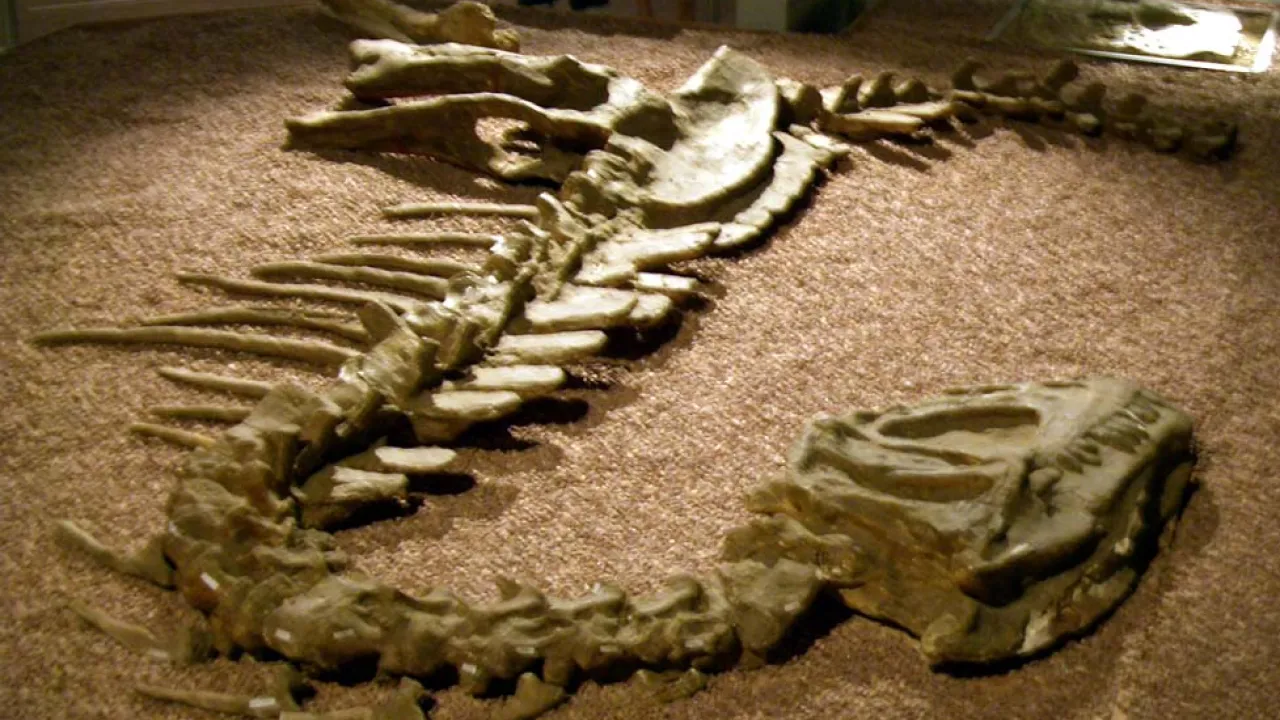
Clang, dig, scrape! In June 1977, construction workers building the Shangyou dam in Sichuan, China, spotted an enormous fossil skull gleaming in red rock! Paleontologist Dong Zhiming named the twenty-six-foot skeleton Yangchuanosaurus shangyouensis—and larger cousins found nearby stretched up to thirty-six feet!
2
China's Answer to Allosaurus
While Allosaurus patrolled North America, Yangchuanosaurus held the exact same top-predator job across Asia. Wide windows in its tall skull kept its head light enough for quick .
3
Careful Around Spiky Tails!
Sharing forests with giant long-necked Mamenchisaurus and spiky stegosaurs like Tuojiangosaurus meant choosing targets wisely!
1. Which famous North American predator filled a role very similar to Yangchuanosaurus?
2. Why wasn't the three-foot skull of Yangchuanosaurus too heavy to lift?
🤯 Mind-Blowing Fact • Grade 3
Sichuan's Shaximiao Formation has yielded so many spectacular skeletons alongside Yangchuanosaurus that Zigong built an entire museum directly on top of a dinosaur bonebed!
✨ Word Sparks (Grade 3 Glossary)
Tap 🔊 to hear
ornate
decorated with fancy ridges and patterns
grapple
to grab and hold on tightly
ginkgo
an ancient tree with fan-shaped leaves
🪝
What kind of hunting tools did Yangchuanosaurus need in a land of fifty-foot necks and spiked tails?
1
Land of Red Stone Giants
Travel back 160 million years to China's Sichuan Basin, where wide rivers wind through lush and conifer forests. Towering Mamenchisaurus swing necks longer than any bus, while armored Tuojiangosaurus bristle with shoulder and tail spikes. Prowling through the trees comes thirty-five-foot Yangchuanosaurus, apex predator of the Shaximiao Formation.
2
Ornate Ridges and Steak-Knife Teeth
Across the top of its snout ran rough bony ridges and low brow hornlets, likely covered in colorful keratin sheaths to signal rivals and mates. Below those ornaments, its jaws held dozens of curved, saw-edged teeth built for slicing rather than crushing solid bone.
3
Three-Clawed Grappling Arms
Although shorter than its pillar-strong hind legs, its muscular arms ended in three fingers tipped with sharp, curved claws for gripping prey.
4
Preserved Almost Nose to Tail
Unlike many giant predators known only from scraps, the 1977 Shangyou dam skeleton preserved nearly every bone connected in place!
1. How were the curved, saw-edged teeth of Yangchuanosaurus used?
2. Which long-necked giant shared ancient Sichuan with Yangchuanosaurus?
🤯 Mind-Blowing Fact • Grade 4
Scientists studying Chinese fossils realized that skeletons once placed in a separate genus, Sinraptor, belong to the very same metriacanthosaurid family tree right beside Yangchuanosaurus!
✨ Word Sparks (Grade 4 Glossary)
Tap 🔊 to hear
antorbital
skull opening right ahead of eyes
rugose
wrinkled, bumpy, and rough in texture
megacarnivore
a giant meat-eating predator weighing tons
🪝
How did isolation across Jurassic seas turn China's Yangchuanosaurus into a specialized giant?
1
Isolated Kingdom of East Asia
During the Middle and Late Jurassic Periods roughly 168 to 157 million years ago, rising shallow seas and mountain ranges periodically cut East Asia off from Europe and North America. Inside that isolated realm, dinosaurs evolved spectacular local dynasties! Towering atop the food chain of Sichuan's Shaximiao Formation stood Yangchuanosaurus, reaching eleven meters in length and more than three metric tons in mass.
2
Skull Fenestrae and Pneumatic Sinuses
Despite measuring over one meter long in massive adults, the cranium of Yangchuanosaurus was engineered like an arched steel bridge. Extra-wide openings ahead of the eyes and air-filled sinus pockets lightened the skull dramatically without sacrificing vertical strength. Meanwhile, nasal crests and lacrimal hornlets formed bold visual badges across sunlit riverbanks.
3
Master of the Metriacanthosaurids
Paleontologists classify Yangchuanosaurus within Metriacanthosauridae—an agile branch of allosauroids characterized by tall neural spines along the back and deeply rimmed hip sockets. Compared with later bone-crushing tyrannosaurs, Yangchuanosaurus swung its flexible S-curved neck downward in fast, hatchet-style slicing strikes.
4
Growing From Sleek to Massive
Comparing the eight-meter Shangyou skeleton with the nearly eleven-meter specimen named Yangchuanosaurus magnus shows how juveniles matured into formidable .
1. Why did East Asia evolve distinct dinosaurs like Yangchuanosaurus and Mamenchisaurus during the Jurassic?
2. To which specific family of allosauroid theropods does Yangchuanosaurus belong?
🤯 Mind-Blowing Fact • Grade 5
Modern uranium-lead dating of tiny volcanic zircon crystals in Sichuan rocks showed Yangchuanosaurus achieved three-ton giant status several million years earlier in the Jurassic than scientists originally thought!
✨ Word Sparks (Grade 5 Glossary)
Tap 🔊 to hear
epaxial
muscles lying along top of backbones
zircon
tiny crystal used to date rocks
allosauroid
superfamily of big slicing Jurassic-Cretaceous hunters
🪝
What does the remarkably complete skeleton of Yangchuanosaurus reveal about allosauroid evolution in isolated Jurassic Asia?
1
Serendipity at Shangyou Reservoir
In June 1977, a construction supervisor overseeing excavation at the Shangyou Reservoir dam in Yongchuan—historically romanized Yangchuan—district of Chongqing exposed an articulated theropod skeleton embedded in purplish-red mudstones of the Shaximiao Formation. Described in 1978 by renowned Chinese paleontologist Dong Zhiming and colleagues as Yangchuanosaurus shangyouensis, the eight-meter holotype (CV 00215) was soon joined by a massive ten-point-eight-meter specimen named Yangchuanosaurus magnus, boasting a 1.11-meter cranium and an estimated body mass exceeding three metric tons.
2
Cranial Pneumaticity and Ornamentation
Despite approaching the scale of Late Cretaceous tyrannosaurs, the skull of Yangchuanosaurus adhered to classic lightness. Expansive antorbital, maxillary, and promaxillary fenestrae channeled paranasal air sacs throughout the snout, leaving robust osseous struts to resist dorsoventral biting loads. Dorsally, coalesced rugosities along the nasals and paired lacrimal hornlets anchored keratinous display crests.
3
Phylogeny of Metriacanthosauridae
Detailed cladistic revisions by Matthew Carrano, Roger Benson, and Scott Sampson in 2012 solidified Yangchuanosaurus as the flagship genus of Metriacanthosaurinae within Allosauroidea, closely allied with Sinraptor dongi and European Metriacanthosaurus. Moderately elongated dorsal neural spines anchored deep muscles along the trunk, while a four-sacral pelvis and fifty-percent-body-length tail provided agile counterbalance.
4
Predatory Biomechanics in a Sauropod Realm
Armed with laterally compressed, ziphodont maxillary crowns and recurved manual unguals on digits one through three, Yangchuanosaurus delivered rapid, flesh-rending strikes boosted by powerful ventroflexor neck muscles—ideal for targeting subadult eusauropods such as Omeisaurus and Mamenchisaurus while steering clear of the lethal tail spikes of stegosaurids Tuojiangosaurus and Chungkingosaurus.
5
Revised Radiometric Age of the Shaximiao Biota
Modern U-Pb dating places key Shaximiao horizons near the Bathonian-Oxfordian transition around 166 to 159 million years ago, demonstrating that multi-ton metriacanthosaurids achieved apex gigantism across East Asia millions of years earlier than once assumed.