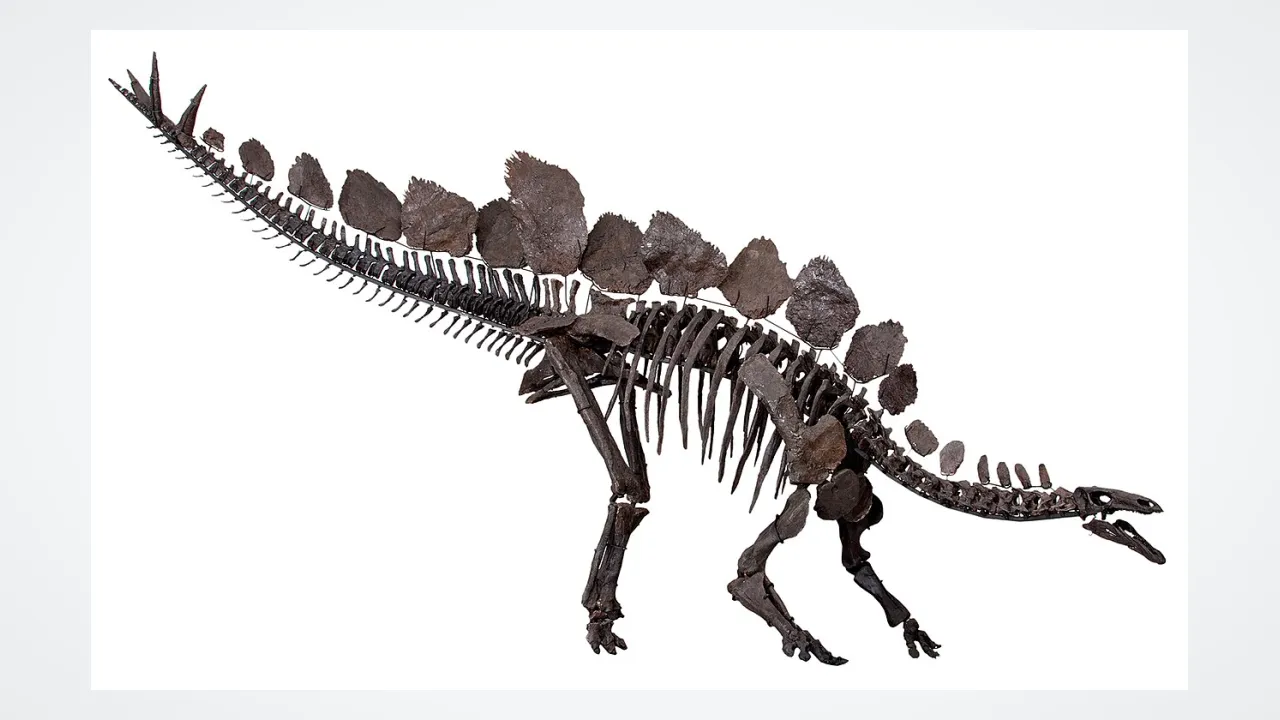
⚡ Survival SuperpowerSeventeen vascular diamond back plates paired with a four-spiked thagomizer tail
🤯 Mind-Blowing Fact • Grade 1
Even though Stegosaurus weighed five tons, its brain was no bigger than a small green lime!
✨ Word Sparks (Grade 1 Glossary)
Tap 🔊 to hear
Plates
Flat upright bony shields along a dinosaur's back
Spikes
Long pointed horns growing on a dinosaur's tail
Flexible
Able to bend and swing easily
🪝
Why did this dinosaur carry seventeen giant kite shapes along its back?
1
Kites Along Its Back
Swish, thump! Seventeen tall bony march through the green ferns! Each flat plate looks like a big diamond kite standing straight up. Here comes gentle Stegosaurus!
2
Four Tail Spikes
Look at the tip of its tail! Four long, sharp stick out to the sides. One big swing told hungry meat-eaters to stay back!
3
Tiny Head, Big Body
Even though its body grew as big as a bus, its narrow head stayed very small. Inside sat a tiny brain the size of a lime!
1. How many sharp spikes grew at the tip of a Stegosaurus tail?
2. About how small was the brain inside a giant Stegosaurus?
🤯 Mind-Blowing Fact • Grade 2
More time passed between Stegosaurus and Tyrannosaurus Rex than between Tyrannosaurus Rex and you today!
✨ Word Sparks (Grade 2 Glossary)
Tap 🔊 to hear
Staggered
Arranged in alternating zig-zag rows instead of pairs
Shingles
Overlapping flat tiles covering a house roof
Horsetail
Ancient reed-like plant that grew near streams
🪝
Why does the name Stegosaurus mean 'roof lizard' if its plates stood upright?
1
A Funny Naming Mistake
Imagine piecing together a giant rock puzzle with no picture on the box! When scientists dug up the first Stegosaurus in 1877, they thought its flat plates lay across its back like roof —so they named it roof lizard! Complete skeletons later showed seventeen plates standing upright in two rows.
2
Solar Panels and Billboards
Tiny grooves across each bony plate held blood vessels. Turning sideways into morning sunshine warmed its blood, while standing in cool breezes helped it shed heat! Bright colors on those big plates also helped herd mates recognize each other.
3
Munching Low Ferns
Short front legs kept its toothless beak right beside low ferns, mosses, and .
1. Why did scientists originally name Stegosaurus 'roof lizard'?
2. Which surprising timeline fact is true about Stegosaurus and Tyrannosaurus Rex?
🤯 Mind-Blowing Fact • Grade 3
Beneath its chin, Stegosaurus wore hundreds of pebble-like bones embedded in its skin like medieval chain-mail armor!
✨ Word Sparks (Grade 3 Glossary)
Tap 🔊 to hear
Thagomizer
Official scientific name for four stegosaur tail spikes
Osteoderm
Bony plate or scale growing directly inside skin
Ossicles
Pebble-sized armor bones protecting a dinosaur's throat
🪝
Did you know scientists named the spiked tail of Stegosaurus after a newspaper comic?
1
Armored Browser of the Late Jurassic
Step into lush riverbeds of Colorado and Wyoming one hundred fifty million years ago. Grazing quietly among cycads and tree ferns walks Stegosaurus stenops, a thirty-foot, five-ton herbivore arched high over sturdy hind legs.
2
Meet the Thagomizer!
For over a century, paleontologists had no official scientific word for the four three-foot spikes at the end of a stegosaur's tail. In 1982, cartoonist Gary Larson joked in a comic strip that the spikes were called a '.' Paleontologists loved the word so much they adopted it into real science museums and textbooks!
3
Plates Embedded in Skin, Not Spine
Surprisingly, those seventeen two-foot-tall diamond plates were —bony growths anchored straight inside thick back skin rather than attached to the backbone!
4
Throat Armor Too
Pebble-sized round bones called formed flexible chain-mail armor underneath its throat, protecting its neck from predators like Allosaurus.
1. How were the seventeen large back plates attached to Stegosaurus?
2. Where did the scientific term 'thagomizer' originally come from?
🤯 Mind-Blowing Fact • Grade 4
Wind-tunnel experiments proved that the alternating zig-zag pattern of Stegosaurus back plates stirred up airflow to cool blood much faster than side-by-side rows!
✨ Word Sparks (Grade 4 Glossary)
Tap 🔊 to hear
Thermoregulation
Controlling internal body temperature whether hot or cold
Glycogen Body
Energy-storing organ near the spinal cord in hips
Vascular
Filled with tiny channels that carry flowing blood
🪝
Did Stegosaurus really have a 'second brain' in its hips, or was something much cooler inside that cavity?
1
Debunking the Two-Brain Myth
When Othniel Charles Marsh examined Stegosaurus skeletons in the 1880s, he noticed a hollow space inside the hip vertebrae twenty times larger than its tiny three-ounce braincase! For generations, books repeated the myth that Stegosaurus needed a 'butt brain' to control its heavy tail. Modern zoologists solved the mystery: living ostriches and pigeons have the exact same hip enlargement—a that stores energy-rich sugars for the spinal cord!
2
Thermoregulation in Wind-Tunnel Tests
Why grow seventeen staggered plates if thin bone cracked too easily to block heavy predator bites? Engineers placed scale models of Stegosaurus plates inside wind tunnels and discovered that staggered alternating rows created swirling air currents, cooling blood flowing through grooves far better than paired parallel rows ever could.
3
Active Tail Defense Against Allosaurus
Unlike sauropods with stiffened tails, Stegosaurus lacked rigid tail tendons, letting muscular hips whip its four keratin-sheathed spikes horizontally at high speed. Paleontologists even found an Allosaurus tail vertebra punctured by a hole matching a Stegosaurus spike!
4
Cheeks and Leaf-Shredding Teeth
Small leaf-shaped cheek teeth bearing rounded ridges crushed soft ferns, mosses, horsetails, and fallen cycad fruits close to the ground.
1. What actually filled the large hollow space inside the hip bones of Stegosaurus?
2. What fossil evidence proves Stegosaurus actively swung its tail spikes to defend itself?
🤯 Mind-Blowing Fact • Grade 5
Colorado officially named Stegosaurus its state fossil in 1982 after generations of fourth-grade students campaigned to honor the dinosaur discovered right in Morrison, Colorado!
✨ Word Sparks (Grade 5 Glossary)
Tap 🔊 to hear
Thyreophoran
Group of armored, plant-eating dinosaurs bearing bony plates
Dimorphism
Physical shape differences between males and females
Histology
Microscopic study of internal bone and tissue structure
🪝
How do microscopic bone scans reveal how Stegosaurus used its plates for both temperature control and species recognition?
1
Lakes Ranch and the Morrison Ecosystem
In 1877, schoolteacher Arthur Lakes discovered giant dermal plates encased in hard sandstone along Dinosaur Ridge near Morrison, Colorado, shipping them to Yale paleontologist Othniel Charles Marsh. Nine years later, a nearly complete articulated skeleton of Stegosaurus stenops ('narrow-faced roof lizard') unearthed at Garden Park revealed the true architecture of this nine-meter (30-foot), five-metric-ton herbivore.
2
Histology of the Dorsal Osteoderms
CT scans and microscopic thin sections of the seventeen dorsal plates show a spongy interior honeycombed with wide vascular pipes feeding branching surface grooves. Covered in life by tough keratin sheaths—likely pigmented in vivid patterns—these plates functioned simultaneously as visual display billboards for species and maturity signaling and as convective heat exchangers across semi-arid floodplains.
3
Sexual Dimorphism in Plate Shape
In 2015, paleontologist Evan Saitta analyzed dozens of Stegosaurus skeletons from a single Montana quarry and identified two distinct plate shapes within one species: wide, rounded plates with forty-five percent more surface area, and taller, narrower plates—strong evidence of male-and-female .
4
Biomechanics of the Thagomizer
Unlike ankylosaurs whose tails stiffened into clubs, Stegosaurus possessed flexible caudal vertebrae without ossified tendons. Muscular caudofemoralis attachments allowed thirty-degree lateral arcs, driving meter-long spikes sheathed in horn with enough force to pierce solid predator bone.
5
Cranial Bite Mechanics and Low-Level Foraging
Finite-element skull modeling shows that despite small, triangular cheek teeth, Stegosaurus generated bite forces comparable to modern sheep and cattle. Fleshy muscular cheeks prevented clipped foliage from spilling sideways while its keratinous front beak efficiently cropped low-growing horsetails, ferns, mosses, and conifers under one meter tall, allowing stegosaurs to thrive alongside towering sauropods that harvested the upper forest canopy. Together, these remarkable adaptations kept Stegosaurus flourishing across North America and Europe for nearly ten million years.