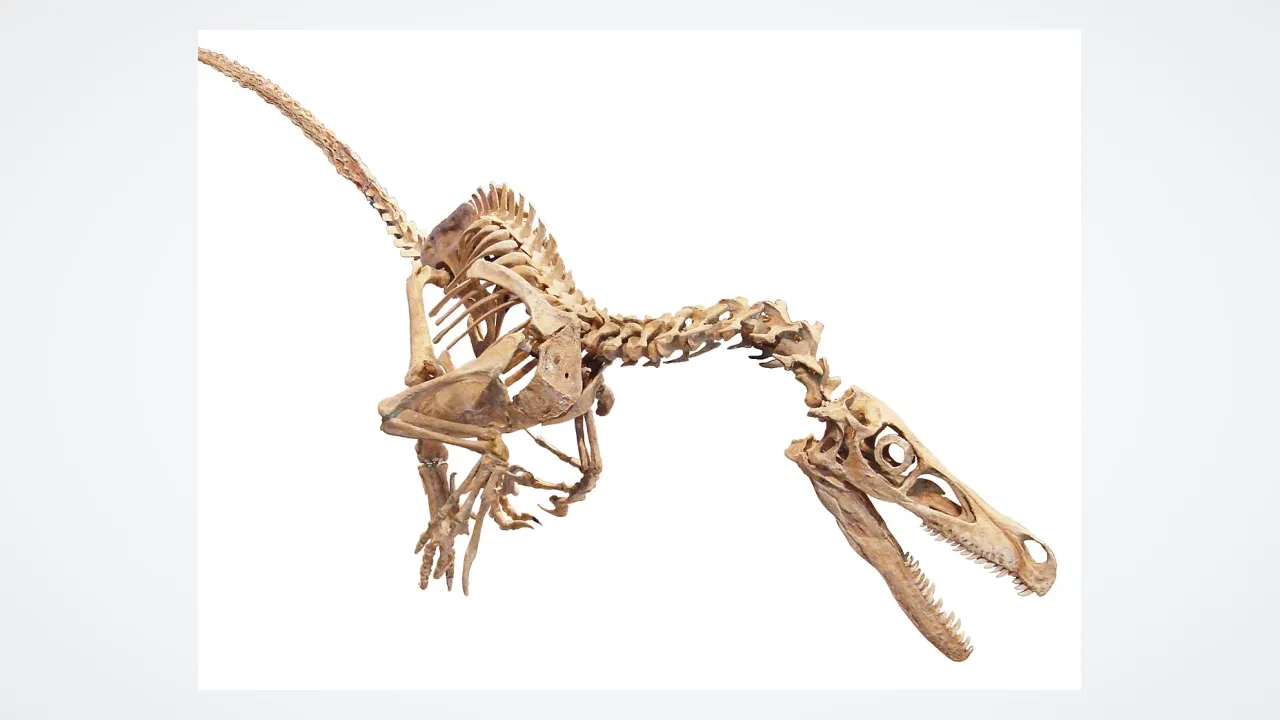
⚡ Survival SuperpowerTurkey-sized feathered body armed with retractable curved sickle toe claws
🤯 Mind-Blowing Fact • Grade 1
Real Velociraptors weighed only about thirty-five pounds—roughly the same as a medium-sized pet dog!
✨ Word Sparks (Grade 1 Glossary)
Tap 🔊 to hear
Dune
A hill of loose sand shaped by wind
Sprint
To run as fast as you can
Sickle
A curved hook shape with a sharp point
🪝
Did you know Velociraptor was really the size of a big turkey and had feathers?
1
Dash Across the Sand!
Whoosh! Sand flies across orange desert . A quick little dinosaur on two fast legs. Out rushes Velociraptor! It stood about as tall as a big turkey.
2
Feathers Like a Bird
Soft feathers covered its light, speedy body. Long wing feathers grew right along its arms! It could not fly, yet those wings helped it steer and balance.
3
Curved Toe Claws
Check out its back feet! Each foot carried one big curved claw held high off the sand. Keeping that claw lifted kept the point super sharp.
2. Why did Velociraptor hold its big curved toe claw up off the ground?
🤯 Mind-Blowing Fact • Grade 2
Tiny bumps called quill knobs on Velociraptor arm bones proved beyond doubt that it wore real wing feathers just like modern hawks!
✨ Word Sparks (Grade 2 Glossary)
Tap 🔊 to hear
Quill Knobs
Tiny bone bumps where strong wing feathers attach
Agile
Able to move and turn quickly with ease
Mongolia
Rocky, sandy country in Asia rich with fossils
🪝
How do scientists know for sure that Velociraptor had real bird-like wing feathers?
1
Speedy Runner of the Gobi
Picture windblown red sand dunes in seventy-five million years ago! Dashing after lizards and small mammals comes Velociraptor, whose name means swift seizer. Including its long bony tail, it stretched nearly seven feet, yet stood just under two feet tall at the hip.
2
Bumps That Prove Feathers
In 2007, scientists looked closely at a Velociraptor forearm bone under bright light. They spotted a neat row of tiny bumps called —the exact spots where modern birds attach strong wing feathers! Those feathered arms kept eggs warm in sandy nests.
3
Stiff Tail for Tight Turns
Thin rods of bone ran along its tail, turning it into a stiff balancing pole so Velociraptor could zig and zag across dunes without tipping over.
1. What clue on Velociraptor arm bones proved it had wing feathers?
2. If Velociraptor could not fly, how could arm feathers help it?
🤯 Mind-Blowing Fact • Grade 3
The famous Fighting Dinosaurs fossil found in Mongolia preserves a Velociraptor and a Protoceratops locked together under a collapsed sand dune!
✨ Word Sparks (Grade 3 Glossary)
Tap 🔊 to hear
Dromaeosaur
Family of feathered, sickle-clawed running theropod dinosaurs
Talon
Sharp hooked claw on a bird of prey
Sclerotic Ring
Circle of tiny bones supporting an animal's eyeball
🪝
What happened when a collapsing sand dune buried a Velociraptor mid-struggle 71 million years ago?
1
Life in an Ancient Sand Sea
Step into Mongolia's ancient Djadochta desert seventy-two million years ago, where scrubby bushes clustered around seasonal streams between towering dunes. Scurrying through twilight shadows came Velociraptor mongoliensis, a nimble thirty-eight-pound built for speed and precision.
2
How the Sickle Claw Really Worked
Each hind foot featured a hyper-extendable second toe tipped with a curved, two-and-a-half-inch claw. Instead of slashing like a sword, biomechanics tests show the claw worked like a hawk's —pinning struggling prey firmly while Velociraptor flapped its feathered wings to stay balanced on top!
3
Frozen in Stone Forever
In 1971, Polish and Mongolian paleontologists unearthed one of the most famous fossils ever found: the Fighting Dinosaurs. A Velociraptor and a pig-sized horned Protoceratops were buried instantly together by a rain-soaked collapsing sand dune.
4
Twilight Eyes
Rings of tiny bones inside its eye sockets, called , were wide enough to gather dim light, suggesting Velociraptor hunted actively at dusk and night.
1. How did Velociraptor use its curved second-toe claw according to biomechanics studies?
2. What do the wide sclerotic eye rings of Velociraptor suggest?
🤯 Mind-Blowing Fact • Grade 4
Velociraptor had a half-moon-shaped wrist bone called a semilunate carpal that let it fold its feathered hands sideways against its body just like a bird!
✨ Word Sparks (Grade 4 Glossary)
Tap 🔊 to hear
Theropod
Three-toed, hollow-boned dinosaur group that includes birds
Ornithologist
A scientist who studies living and extinct birds
Opportunist
Animal flexible enough to grab whatever food appears
🪝
Why do movie raptors look so different from the real feathered Velociraptor of Mongolia?
1
Expedition to the Flaming Cliffs
During a 1923 expedition to Mongolia's glowing red sandstone outcrops—nicknamed the Flaming Cliffs—fossil collector Peter Kaisen uncovered a slender, upturned skull alongside a curved toe claw. A year later, paleontologist Henry Fairfield Osborn named the newcomer Velociraptor, from Latin words meaning 'swift seizer.' Real skeletons quickly revealed a sleek creature barely two meters long, half of which was tail.
2
Why Pop Culture Got the Size Wrong
Decades later, storytellers borrowed the dramatic name Velociraptor while modeling screen creatures after Deinonychus, a much heavier North American cousin discovered in Montana. Scientists also discovered feathered fossils across Asia in the 1990s and 2000s, proving dromaeosaurs were warmly plumed, bird-like rather than scaly lizards.
3
Raptor Prey Restraint Mechanics
Modern hawks subdue catches using a behavior call raptor prey restraint: pinning the target beneath curved talons while beating their wings to keep centered. Velociraptor shared the exact anatomical toolkit—grasping three-fingered hands, hinged wrists that folded sideways like bird wings, a stiffened tail counterbalance, and piercing sickle claws.
4
Solitary Desert Opportunist
Although popular stories imagine coordinated raptor packs, Velociraptor fossils in the Gobi Desert are almost always found alone, pointing toward a solitary hunter that ambushed lizards, mammals, and young protoceratopsians.
1. Which larger North American cousin inspired the oversized 'raptors' seen in popular fiction?
2. What special wrist feature did Velociraptor share with modern birds?
🤯 Mind-Blowing Fact • Grade 5
Velociraptor possessed a wishbone—scientifically called a furcula—almost identical to the wishbone found inside modern Thanksgiving turkeys!
✨ Word Sparks (Grade 5 Glossary)
Tap 🔊 to hear
Furcula
Forked wishbone fusing the two collarbones together
Pennaceous
Stiff, vaned feathers anchored by a central shaft
Taphonomy
Science studying how organisms decay and become fossils
🪝
How does Velociraptor bridge the evolutionary gap between ground-running dinosaurs and soaring birds?
1
Unearthing Velociraptor in the Djadochta Formation
Seventy-five to seventy-one million years ago, arid eolian sand seas blanketed southern Mongolia and Inner Mongolia. In 1923, an American Museum of Natural History team led by Roy Chapman Andrews explored the red sandstone bluffs of Bayanzag, recovering the holotype skull and raptorial claw of Velociraptor mongoliensis. Measuring 2.07 meters (6.8 feet) long and weighing roughly fifteen to eighteen kilograms, this agile dromaeosaurid reshaped science's view of small theropods.
2
Avian Anatomy Before Flight
Every major skeletal feature of Velociraptor highlights how bird traits evolved on the ground long before powered flight. Hollow pneumatic bones lightened its frame, a wishbone () braced the shoulders like a spring, and a backward-pointing pubis bone mirrored avian hips. In 2007, paleontologists Alan Turner, Peter Makovicky, and Mark Norell documented fourteen evenly spaced quill knobs on a Velociraptor ulna, confirming secondary wing feathers.
3
Wing-Assisted Incline Running and Stability
Too heavy relative to arm length to fly, Velociraptor likely beat its feathered forelimbs to generate downward traction while sprinting up steep sand dunes—a behavior observed in modern ground birds called wing-assisted incline running—and to maintain balance atop pinned prey.
4
Cranial and Tail Specializations
Unlike deeper-snouted dromaeosaurs, Velociraptor had a long, shallow, slightly upturned skull lined with twenty-six to twenty-eight widely spaced teeth per jaw, serrated more coarsely on the rear edge than the front for gripping slippery desert reptiles. Bundles of ossified tendons stiffened the caudal vertebrae into a dynamic rudder.
5
Taphonomy of the Fighting Dinosaurs
Sedimentological study of the famous 1971 Fighting Dinosaurs specimen shows neither sandstorm winds nor floodwaters killed the pair; instead, a sudden slip-face collapse of wet dune sand entombed both animals mid-grapple, preserving behavioral paleobiology in breathtaking detail.