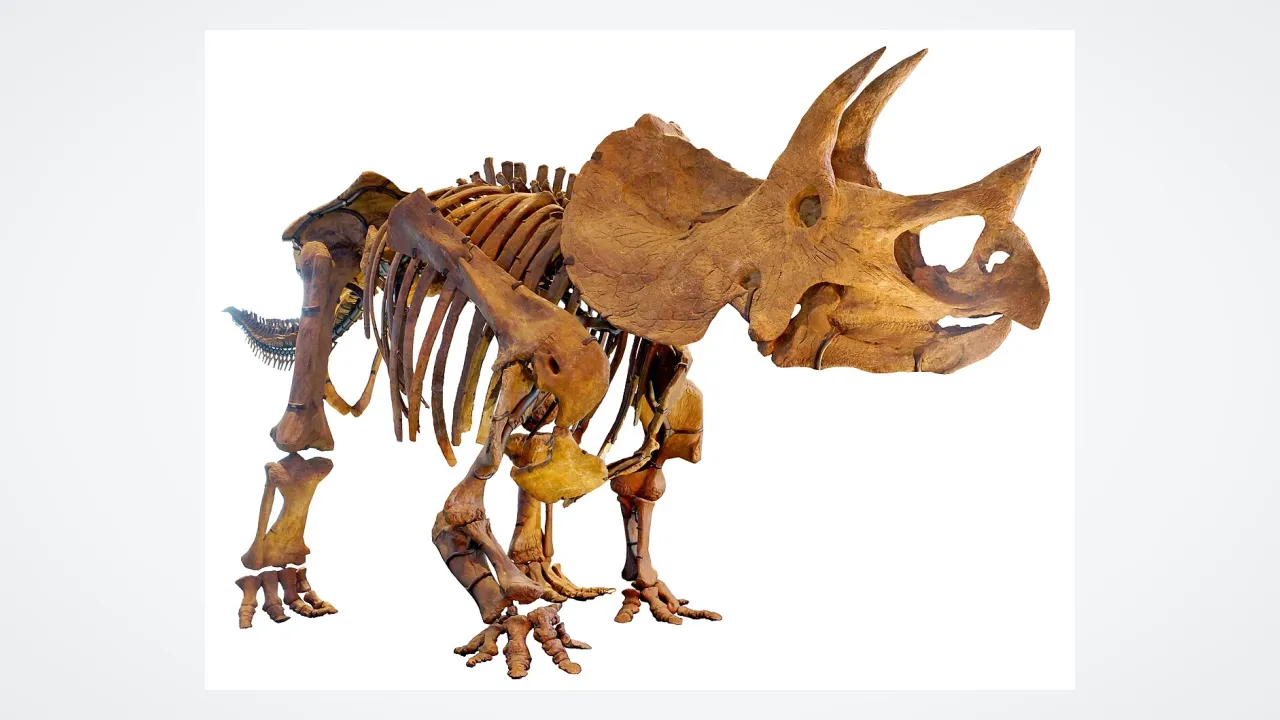
⚡ Survival SuperpowerThree-horned skull with a solid seven-foot bony neck shield and 800 slicing teeth
🤯 Mind-Blowing Fact • Grade 1
Just the skull of a grown-up Triceratops could measure longer than a taller-than-average adult human!
✨ Word Sparks (Grade 1 Glossary)
Tap 🔊 to hear
Frill
Wide bony shield behind a horned dinosaur's head
Beak
Hard, curved mouth tip used to snip plants
Herbivore
An animal that eats plants, leaves, and ferns
🪝
Why did this plant-eater wear three giant horns and a shield on its head?
1
Crunch, Munch in the Ferns
Snap, crunch! Tough green ferns disappear into a sharp . A sturdy dinosaur with three horns munches breakfast in the sunny woods. Meet the mighty Triceratops!
2
Three Horns and a Frill
One short horn sits right on its nose. Two long horns point out above its eyes. Behind its head rises a wide bony shield called a .
3
Built Like a Tank
Four thick legs hold up its heavy body. If a hungry meat-eater comes close, those horns and shield help keep this peaceful plant-eater safe.
1. How many horns grew on the face of a Triceratops?
2. What kind of food did Triceratops eat?
🤯 Mind-Blowing Fact • Grade 2
When the very first pair of Triceratops brow horns was found in 1887, scientists thought they belonged to a giant prehistoric bison!
✨ Word Sparks (Grade 2 Glossary)
Tap 🔊 to hear
Brow
The ridge of bone right above the eyes
Browse
To nibble leaves, twigs, and low bushes
Shield
A broad protective plate that blocks danger
🪝
Could a dinosaur skull really grow seven feet long?
1
Living Tank of the Forest
Imagine a prehistoric plant-eater heavier than an African elephant! Sixty-seven million years ago, Triceratops wandered warm forests in western North America. Its name means three-horned face.
2
A Giant Bony Shield
Most horned dinosaurs had large openings in their neck frills to save weight, yet Triceratops grew a solid sheet of bone. Combined with two three-foot horns, its skull stretched seven feet long—almost one-third of its entire body!
3
Parrot Beak and Hundreds of Teeth
With its head held low to the ground, it snipped woody palms and ferns using a narrow, toothless beak. Further back in its cheeks, rows of sharp teeth sliced tough stems like scissors.
1. How was the neck frill of Triceratops special compared to most cousin species?
2. What animal did scientists first mistake Triceratops horns for in 1887?
🤯 Mind-Blowing Fact • Grade 3
Triceratops balanced its giant head on an almost perfectly round ball-and-socket neck joint so it could swing its horns quickly toward danger!
✨ Word Sparks (Grade 3 Glossary)
Tap 🔊 to hear
Dental Battery
Stacked columns of replacement teeth inside dinosaur jaws
Keratin
Tough fingernail material covering horns and beaks
Pivot
To turn or swing smoothly around a central point
🪝
How did Triceratops chew tough woody plants with up to 800 teeth at once?
1
Sharing Land with Giants
Picture misty Late Cretaceous floodplains where palms, cycads, and ferns carpeted the ground. Grazing peacefully—yet ready to stand its ground—walked Triceratops, a thirty-foot ceratopsian weighing up to nine tons. It shared its habitat directly with hungry Tyrannosaurus Rex!
2
Dental Batteries Built Like Scissors
Behind its hooked beak sat tightly packed columns of teeth called dental batteries. Up to eight hundred teeth stacked inside the jaws at one time! Instead of grinding flat like cow teeth, they slid past one another vertically to shear fibrous branches.
3
Horns That Changed Shape with Age
Fossils of babies, youngsters, and adults reveal a surprise. Young Triceratops had brow horns that curved backward, while older adults had horns curving forward, plus triangular scallops called epoccipitals lining the frill edge.
4
Swivel Head on a Ball Joint
Supporting a thousand-pound skull took a special neck joint: a smooth sphere of bone like a trailer hitch that let Triceratops its horns rapidly in any direction.
1. How did the teeth inside Triceratops jaws process tough plants?
2. How did Triceratops brow horns change as youngsters grew into adults?
🤯 Mind-Blowing Fact • Grade 4
One fossilized Triceratops horn shows a healed Tyrannosaurus Rex bite mark, proving the three-horned dinosaur fought off the giant predator and lived!
✨ Word Sparks (Grade 4 Glossary)
Tap 🔊 to hear
Quadruped
An animal that walks supported on all four legs
Angiosperm
A plant species that produces flowers and seeds
Ceratopsian
Member of the beaked, horned dinosaur family
🪝
Were Triceratops horns and frills meant for predator defense, visual display, or both?
1
Abundant Herbivore of the Hell Creek
Dig into sixty-six-million-year-old rock layers in Montana or Wyoming, and Triceratops bones turn up more often than almost any other large dinosaur. Making up nearly forty percent of big fossils in the Hell Creek Formation, these sturdy clearly thrived across Late Cretaceous coastal plains.
2
Evidence of Real Prehistoric Clashes
For decades, paleontologists debated whether the three horns and seven-foot solid squamosal-parietal frill were purely decorative billboards or functional armor. Then researchers discovered a Triceratops brow horn bearing a partially healed bite mark matching Tyrannosaurus Rex teeth! Because new bone grew around the wound, we know the Triceratops survived that face-to-face encounter.
3
Signaling and Rival Sparring
Fossil skulls also display healed punctures on the frill that match the spacing of another Triceratops's horns. Just like modern bighorn sheep or elk, rivals likely locked horns in pushing contests while using keratin-covered frills flushed with blood vessels to signal maturity to herd mates.
4
Clearing Forests from Below
Standing ten feet tall at the hips on pillar-like legs, Triceratops acted as a powerful ecosystem engineer across coastal plains. By shearing dense woody thickets and trampling overgrown ferns, herds opened sunny forest clearings where fast-growing flowering plants could sprout, feeding small mammals, turtles, and ground birds throughout the valley.
1. What proves that a Triceratops survived an actual encounter with Tyrannosaurus Rex?
2. How did Triceratops shape its Late Cretaceous plant community?
🤯 Mind-Blowing Fact • Grade 5
Preserved Triceratops skin fossils show giant geometric scales up to four inches wide arranged like mosaic tiles with raised bumps in the middle!
✨ Word Sparks (Grade 5 Glossary)
Tap 🔊 to hear
Fenestrae
Natural window-like openings inside skull or frill bones
Stratigraphic
Relating to the chronological layering of rock beds
Epoccipital
Small decorative triangular bones lining a ceratopsian frill
🪝
Why did Triceratops evolve a solid bone shield when nearly all its horned relatives had hollow window-like frills?
1
Othniel Marsh and the Great Bone Wars
When rancher collectors shipped a pair of enormous horn cores from Denver, Colorado, to Yale paleontologist Othniel Charles Marsh in 1887, Marsh initially cataloged them as an extinct giant bison. Two years later, intact skulls arrived from Wyoming's Lance Formation, revealing a Cretaceous dinosaur unlike anything known to science. Marsh named it Triceratops horridus—meaning 'rough three-horned face.'
2
Cranial Architecture and Solid Frill Evolution
Reaching nine meters (30 feet) in length and six to ten metric tons in body mass, Triceratops carried one of the largest skulls of any terrestrial vertebrate—up to 2.5 meters long. Whereas chasmosaurine relatives possessed wide openings () in their neck frills covered only by skin, Triceratops evolved a thick, unperforated parietal-squamosal shield reinforced by dense collagen fibers.
3
Ontogenetic Transformation and Skin Impressions
Detailed growth series studied by paleontologists show dramatic cranial remodeling from hatchling to elder. Juvenile skulls featured upturned brow horns and spiky triangular bones bordering the frill, which flattened and fused smoothly in mature adults. Rare mummified skin impressions from Wyoming reveal large polygonal scales arranged in rosette patterns, some sporting central nipple-like bumps that may have held stiff bristles.
4
Biomechanics of High-Fiber Shearing
Inside the jaws, thirty-six to forty tooth columns per jaw side formed self-sharpening shearing blades. Hard enamel coated only one side of each tooth, so wear automatically maintained a chisel-sharp cutting edge for slicing fibrous palms, ferns, and cycads.
5
Last Stand at the K-Pg Boundary
surveys show Triceratops horridus and its slightly later descendant Triceratops prorsus flourished right up to the asteroid impact sixty-six million years ago, making it one of the very last non-avian dinosaurs on Earth.