1. What kind of shop did Wilbur and Orville Wright run before building airplanes?
2. Where did the Wright brothers fly their powered airplane on December 17, 1903?
🤯 Mind-Blowing Fact • Grade 2
In 1969, astronaut Neil Armstrong carried a tiny piece of wood and fabric from the 1903 Wright Flyer all the way to the Moon!
✨ Word Sparks (Grade 2 Glossary)
Tap 🔊 to hear
dunes
Hills of loose sand shaped by blowing wind
sustained
Kept going steadily without dropping right down
wingspan
Distance from one wingtip to the other wingtip
🪝
Why did two inventors from Ohio travel all the way to windy sand dunes in North Carolina?
1
Liftoff in Chilly December Wind
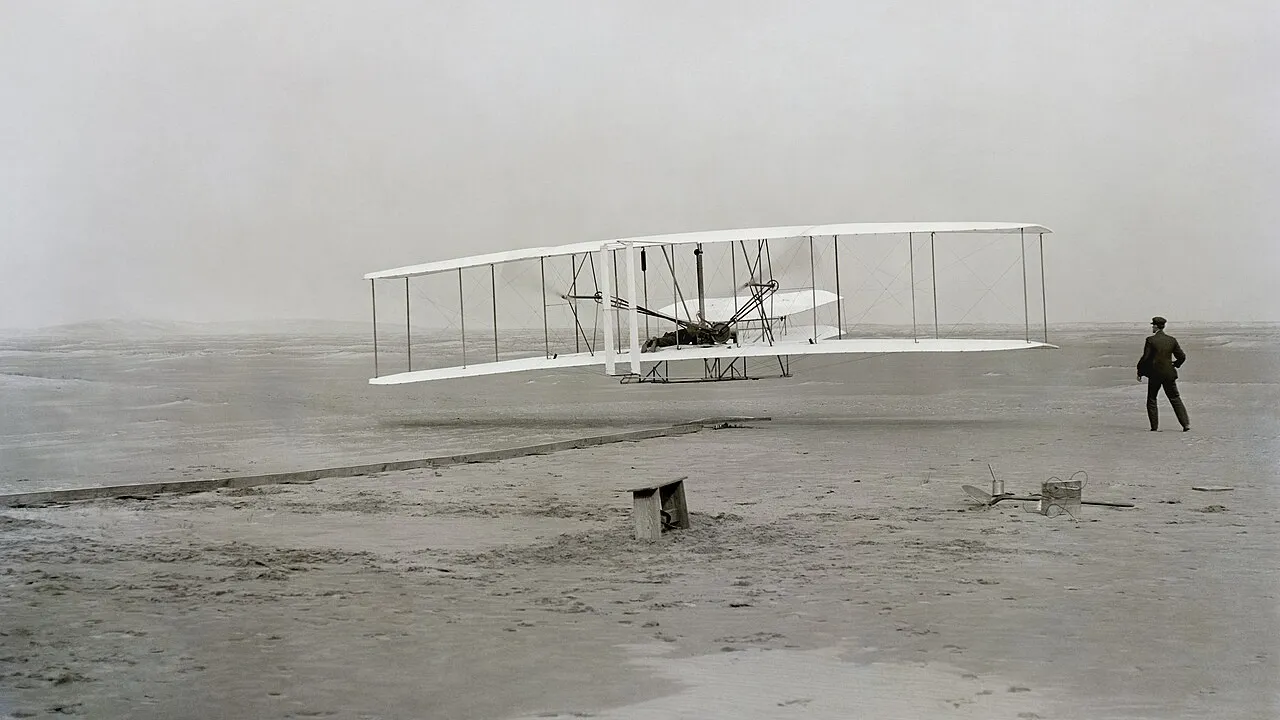
Brrr! Freezing Atlantic wind whipped across the sandy Outer Banks near Kitty Hawk, North Carolina, on December 17, 1903. At 10:35 in the morning, Orville Wright lay flat on the lower wing of the Wright Flyer while Wilbur steadied the wingtip.
2
Testing Gliders Before Motors
Back home in Dayton, Ohio, the brothers built bicycles and studied how hawks banked through the air. They wrote to the Weather Bureau to find a spot with steady breezes and soft sand for safe landings, testing gliders for three summers.
3
Four Flights Change the World
Orville's first powered flight covered 120 feet in twelve seconds, and by noon Wilbur flew an astonishing 852 feet in fifty-nine seconds!
1. Why did the Wright brothers choose the area near Kitty Hawk for testing their aircraft?
2. How long did Wilbur Wright's longest fourth flight last on December 17, 1903?
🤯 Mind-Blowing Fact • Grade 3
John T. Daniels had never used a camera before December 17, 1903, yet his one click captured the most famous photograph in aviation history!
✨ Word Sparks (Grade 3 Glossary)
Tap 🔊 to hear
wind tunnel
Tube blowing air over models to test flight
rudder
Movable tail flap that steers left or right
aviation
Designing, building, and flying airplanes in the sky
🪝
What secret did the Wright brothers notice about soaring birds and leaning bicycles that other inventors missed?
1
A Camera Clicks at Kill Devil Hills
Just as the wooden spruce-and-muslin Wright Flyer rose off its launching rail at Kill Devil Hills near Kitty Hawk on December 17, 1903, coastal lifesaver John T. Daniels snapped a single glass-plate photograph. Frozen in that instant was humanity's first controlled, powered, heavier-than-air flight.
2
Solving the Control Puzzle
Many earlier inventors tried building powerful engines first, only to crash because they could not steer in three dimensions. Bicycle makers Wilbur and Orville Wright of Dayton, Ohio, realized that balancing an aircraft in midair was just like leaning a bicycle into a turn.
3
Wind Tunnels and Wing Warping
When published lift charts proved inaccurate, the brothers built a six-foot wooden in their shop and tested more than two hundred miniature metal wing shapes. They invented wing-warping cables linked to a rear so pilots could roll, pitch, and turn smoothly.
4
An Age of Aviation Begins
With mechanic Charlie Taylor, they crafted a lightweight aluminum engine and twin propellers. Four historic flights that frosty morning launched modern , connecting continents within a single lifetime.
1. What tool did the Wright brothers build in their Ohio shop to test over 200 tiny wing shapes?
2. Who helped Wilbur and Orville build the lightweight aluminum engine for the 1903 Flyer?
🤯 Mind-Blowing Fact • Grade 4
Wilbur and Orville tossed a coin on December 14 to decide who would try flying first; Wilbur won the toss but stalled right after takeoff, giving Orville the historic turn on December 17!
✨ Word Sparks (Grade 4 Glossary)
Tap 🔊 to hear
aerodynamic
Shaped so air flows smoothly with little drag
methodical
Working step by step in careful order
three-axis
Steering up-down, tipping sideways, and turning left-right
🪝
How did two high-school-educated bicycle mechanics outperform government-funded scientists in the race for human flight?
1
Twenty-Seven-Mile-Per-Hour Headwinds
Stand beside the wooden monorail track laid across icy sand flats four miles south of Kitty Hawk, North Carolina, at 10:35 a.m. on December 17, 1903. Facing a brisk twenty-seven-mile-per-hour wind, Orville Wright released the restraining wire, and the 605-pound Wright Flyer climbed ten feet above the beach under its own twelve-horsepower engine.
2
Why Control Mattered More Than Power
Just nine days earlier, Samuel Pierpont Langley's well-funded Aerodrome had plunged into the Potomac River because its structure and controls failed. Meanwhile, Wilbur and Orville Wright approached aviation like scientists. Inspired since childhood by a rubber-band toy helicopter their father brought home in 1878, they observed buzzards twisting their wingtips to maintain lateral balance.
3
Three-Axis Mastery
Between 1900 and 1902, the brothers camped at Kill Devil Hills performing hundreds of glider flights. After discovering errors in European tables, they constructed a home wind tunnel in Dayton to measure lift and drag with precision instruments made from hacksaw blades and bicycle spokes. Combining wing-warping for roll, a forward elevator for pitch, and a linked rear rudder for yaw, they patented flight control—the exact principle every airplane still uses.
4
Telegram Home to Dayton
After Wilbur's fourth flight covered 852 feet in 59 seconds, a sudden wind gust flipped and damaged the Flyer, ending its flying career. Orville wired their father in Ohio announcing success—ushering humanity from horse-drawn roads to global airways.
1. Which breakthrough made the Wright brothers' aircraft controllable when rival designs crashed?
2. What childhood gift first sparked Wilbur and Orville's lifelong curiosity about flight?
🤯 Mind-Blowing Fact • Grade 5
A postage-stamp-sized swatch of fabric from the 1903 Wright Flyer's left wing flew on another planet in April 2021, wrapped around a cable beneath NASA's Ingenuity helicopter on Mars!
✨ Word Sparks (Grade 5 Glossary)
Tap 🔊 to hear
airfoil
Curved wing shape designed to create upward lift
equilibrium
Steady physical balance between opposing forces
empirical
Proven through real experiments and careful measurements
🪝
How did just sixty-six years separate twelve seconds over North Carolina sand dunes from bootprints on the Moon—and even a helicopter flight on Mars?
1
10:35 a.m. at Kill Devil Hills
On the frigid morning of December 17, 1903, puddles around the wooden camp sheds at Kill Devil Hills, four miles south of Kitty Hawk on North Carolina's Outer Banks, skimmed with ice as winter gusts surged at twenty-seven miles per hour. Five local witnesses—three men from the nearby Lifesaving Station, a lumber merchant, and a teenager—watched Orville Wright position himself prone beside the roaring engine of the forty-foot-wingspan Wright Flyer, release a restraining wire, and lift smoothly into sustained, controlled, powered heavier-than-air flight.
2
Empirical Engineering in a Dayton Bicycle Shop
Unlike rivals who treated flight primarily as an engine problem—such as Smithsonian Secretary Samuel Pierpont Langley, whose $50,000 government-backed Aerodrome crashed into the Potomac River on December 8, 1903—Dayton bicycle manufacturers Wilbur and Orville Wright recognized three-dimensional control as aviation's central obstacle. Drawing upon their mechanical skill with lightweight tubing, chain drives, and dynamic , they analyzed how soaring turkey vultures twisted wingtips to recover balance.
3
Rewriting Aerodynamics With a Six-Foot Wind Tunnel
When their 1900 and 1901 Outer Banks gliders generated barely one-third the lift predicted by German pioneer Otto Lilienthal's equations, the brothers built a six-foot wooden wind tunnel in autumn 1901. Using ingenious balances crafted from old hacksaw blades and bicycle spokes, they tested over two hundred miniature , proving high aspect-ratio wings outperformed stubby ones and pinpointing the faulty Smeaton pressure coefficient that had misled scientists for decades. Their 1902 glider integrated wing-warping (roll), a forward elevator (pitch), and a movable rear rudder (yaw).
4
Propellers as Rotating Wings
For 1903, shop machinist Charlie Taylor cast a lightweight aluminum crankcase producing twelve horsepower at 180 pounds, while the brothers conceived aircraft propellers not as marine screws but as twisted rotating wings achieving 66 percent efficiency. Across four flights on December 17, distance climbed from Orville's initial 120 feet in 12 seconds to Wilbur's fourth run of 852 feet in 59 seconds before a fierce gust overturned the craft.
5
From Outer Banks Muslin to Martian Skies
By 1905, their improved Flyer III circled Huffman Prairie in Ohio for thirty-nine minutes nonstop. Orville Wright lived until 1948—long enough to witness supersonic flight—and pieces of unbleached Pride of the West muslin from the 1903 Kitty Hawk wing traveled to Tranquility Base aboard Apollo 11 in 1969 and soared through another planet's atmosphere taped beneath NASA's Ingenuity Mars Helicopter in 2021.